
2025 Nobel Prize in Medicine Awarded to Brunkow, Ramsdell, and Sakaguchi for Discoveries in Immune Tolerance

In this article
The 2025 Nobel Prize: The Immune System's Hidden Balance
Our body's immune system is a marvel: every day, it protects us from thousands of viruses, bacteria, and other microbes. Yet this powerful system must be carefully controlled . Otherwise, it can attack our own organs and cause autoimmune disease. This critical balance became the subject of the 2025 Nobel Prize in Medicine.
🏆 Who Received the Prize?
This year's Nobel Prize in Physiology or Medicine was awarded to Mary E. Brunkow, Fred Ramsdell and Shimon Sakaguchi. The reason: “Their discoveries concerning peripheral immune tolerance”.
These three scientists opened a new research field by identifying the immune system's “security guards,” regulatory T cells (Tregs) .
🔹 In cancer treatment, developing more effective immunotherapies,
🔹 For autoimmune diseases, finding new treatment pathways,
🔹 After stem cell transplantation, preventing serious complications...
All stem from the knowledge these discoveries provided.
🛡️ Why Is the Immune System So Important?
Without an immune system, even an ordinary flu virus or common bacterium could threaten our lives. Its greatest achievement is recognizing invading microbes and distinguishing them from the body's own cells.
Microbes are not all alike; they come in different forms. Some even camouflage themselves to resemble human cells. Nevertheless, the immune system scans millions of cells each day, distinguishing “friend” from “foe.”
For a long time, scientists thought this surveillance depended solely on “central immune tolerance” . Brunkow, Ramsdell, and Sakaguchi's work showed that the system was far more complex.
🔬 T Cells in the 1990s: Immunity's Front-Line Fighters
In the 1990s, scientists understood T cells to be central to the immune system. These cells were the body's front-line fighters . There were different types, each with a critical role in immune defense:
- Helper T cells (CD4⁺): When they detect microbes, they alert other immune cells, acting like commanders .
- Killer T cells (CD8⁺): Destroy virus-infected or tumor cells. They focus on their target like a surgeon.
🧩 T-Cell Receptors: Immunity's Sensors
All T cells have T-cell receptors on their surface. These receptors work like a lock-and-key system. Each has a different shape, and we can think of them as microscopic sensors .
Thanks to the diversity of genetic combinations, theoretically 1015 different T-cell receptors can be produced. This immense diversity allows the immune system to recognize even a virus it has never encountered before . The mechanism also worked against new threats such as the COVID-19 virus that emerged in 2019.

⚖️ Central Immune Tolerance: The First Safety Check
This diversity also creates risk: some T cells may mistakenly recognize the body's own tissues. The immune system therefore conducts a test in an organ called the thymus . This is known as “central immune tolerance” .
T cells maturing in the thymus undergo a strict examination: those recognizing the body's own tissues are eliminated. This prevents autoimmune attacks.
However, some cells always manage to escape this test. Scientists therefore long debated the existence of suppressor T cells
. But fraudulent experimental results in the 1980s led to the theory being abandoned and the research field forgotten.
❗ Yet Shimon Sakaguchi swam against the current. His experiments in the 1980s suggested that the immune system really must have a “security guard.”

Sakaguchi's Starting Point: “Immunity Must Have a Security Guard”
In the 1980s, the suppressor T-cell hypothesis had been almost entirely abandoned because of flawed experiments. However, Shimon Sakaguchi at the Aichi Cancer Center in Nagoya went against the current, arguing that the immune system must have a security guard to calm cells escaping selection in the thymus.
An Experimental Clue: What Happens When the Thymus Is Removed?
One observation shaped the research: in young mice whose thymus was removed shortly after birth, the immune system became overactive and multiple autoimmune symptoms appeared. However, the autoimmune phenotype was suppressed in models supplemented with mature T cells. This pointed to a braking subgroup of T cells in the periphery.
Inference: In the thymus, central tolerance alone is not enough; there must also be a regulatory layer operating in the periphery.

🧩 The 1995 Breakthrough: CD4⁺CD25⁺ Regulatory T Cells
After a long, meticulous separation process, Sakaguchi identified a special subgroup within CD4⁺ T cells carrying CD25 : regulatory T cells (Tregs). Unlike conventional helper T cells, these cells put the brakes on immune responses, calming overactivity and reducing the risk of “self-attack” (J Immunol, 1995).
- Phenotype: CD4⁺CD25⁺
- Main function: Suppressing overactivated T cells to maintain peripheral tolerance .
- Clinical implication: Suppressing autoimmunity, reducing graft rejection, and helping balance tumor immunity

🧭 From Doubt to Acceptance: The Treg Field Opens Up
After the initial description, “Is this really a new subgroup?” was a frequent question; the field sought convincing additional evidence. A turning point was showing that the transcription factor FOXP3 was the master regulator of Treg development (2003). This completed both the phenotypic and genetic frameworks and gave Treg biology a firm foundation.

A Bridge From the Laboratory to the Clinic
Clarifying Tregs' existence and function placed peripheral tolerance at the center of immune medicine: in cancer, tumors protect themselves by accumulating Tregs; in autoimmunity, strategies aim to increase Tregs; in transplantation, Treg-mediated tolerance induction and many other clinical applications emerged.
🧬 Scurfy Mice: A Clue From a Mutation
In the 1940s, researchers at Oak Ridge laboratory in Tennessee encountered an unexpected mutation. Some male mice were born with scaly skin, enlarged spleens, and enlarged lymph nodes and survived only a few weeks. They were called “scurfy” .
Researchers realized that the cause was a mutation on the X chromosome . Male mice became ill because they have only one X chromosome, while females could be carriers.
🔎 Brunkow & Ramsdell: Seeking the Key to Autoimmunity
In the 1990s, Mary Brunkow and Fred Ramsdellworked at Celltech Chiroscience , a biotechnology company in Washington, investigating autoimmune diseases. They thought the mutation in scurfy mice might unlock the mechanisms of human autoimmune disease.
Scanning the X chromosome's 170 million base pairs was like looking for a needle in a haystack . After years of meticulous work, they found the mutation in a new gene they named Foxp3 .
📌 Discovery: Foxp3, a member of the forkhead box (FOX) gene family, was a transcription factor that controlled T-cell development.
👶 The Link to Human Disease: IPEX Syndrome
Brunkow and Ramsdell realized this finding might be linked to a rare but fatal human autoimmune disease, IPEX syndrome (Immune dysregulation, Polyendocrinopathy, Enteropathy, X-linked) .
Working with pediatricians worldwide, they collected DNA samples from children with IPEX. Analysis found harmful mutations in the FOXP3 gene . Their paper, published in 2001 in Nature Genetics , demonstrated that scurfy disease in mice and IPEX in humans shared the same genetic origin.
💡 This finding paved the way for later studies showing that FOXP3 plays a key role in regulatory T-cell development .
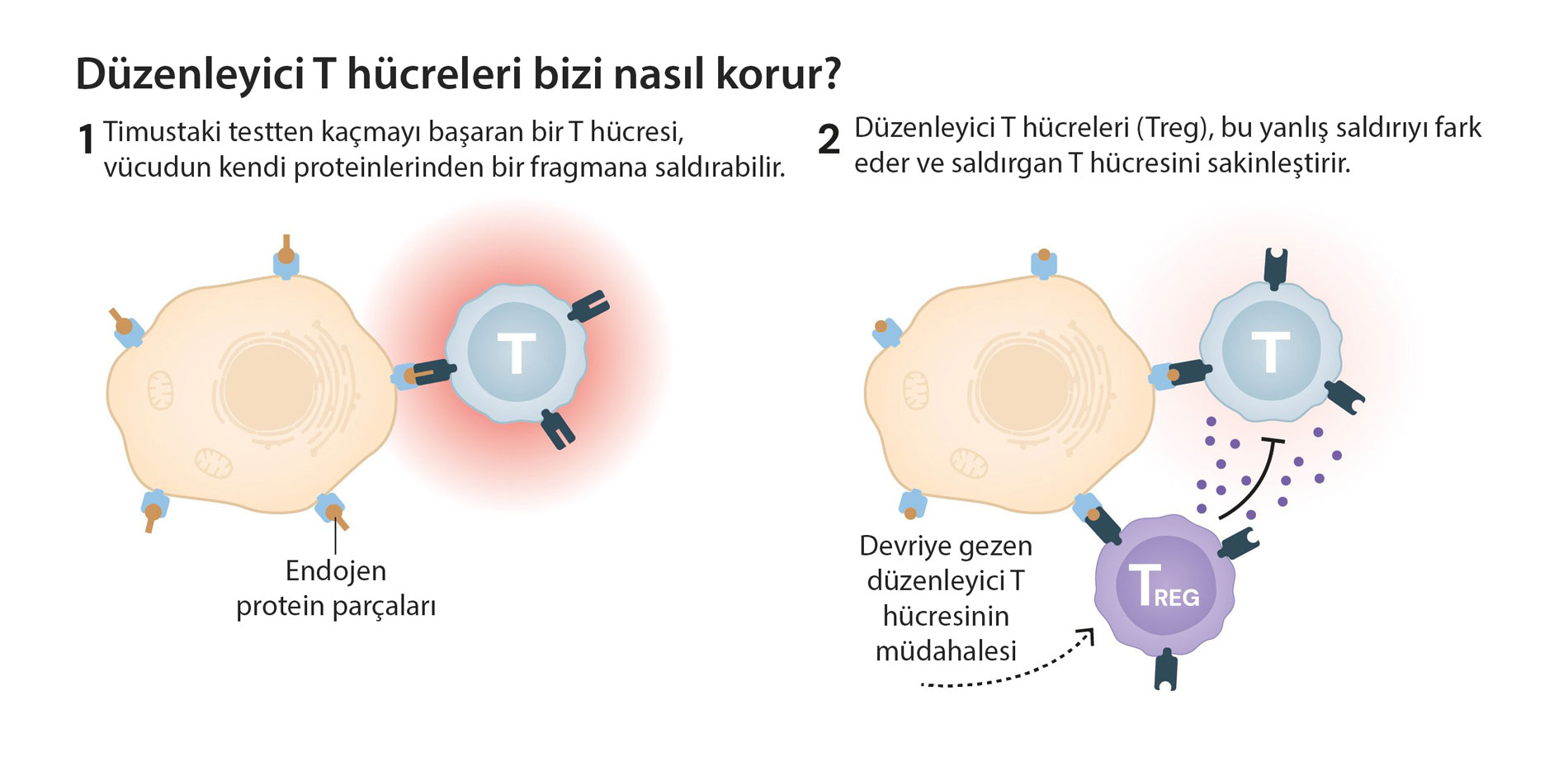
⚕️ Regulatory T Cells: From Laboratory to Clinic
Regulatory T cells (Tregs)restrain excessive immune activity, protecting the body from attacking itself . This Nobel-winning discovery led to revolutionary clinical applications in three major areas:
- Cancer: Tumors accumulate Tregs around them, protecting themselves from immune attack.
- Autoimmune Diseases: Absent or insufficient Treg function leads to autoimmunity; increasing Tregs is therefore a treatment goal.
- Organ Transplantation: Tregs may prevent organ rejection by inducing tolerance.
🎯 Cancer and Treg Cells
Cancer cells attract Tregs as a “shield.” Even if the immune system detects the tumor, Tregs send suppressive signals that block the attack.
📌 Clinical research aims to remove this Treg barrier and allow immune cells to reach the tumor.
🌀 The Role of Tregs in Autoimmune Diseases
In autoimmune diseases, the immune system loses its ability to distinguish friend from foe . Increasing Tregs may therefore be a critical treatment strategy.
Clinical trials are using low-dose interleukin-2 (IL-2) to encourage Treg expansion, restraining the immune system and reducing damage.
🧪 Pilot studies suggest that IL-2 may also help prevent organ rejection .
💉 Treg Strategies in Organ Transplantation
A major problem in organ transplantation is immune rejection of the new organ. Researchers are therefore testing whether Tregs taken from a patient can be expanded in the laboratory and returned to that patient.
Some studies even use antibody-guided targeting to send these cells specifically to the transplanted organ, protecting it from immune attack with an “address label” .
🌟 These strategies may eventually allow reduced immunosuppressive medication and long-term tolerance .
🔑 Conclusion: A Major Scientific Contribution to Humanity
Thanks to Brunkow, Ramsdell, and Sakaguchi's discoveries, we now know that regulatory T cells determine the immune system's balance point. This knowledge could transform many areas of modern medicine, from cancer and autoimmune disease to organ transplantation and stem cell therapies.
The 2025 Nobel Prize in Physiology or Medicine thus honored not only three scientists, but one of humanity's greatest advances in understanding the immune system.
Was this article helpful?
Your feedback helps us improve our content.




Reader comments
Share your comment
Your name and comment are published only after administrator approval. Your email address is never shown to visitors.
Be the first to comment.