
A New Era in RET-Positive Lung Cancer: Selpercatinib Reduced Recurrence Risk by 83%

In this article
LIBRETTO-432: Adjuvant Selpercatinib May Become a New Standard
Study design
LIBRETTO-432 is a global, multicenter, double-blind, randomized, placebo-controlled phase 3 study. It enrolled patients with RET fusion-positive NSCLC who had completed surgery or radiotherapy with curative intent, received adjuvant chemotherapy if considered necessary, and had no evidence of recurrence or progression.
| Parameter | Selpercatinib arm | Placebo arm | Clinical significance |
|---|---|---|---|
| Number of patients | 75 patients | 76 patients | Because RET fusion is rare, the study involved extensive screening across 65 centers in 22 countries. |
| Primary analysis population | Stage II–IIIA: 54 patients | Stage II–IIIA: 55 patients | The primary EFS analysis was performed in the higher-risk stage II–IIIA group. |
| Treatment | Selpercatinib 160 mg 2 times daily; if <50 kg, 120 mg 2 times daily | Placebo 2 times daily | Treatment continued for up to 3 years or until recurrence/progression/death. |
| Previous treatment | Definitive surgery or radiotherapy; adjuvant chemotherapy in suitable patients | Selpercatinib was given as adjuvant treatment after standard curative therapy, rather than replacing it. | |
| Primary endpoint | Investigator-assessed EFS, stage II–IIIA population | Time without recurrence, progression, or death was assessed. | |
RET fusion is a targetable genetic alteration that gives cancer cells a continuous growth signal. RET fusion-positive lung cancer accounts for approximately 1–2% of all NSCLC cases. Although this proportion may seem small, correct identification can completely change treatment.
Main efficacy results
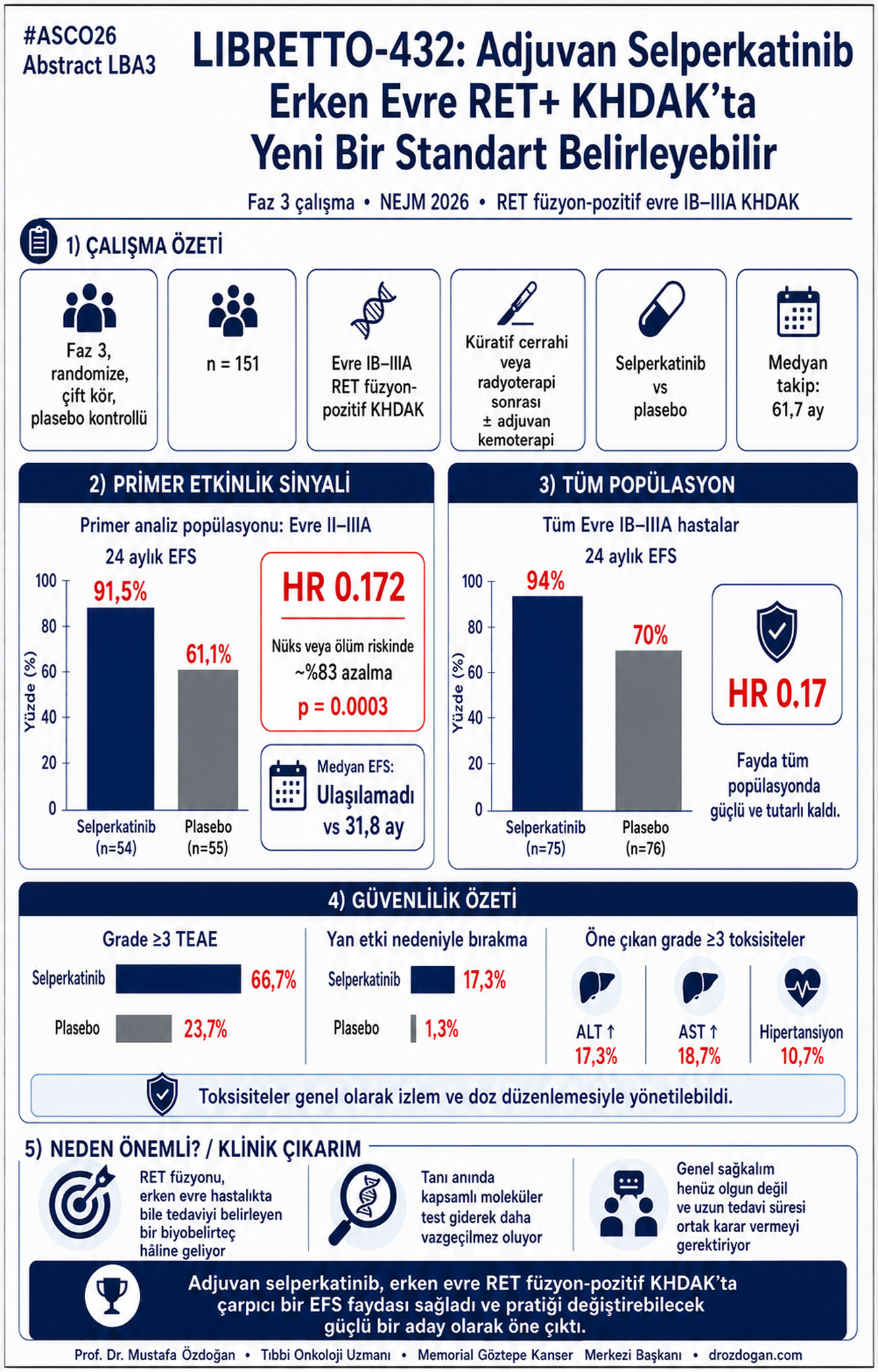
In the primary analysis population, namely stage II–IIIA patients, selpercatinib substantially improved EFS. The 24-month EFS rate with selpercatinib was %91,5, versus %61,1 with placebo. Median EFS was not reached in the selpercatinib arm, whereas in the placebo arm it was reported as 31,8 months . The HR was 0,172 .
Results were consistent in the entire stage IB–IIIA population. The 24-month EFS rate in the selpercatinib arm was %94, versus %70 in the placebo arm; the HR was reported as 0,17 . Independent central review and subgroup analyses were also consistent with the overall finding.
| Outcome | Selpercatinib | Placebo | Clinical interpretation |
|---|---|---|---|
| 24-month EFS, stage II–IIIA | %91,5 | %61,1 | Dramatic separation in the primary analysis population. |
| Median EFS, stage II–IIIA | Not reached | 31,8 months | Median EFS could not be calculated in the selpercatinib arm at data cutoff. |
| EFS HR, stage II–IIIA | 0,172 | Approximately 83% relative reduction in the risk of recurrence or death. | |
| 24-month EFS, stage IB–IIIA | %94 | %70 | Strong and consistent benefit in the overall population as well. |
| OS | Not yet mature | Long-term survival and outcomes after treatment should be followed in adjuvant targeted therapy. | |
Why is this practice-changing?
The paradigm of targeted adjuvant therapy in early-stage lung cancer was strengthened first with osimertinib in EGFR-mutant disease, then with alectinib in ALK-positive disease. LIBRETTO-432 brings the same rationale to RET fusion-positive disease. RET fusion thus becomes a critical biomarker determining treatment decisions not only in metastatic disease, but also at an early stage.
It is treatment given after surgery or radiotherapy with curative intent to suppress microscopic cancer cells and reduce recurrence risk, even when no visible disease remains.
Safety
Selpercatinib’s safety profile was generally consistent with previous advanced-stage studies. All selpercatinib patients reported at least one treatment-emergent adverse event; the rate of grade 3 or higher adverse events in the selpercatinib arm was %66,7, versus %23,7 in the placebo arm. The most common high-grade laboratory adverse events were increases in ALT and AST.
| Adverse event | Any grade | Grade ≥3 | Clinical interpretation |
|---|---|---|---|
| Increased ALT | %62,7 | %17,3 | Liver enzyme monitoring is essential. |
| Increased AST | %60,0 | %18,7 | Treatment interruption or dose reduction may be required. |
| Hypertension | %30,7 | %10,7 | Blood pressure should be monitored from the outset. |
| Diarrhea | %38,7 | %4,0 | Generally manageable; fluid and electrolyte balance is important. |
Critical reading: strong data, but some issues require follow-up
- The patient number is small, but the biological subgroup is rare: 3446 people were assessed; RET negativity was the most common reason for exclusion. This illustrates the operational challenge of comprehensive molecular testing at an early stage.
- OS is not yet mature: EFS is dramatically positive, but overall survival and long-term outcomes after treatment will become clearer over time.
- There is a 3-year treatment burden: Adjuvant selpercatinib is given for up to 3 years. Liver enzymes, blood pressure, gastrointestinal adverse events, and treatment adherence should be monitored throughout this period.
- Treatment discontinuation is not uncommon: Discontinuation due to TEAE was 17,3% in the selpercatinib arm. This makes shared patient-physician decision-making important in early-stage patients treated with curative intent.
- Regulatory developments should be awaited: Selpercatinib is approved in metastatic RET+ NSCLC; country-specific approval and reimbursement processes for adjuvant use should be followed separately.
Message for practice in Türkiye
The most direct practical implication of LIBRETTO-432 is that molecular testing in early-stage lung adenocarcinoma should be performed not only for metastatic disease, but also at diagnosis and when planning treatment with curative intent. Strengthening evidence for adjuvant targeted therapy in EGFR, ALK, and now RET makes a comprehensive NGS panel increasingly indispensable in early-stage NSCLC.
How should this be explained to patients?
“If your tumor has a specific genetic alteration called RET fusion, a targeted drug may be considered after surgery or treatment with curative intent to reduce the risk of the cancer returning. In the LIBRETTO-432 study, selpercatinib substantially reduced this risk. However, this treatment requires long-term follow-up, regular blood tests, and side effect management.”
Drozdogan Academic Commentary
LIBRETTO-432 is a practice-changing study showing that the era of molecularly targeted adjuvant treatment in early-stage lung cancer is no longer confined to EGFR and ALK: RET fusion has now reached this level as well.
The effect represented by an EFS HR of 0,17 is a magnitude of benefit rarely seen in adjuvant oncology and strongly reinforces the message that “RET fusion must be sought at diagnosis.”
However, because OS remains immature, treatment carries a 3-year burden, and treatment discontinuation is a concern, this approach should be delivered through open shared decision-making with patients, at experienced centers, and with regular toxicity monitoring.
Conclusion
LIBRETTO-432 showed that adjuvant selpercatinib reduced the risk of recurrence or death by approximately 83% in stage II–IIIA RET fusion-positive early-stage NSCLC. The 24-month EFS rate was 91,5% with selpercatinib and 61,1% with placebo. In the overall stage IB–IIIA population, 24-month EFS was also reported as 94% versus 70%.
These results make adjuvant selpercatinib a candidate for a new standard in early-stage RET fusion-positive NSCLC. The broader message is even greater: molecular testing in early-stage lung cancer should now be central to curative treatment decisions, as well as to metastatic disease management.
- Goldman JW et al. Selpercatinib in Early-Stage RET Fusion–Positive Non–Small-Cell Lung Cancer. New England Journal of Medicine. 2026.
- ASCO 2026 LBA3. Event-free survival with adjuvant selpercatinib in stage IB–IIIA RET fusion-positive NSCLC: Primary results of LIBRETTO-432.
- Eli Lilly and Company. LIBRETTO-432 phase 3 results. 31 May 2026.
- OncLive. Adjuvant Selpercatinib Significantly Improves EFS in Early-Stage RET Fusion–Positive NSCLC. 31 May 2026.
- Targeted Oncology. Adjuvant Selpercatinib Significantly Extends EFS in RET Fusion–Positive NSCLC. 31 May 2026.
- Tsuboi M et al. LIBRETTO-432 study design. Future Oncology. 2022.
- drozdogan.com. ASCO 2026 Önizlemesi – LIBRETTO-432 klinik etki çerçevesi.
Was this article helpful?
Your feedback helps us improve our content.


Reader comments
Share your comment
Your name and comment are published only after administrator approval. Your email address is never shown to visitors.
Be the first to comment.