
A Study Set to Change the Treatment Pathway in HER2-Positive Breast Cancer

For the breast cancer subtype called HER2-positive , an important study expected to change the treatment pathway presented its results between 4-8 December 2018 in Texas, USA, at the San Antonio Breast Cancer Symposium, and simultaneously in NEJMthey were published.
This KATHERINE phase-3 clinical trialfound that, despite receiving neoadjuvant (preoperative tumor-shrinking) chemotherapy and the targeted drug trastuzumab (Herceptin), early-stage breast cancer patients with residual disease, meaning surgical pathology showed the tumor had not completely disappeared, benefited from postoperative protective treatment using, instead of trastuzumab, ado-trastuzumab emtansine (T-DM1; Kadcyla) , reducing cancer recurrence or breast cancer-related mortality risk by % 50.
What Is Trastuzumab Emtansine, and How Does It Work?
Also called T-DM1, ado-trastuzumab emtansine combines two different drugs:
- T: trastuzumab (a targeted medicine)
- DM1: a chemotherapy drug acting on microtubules, the cell's skeleton
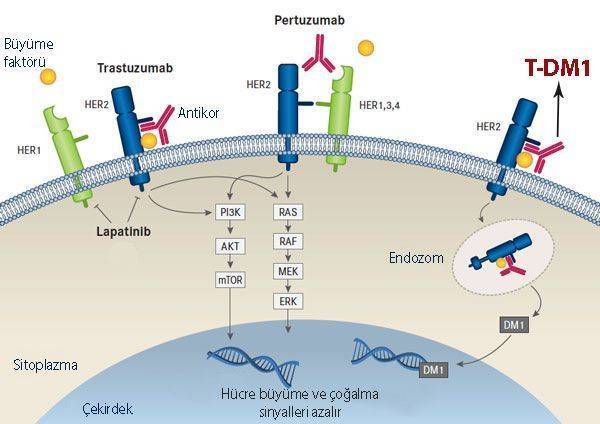
Image description: Kadcyla targets, known as human epidermal growth factor receptor 2 (HER-2), a receptor on the surface of breast cancer cells. After binding to this protein receptor, it enters the cells and releases a chemical called DM-1 that stops cell growth or division.
Kadcyla, in 2013, for advanced breast cancer received FDA approval.
Details and Results of the KATHERINE Study
- A large clinical trial was conducted involving approximately 1500 HER2-positive breast cancer patients.
- All patients had HER2-positive early breast cancer at diagnosis. Tumor size ranged from T1 to T4, nodal stage from N0 to N3, and metastasis was absent (see breast cancer staging). Patients with stages T1aN0 or T1bN0 were not enrolled. In addition, an anthracycline with or without it, a taxane-containing chemotherapy regimen and at least 9 weeks of trastuzumab were included in completed neoadjuvant treatment; patients with residual disease in the breast or axilla (armpit) at surgery were enrolled. Patients were then randomly assigned to two arms for postoperative treatment consisting of 14 cycles of adjuvant therapy (T-DM1 in one group and trastuzumab in the other).
- In an early analysis, in the T-DM1 group, among 743 patients, 91 (% 12), and in the trastuzumab group, among 743 patients, 165 (% 22), experienced cancer recurrence or death (see the figure below).

- At year 3, the cancer-free rate in the T-DM1 group was % 88, compared with % 77 in the trastuzumab group. This % 11 difference is striking for early-stage breast cancer (see the figure below).

- The benefit of T-DM1;
- In both hormone receptor-positive and -negative disease,
- At different levels of residual disease,
- And in those receiving single or dual anti-HER2-targeted therapy in the neoadjuvant regimen, appeared similar.
- More importantly, distant organ metastasis, in those receiving T-DM1, occurred in 78 patients (% 10.5), and in those receiving trastuzumab, in 118 patients (% 15.9). However, there was no difference in brain metastases.
- Longer follow-up is required to determine overall survival benefit. Median follow-up is currently approximately 41 months. At this point, in the T-DM1 group there were 42 deaths, and in the trastuzumab group 56.
- Regarding adverse effects, those in the T-DM1 group were similar to those reported in previous studies of this drug. Of the 14-cycle treatment, among patients receiving trastuzumab, % 81 completed it; among those receiving T-DM1, % 71 completed it. In the T-DM1 group, %18 of patients, and in the trastuzumab group, %2, discontinued treatment because of adverse effects. However, most adverse effects in the T-DM1 group were temporary and manageable. For example, sensory impairment at the tips of the hands and feet (peripheral neuropathy) developed in the T-DM1 group in %19 of patients, but was severe in only %5.
Some Thoughts on Pertuzumab (Perjeta), Another Anti-HER2 Treatment
In HER2-positive breast cancer patients receiving preoperative tumor-shrinking treatment, adding pertuzumab (Perjeta) to trastuzumab was shown to improve treatment success; consequently, in 2013 pertuzumab received neoadjuvant treatment approval from the FDA. After this approval, the standard neoadjuvant treatment for HER2-positive breast cancer became dual anti-HER2 therapy. In KATHERINE, only a small proportion of patients (% 18) received pertuzumab, which had become standard neoadjuvant treatment; this may be seen as a weakness of the study. Another question is whether patients receiving dual anti-HER2 neoadjuvant treatment should switch to T-DM1 after surgery. The answer may be "yes", because without a pathological complete response to pertuzumab, these patients are unlikely to benefit from pertuzumab.
In conclusion, KATHERINE provides highly valuable information on postoperative T-DM1 use and will probably change clinical practice in HER2-positive early-stage breast cancer.
Sources
Trastuzumab Emtansine for Residual Invasive HER2-Positive Breast Cancer.
NEJM, December 2018.
Was this article helpful?
Your feedback helps us improve our content.




Reader comments
Share your comment
Your name and comment are published only after administrator approval. Your email address is never shown to visitors.
Be the first to comment.