
What Is a Receptor? Its Role in Cancer Development and Treatment

In this article
Cancer arises from mutations accumulating in genes controlling relationships between cells and their surroundings, resulting in disease. Cells regulate external and mutual interactions through molecules called receptors . What are these cellular eyes and ears ?
How do they affect cancer development? Receptors are surface or intracellular proteins functioning as sensors . They receive signaling molecules (ligands), determining cell behavior and acting as on-off switches for specific activities.
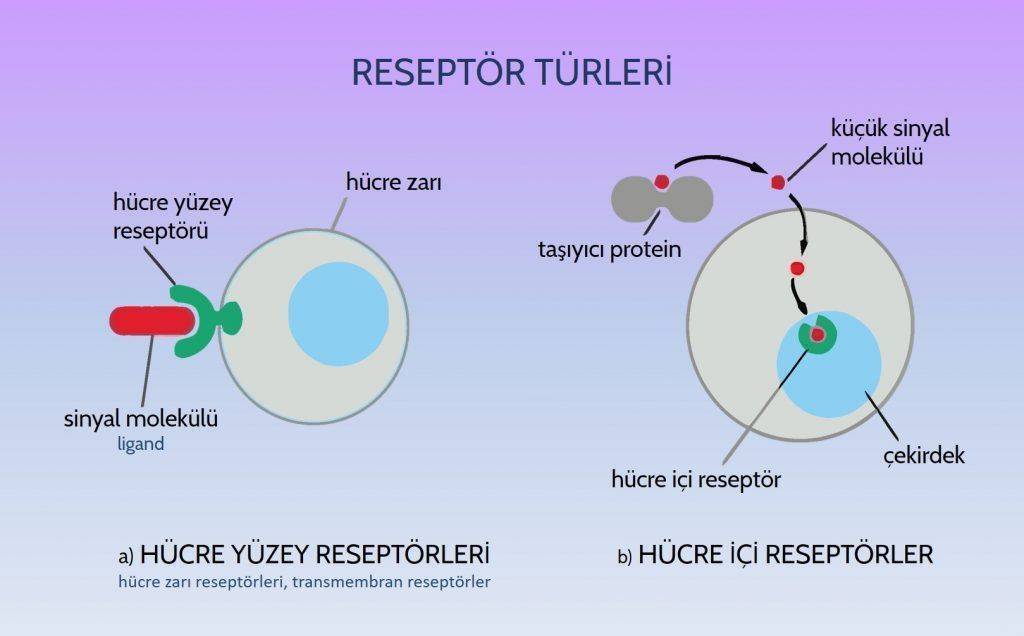
Diagram of extracellular signaling molecules binding surface and intracellular receptors. Despite many subtypes, receptors fall into two groups by location:
- Cell-surface receptors (also cell membrane or transmembrane receptors), comprising most receptors.
- Intracellular receptors (in both cytoplasm and nucleolus). Ligands are signaling molecules such as proteins, hormones, ions or soluble gases like nitric oxide.
Receptors are important in cancer. Normal cells have growth-controlling receptors. During wound healing or renewal, proteins called growth factors bind them to stimulate proliferation. In cancer, these receptors are mutated and signal “keep proliferating” even without external stimulation.

Most signaling molecules bind surface receptors without entering the cell or nucleus. These transduce external signals inward and form 3 main groups:
- Ion Channel Receptors: Participate in rapid signaling among nerve and other electrically excitable cells.
- G-Protein Receptors: Indirectly regulate membrane-bound target proteins, usually enzymes. Activation may change concentrations of one or more small intracellular signaling molecules.
- Tyrosine Kinase Receptors: Generally have three units: an extracellular ligand-binding region, a single transmembrane protein and an intracellular catalytic or enzyme-binding region. They have many more subtypes than the other two groups.
These receptors are important in cancer . Many tyrosine-kinase-blocking medicines are used and many more are being developed… Other receptor structures outside these classes also contribute to tissue renewal, repair and cancer.
Cancer-Cell Surface Receptors Support Targeted Drug Development
Recent cancer medicines called targeted drugs target receptors on cancer-cell surfaces.

Most healthy breast cells have HER2 receptors. HER2 controls growth and is normally switched off. Damage to the “HER2” gene keeps HER2 continuously active, through increased HER2 gene copies or receptor numbers. Breast cancers with HER2 mutation are called HER2-positive breast cancer . HER2 is an important breast cancer biomarker , enabling drugs targeting this receptor in approximately %30 of patients.
What Does Estrogen and Progesterone Receptor Positivity Mean?
These are the first receptors associated with cancer. Estrogen receptors (ER) and progesterone receptors (PR) are specialized surface proteins on certain cells. Circulating hormones bind them and promote growth and division.
Many breast tumors have abundant estrogen and/or progesterone receptors, depend on hormones and grow under their influence. Tissue can be tested; positive results permit medicines blocking these receptors, such as tamoxifen.

Discovering new cancer receptors is vital for early diagnosis and effective targeted drugs. Recent advances in nanotechnologyenabled nanoparticles carrying medicines targeting surface receptors, an important treatment advance.
*
- A Brief History of Breast Cancer: Discovery of Tamoxifen, the First Targeted Drug
Sources
2. Miguel A. Molina, Jordi Codony-Servat, Joan Albanell, Federico Rojo, Joaquín Arribas and Jose Baselga.
Trastuzumab (Herceptin), a Humanized Anti-HER2 Receptor Monoclonal Antibody, Inhibits Basal and Activated HER2 Ectodomain Cleavage in Breast Cancer Cells.
Cancer Res June 15 2001 (61) (12) 4744-4749, Nature Reviews Molecular Cell Biology 3, 639-650 (September 2002)
3. Kristen L. Pierce, Richard T. Premont & Robert J. Lefkowitz.
Seven-transmembrane receptors
Was this article helpful?
Your feedback helps us improve our content.




Reader comments
Share your comment
Your name and comment are published only after administrator approval. Your email address is never shown to visitors.
Be the first to comment.