
What Is Kadcyla (ado-trastuzumab emtansine)? FDA Approval, Authorization in Türkiye and Reimbursement Status

In this article
With a DM1 cytotoxic payload covalently attached to the trastuzumab antibody, it is an antibody–drug conjugate. It is used as a single agent in metastatic and early-stage HER2-positive patients with “residual invasive disease after neoadjuvant treatment.”
FDA Approval History
- 22 February 2013: In metastatic HER2-positive breast cancer, for patients previously treated with trastuzumab and a taxane, approval for use as a single agent was granted.
- 3 May 2019: KATHERINE data formed the basis for approval; despite neoadjuvant taxane+trastuzumab treatment, residual invasive disease in early-stage patients was the setting for adjuvant approval.
- May 2025: The label included KATHERINE long-term updates (Clinical Studies section).
What Is Kadcyla?
Kadcyla (ado-trastuzumab emtansine, T-DM1), targeting HER2, combines the trastuzumab antibody with the intracellularly delivered DM1 microtubule inhibitor to form an antibody–drug conjugatemedicine. 100 mg and 160 mg vials are prepared for IV infusion.
How Does It Work?
Kadcyla binds, on the surface of breast cancer cells, to the HER2 receptor . After the complex is internalized, lysosomal degradation releases DM1 , which disrupts microtubule polymerization, stopping cell division and initiating apoptosis. The trastuzumab component suppresses HER2 signaling and triggers antitumor immune effector mechanisms.
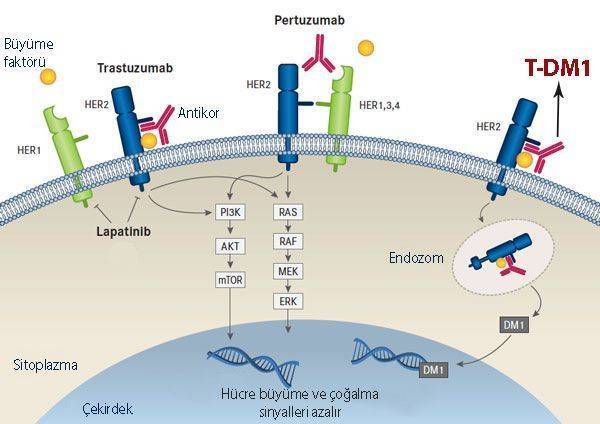
- T: Trastuzumab (targeted antibody)
- DM1: Microtubule-inhibiting chemotherapeutic payload
It combines the effects of “targeted drug + chemotherapy” in a single molecule.
Treatment Goals
- Metastatic Stage: To reduce tumor burden, relieve symptoms, slow progression and prolong survival (palliative goal).
- Adjuvant (Early Stage): Despite neoadjuvant treatment, residual invasive disease if present, calls for reducing the risk of recurrence and increasing the chance of cure.
Approved Indication and Clinical Role
- Metastatic HER2-Positive Breast Cancer: Previously administered trastuzumab and a taxane are the treatment history of patients receiving single-agent T-DM1.
- Early-Stage HER2-Positive: At surgery after neoadjuvant taxane+trastuzumab, residual invasive tumor identified in patients is treated with adjuvant T-DM1 (usually 14 cycles).
An approved HER2 test (IHC 3+ or ISH amplification) is required for patient selection.
Authorization in Türkiye
The product, TİTCK within its regulatory framework, Roche is registered under its authorization. 100 mg and 160 mg vial formulations are available;
Its price as of June 2026:
Kadcyla 100 mg vial price: 44.857,11 TL is the listed amount.
Kadcyla 160 mg vial price: 71.682,95 TL is the listed amount.
The cost of one cycle for an average 70 kg patient is approximately 107.575,55 TL.
SGK Reimbursement Status
In metastatic breast cancer, it is used as a single agent until progression as salvage treatment in patients previously treated with trastuzumab and a taxane whose disease subsequently progressed and whose HER-2/neu test is immunohistochemically 3+ (+++) or FISH/SISH/CISH positive. It cannot be used after progression, either as a single agent or as part of combination treatment. It is not indicated in patients previously treated with pertuzumab for any reason. It is prescribed by medical oncology specialists based on a medical board report that includes a medical oncology specialist and states these conditions.
Summary of Evidence
- EMILIA (phase 3, mBC): T-DM1, compared with lapatinib+capecitabine, has superior PFS and OS; it is better tolerated.
- TH3RESA (phase 3, mBC): In a heavily pretreated population, an OS/PFS benefit was demonstrated.
- KATHERINE (phase 3, adjuvant): In residual disease after neoadjuvant treatment, a ~%50 relative risk reduction in IDFS; sustained benefit with long-term data.
Dose and Administration Schedule
- Standard Dose: 3.6 mg/kg IV, once every 21 days (every 3 weeks). In mBC, until progression/unacceptable toxicity; for adjuvant purposes, usually 14 cycles.
- First Infusion: Approximately 90 minutes; if tolerated, subsequent cycles ≥30 minutes.
- Administration Setting: Outpatient chemotherapy unit; premedication is not routinely required (according to clinical need).

Treatment Duration
- The total visit duration for the first cycle may extend to ~3 hours ; in subsequent cycles, ~1.5 hours approximately.
- After infusion, 30–90 dk of observation is recommended; in the event of a reaction, the infusion may be slowed/stopped.
- Premedications/fluid support may extend the total duration (institutional practice).
Precautions in Administration and Use
- Liver Toxicity: Increased AST/ALT and bilirubin; rarely nodular regenerative hyperplasia — close monitoring.
- Cardiac Toxicity: Decreased LVEF; regular ECHO/MUGA.
- Thrombocytopenia & Bleeding Risk: Particular caution during the first cycles.
- Infusion Reactions/Anaphylaxis and pneumonitis (ILD) may occur.
- Pregnancy: Embryofetal risk; effective contraception is essential.
Pretreatment Checks and Monitoring Between Visits
At Baseline
- HER2 confirmation (IHC 3+ or ISH+; validated test).
- In women of childbearing age, a pregnancy test.
- Liver Function: AST/ALT, bilirubin.
- Complete Blood Count: particularly platelets.
- Cardiac Assessment: LVEF (ECHO/MUGA).
Between Treatments
- Complete blood count + biochemistry before each cycle (AST/ALT/bilirubin, platelets).
- LVEF ~every 3 months or more often according to clinical need.
- CT/PET-CT for response assessment at 2–4 cycle intervals (institutional practice).
Patient Selection Criteria
- HER2-Positive (IHC 3+ or ISH+), suitable performance status.
- Adjuvant: After neoadjuvant treatment, residual invasive tumor must be demonstrated pathologically.
- Metastatic: History of trastuzumab + taxane.
- Note: Patients of Asian origin may have a higher risk of thrombocytopenia (close monitoring).
Drug Interactions
- Strong CYP3A4 inhibitors (for example, clarithromycin, ketoconazole) → increased DM1 exposure: avoid if possible/monitor very closely.
- Strong CYP3A4 inducers (for example, rifampicin, carbamazepine) → efficacy may decrease.
- With anticoagulants/antiplatelet agents, the risk of bleeding requires caution.
- Check the medication list for potential interactions with antifungals and antiepileptics.
Adverse Effects and Management
Common (≈%5+)
- Nausea (~%39)
- Fatigue (~%35)
- Thrombocytopenia / bleeding risk (~%28)
- Diarrhea (~%23); Vomiting (~%19)
- Anemia (~%10)
- Hypokalemia (~%9)
- Mouth sores (stomatitis) (~%7)
- Neutropenia (~%6)
- Hand-foot/skin reactions (~%1+)
Although varying between studies, treatment discontinuation has been reported at around ~%6.
| Adverse Effect | Management |
|---|---|
| Thrombocytopenia | In grade 3–4, withhold; on recovery, reduce the dose. |
| Elevated AST/ALT | Withhold according to severity; if accompanied by bilirubin elevation, discontinue. |
| Decreased LVEF | If below the threshold, withhold; with persistent decrease/symptomatic HF, discontinue. |
| Peripheral Neuropathy | In grade ≥2, withhold; on improvement, resume at a reduced dose. |
| Infusion Reaction | For mild reactions, slow/stop; severe/anaphylaxis → permanently discontinue. |
| Pneumonitis / ILD | Confirm with imaging; in moderate-to-severe cases, discontinue and consider steroids. |
Leukopenia/neutropenia may occur in heavily pretreated cases; if needed, G-CSF support (filgrastim/pegfilgrastim) may be used according to clinical indication.
Dose Modifications
Levels
- Starting: 3.6 mg/kg
- 1. Reduction: 3.0 mg/kg
- 2. Reduction: 2.4 mg/kg
- If further reduction is needed: discontinue
Hematology
- Platelets <75×10⁹/L: Withhold; resume at a reduced dose when ≥75.
- Grade 4 (<25×10⁹/L): On recovery, reduce by one level.
Liver/Cardiac
- AST/ALT >5×ULN or bilirubin >2×ULN: Withhold; according to clinical status, discontinue.
- LVEF below threshold: Withhold; if the decrease persists or symptoms occur, discontinue.
References
- US Prescribing Information — KADCYLA (ado-trastuzumab emtansine). Current label (May 2025), FDA.
- FDA Press/Approval — 2013 mBC approval; 2019 adjuvant approval (KATHERINE).
- NEJM — KATHERINE: von Minckwitz et al., 2019.
- EMILIA & TH3RESA clinical summaries — HCP materials.
- Türkiye KÜB/KT — Roche/Medikaynak; product formulations: 100 mg and 160 mg vials.
- SGK — List of Reimbursable Medicines (EK-4A); SUT criteria.
Sources
Trastuzumab Emtansine for HER2-Positive Advanced Breast Cancer.
N Engl J Med 2012
Was this article helpful?
Your feedback helps us improve our content.




Reader comments
Share your comment
Your name and comment are published only after administrator approval. Your email address is never shown to visitors.
Be the first to comment.