
Adding Local Therapy to Osimertinib Extends Progression-Free Survival by 34 Percent

In this article
A New Approach in EGFR-Mutant Lung Cancer
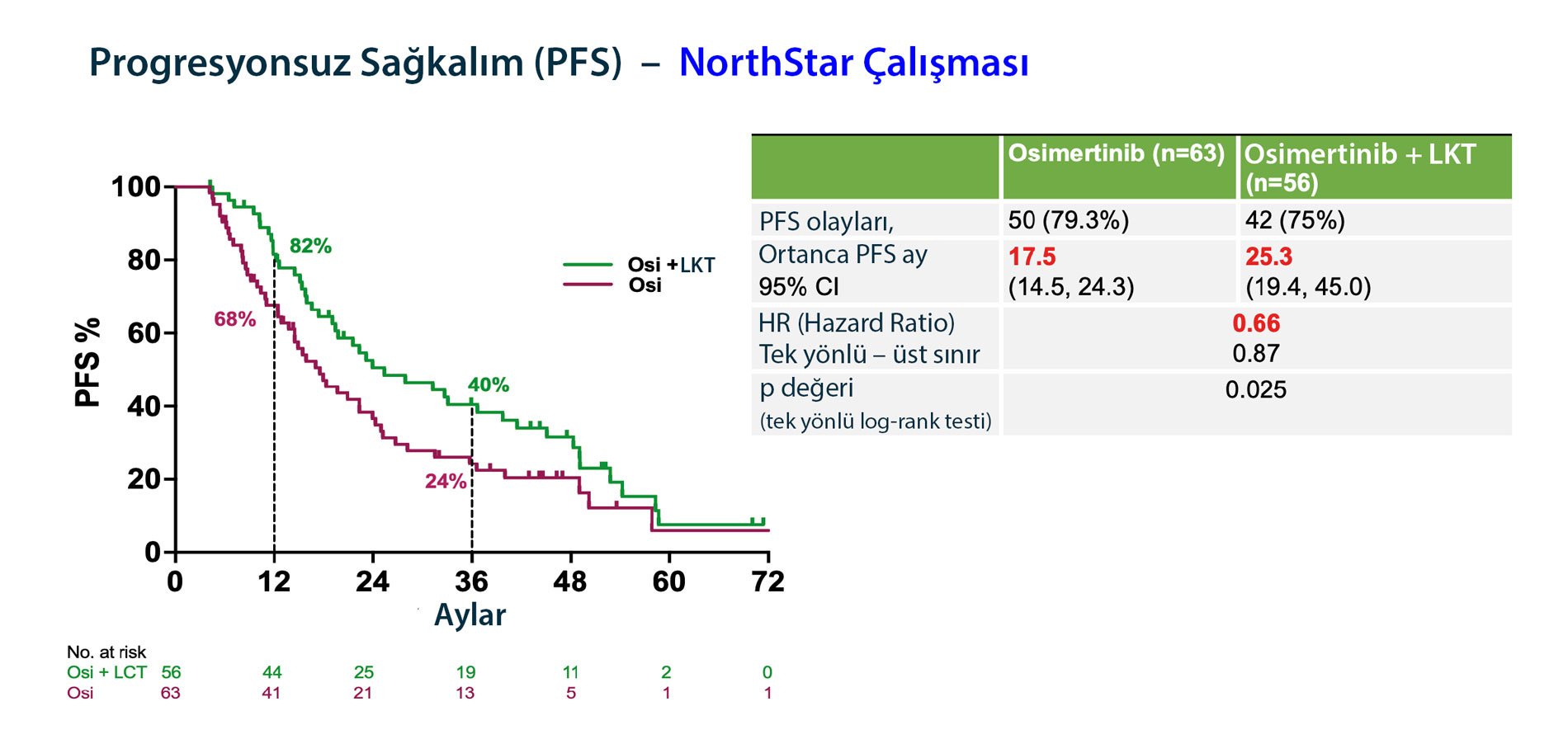
In metastatic or locally advanced EGFR-mutant non-small-cell lung cancer (NSCLC) , adding local consolidative therapy (LCT) to targeted treatment prolongs progression-free survival (PFS) significantly. NorthStar (LBA72) results, presented at ESMO 2025, showed that combining osimertinib with local treatments could provide durable disease control.
Osimertinib is a third-generation EGFR tyrosine kinase inhibitor (TKI), established as standard for EGFR exon 19 deletion (ex19del), L858R, or acquired T790M mutations. However, most metastatic EGFR-mutant NSCLC patients eventually experience resistance and disease progression .
Studies show that local consolidative therapy (LCT) —surgery or radiotherapy—improves survival particularly in oligometastatic NSCLC . By eliminating resistant clones that may arise during EGFR TKI therapy, it may delay systemic progression.
However, prospective randomized evidence on LCT with osimertinib has been limited. NorthStar is important as the first large prospective trial addressing this question.
Study Design
- Study: NorthStar (LBA72, ESMO 2025, Berlin)
- Design: Randomized, phase 3, open-label
- Population: EGFR-mutant (ex19del, L858R, or T790M-positive), locally advanced or metastatic NSCLC
- Criterion: No progression after osimertinib induction
- Arms:
- Osimertinib + LCT (n=56): Surgery (n=17), radiotherapy (n=33), both (n=6)
- Osimertinib alone (n=63)
- Primary endpoint: Progression-free survival (PFS)
- Secondary endpoints: Overall survival (OS), safety, subgroup analyses
Main Findings
| Endpoint | Osimertinib (n=63) | Osimertinib + LCT (n=56) | HR (95% CI) | p Value |
|---|---|---|---|---|
| Median PFS (months) | 17.5 (14.5–24.3) | 25.3 (19.4–45.0) | 0.66 | 0.025 |
| PFS rate at 12 months | 68% | 82% | – | – |
| PFS rate at 36 months | 24% | 40% | – | – |
These results show that adding local therapy produces a 34% reduction in progression risk . PFS benefit was consistent across subgroups.
Subgroup Findings
- PFS with EGFR exon19 deletion: 39.8 months vs 22.8 months (HR 0.58)
- With L858R mutation: 19.1 months vs 11.0 months (HR 0.60)
- With more than 3 metastases: 20.7 months vs 15.9 months (HR 0.73)
- With complete LCT: 33.1 months vs 15.1 months (HR 0.42)
Safety and Tolerability
3 LCT-specific Grade 3 adverse events were reported: pneumonitis, arterial injury, and empyema. Otherwise, treatment was generally well tolerated. Long-term toxicity monitoring continues.
DROZDOGAN Academy Commentary
NorthStar shows that in EGFR-mutant NSCLC receiving targeted treatment, local therapy can extend systemic control . This is particularly promising with limited metastatic burden or oligometastatic disease. Osimertinib + LCT may become an effective, tolerable option when chemotherapy or amivantamab cannot be added. Careful patient selection and prospective validation are needed.
Source: NorthStar Study, ESMO 2025, Late-Breaking Abstract #LBA72 (Berlin, October 17–21, 2025). Garassino M. et al. EClinicalMedicine 2025;87:103435.

Was this article helpful?
Your feedback helps us improve our content.




Reader comments
Share your comment
Your name and comment are published only after administrator approval. Your email address is never shown to visitors.
Be the first to comment.