
An Excellent Treatment Response Wins Oncology’s Best Image Award for 2018

Before-and-after images of advanced-technology treatment for widely metastatic prostate cancer in 8 men were honored by the Society of Nuclear Medicine and Molecular Imaging with the 2018 Image of the Year Award.
A group of prostate cancer researchers led by Professor Michael Hofman at Peter MacCallum Cancer Centre in Melbourne, Australia, conducted this work.
More than 2200 medical images were collected for the competition, presented at the Society of Nuclear Medicine and Molecular Imaging annual meeting, and voted on by reviewers and society leaders.
The images of these eight exceptionally good responders, resistant to hormonal therapy and with stage 4 prostate cancer, came from an Australian study involving 30 patients, a phase-2 clinical trial .
In treating these patients, gallium-68 prostate-specific membrane antigen-11 (PSMA11) positron emission tomography (PET)was used for both imaging and treatment.
- Related topic: A new imaging method in prostate cancer treatment: Gallium-68 PSMA-PET
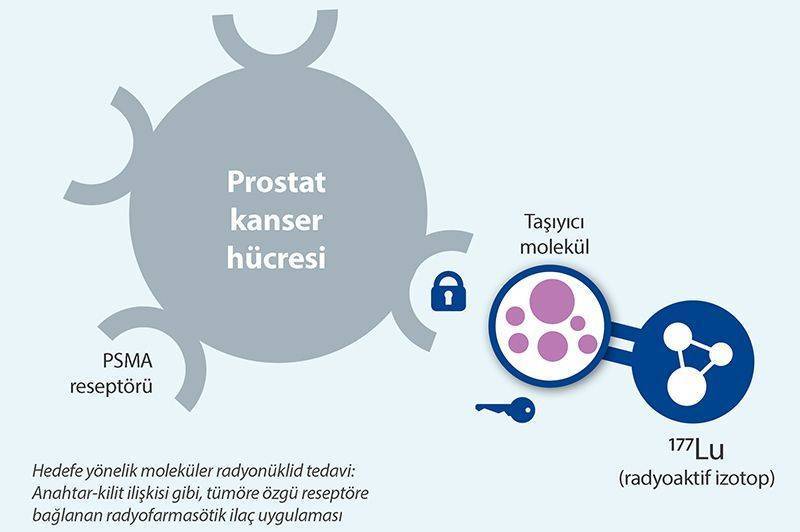
Some prostate tumors have high amounts of prostate-specific membrane antigen (PSMA) on cancer cell surfaces. Small carrier molecules called gallium-68, which bind this PSMA, also have radioactive material attached. Cancer cells can thus be located and imaged as well as killed by radioactive material. This study was designed to attach a beta-emitting radioactive substance called Lutetium-177 to PSMA-positive prostate cancer cells, and the procedure was called LuPSMA .
Post-treatment images show a very marked regression of metastatic disease. In the study, the median duration of blood PSA control with treatment was 7.6 months, and median overall survival was 13.5 months.
Following these intriguing results, researchers noted the need for studies comparing LuPSMA with standard prostate cancer treatments. This molecular treatment has also been successfully used at our center for years. Further research is expected to make nuclear medicine applications more widely used in cancer treatment.
Related Topics:
- Advances in prostate cancer treatment – 2017 and 2018
- Effective results in stage 4 prostate cancer with actinium alpha therapy
Sources
High activity, pain reduction and low toxicity with Lutetium-177 PSMA617 theranostics in metastatic castrate-resistant prostate cancer (mCRPC): results of a phase II prospective trial.
J Nucl Med May, 2018
Was this article helpful?
Your feedback helps us improve our content.




Reader comments
Share your comment
Your name and comment are published only after administrator approval. Your email address is never shown to visitors.
Be the first to comment.