
ESMO ESCAT v2 (2026): Levels of Evidence for Mutations in Tumor Genetic Reports, New Resistance Scale, and Tumor-Agnostic Therapies
In this article
There Is a Mutation in the Report, but What Does It Mean? ESMO's Updated Evidence Scale
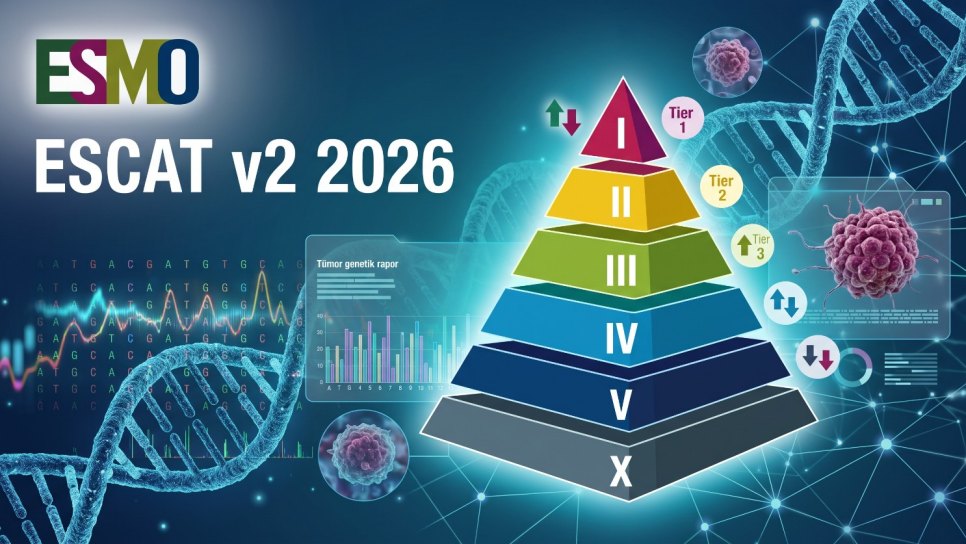
Genetic testing of the tumour (genomic profiling) has become routine in many cancers today; however, not every mutation that appears in the report changes treatment. The European Society for Medical Oncology (ESMO) has comprehensively updated the ESCAT scale, which grades how reliable a guide a finding is for treatment, for the first time since 2018. ESCAT v2 was published on 22 October 2026 in the journal Annals of Oncology. The new version shows the degree of certainty of the evidence more clearly, introduces criteria for tumour-agnostic therapies and, for the first time, defines a separate scale for biomarkers that indicate drug resistance. We have previously covered a comparison of comprehensive genomic tests, next-generation sequencing (NGS), CeGaT tumour tests and RNA sequencing in separate articles.
- What is ESCAT? The ESMO scale that ranks a biomarker–drug match (for example, an EGFR mutation and osimertinib) from Tier I to X according to the strength of the evidence. Tier I means "standard treatment", Tier II "case by case", Tier III "clinical trial", Tier IV "research only" and Tier X "not to be used".
- Tier I has been reorganised: There are now three subtiers based not on trial design but on the certainty of the evidence: proven (I-P), inferred (I-I) and extrapolated (I-E). The clinical message is the same for all three.
- Tumour-agnostic therapies: Whether a match can be generalised to all tumours is now decided not by expert opinion but by ESMO's ETAC-S criteria.
- A resistance scale for the first time: The new four-tier scale shows which finding definitively rules out a drug (I-R) and which only calls for caution. The scale is independent of drug approvals; it is expected to be used in the next updates of the ESMO guidelines.
Why does this matter?
Comprehensive genomic tests can find dozens, sometimes hundreds, of alterations in a tumour. However, only some of these have an approved drug or one with proven efficacy; some are meaningful only for participation in a clinical trial, and others cannot yet be linked to treatment at all. When patients and their families see a "targetable" mutation in the report, they are understandably hopeful; physicians, in turn, need to explain honestly whether this finding will really bring benefit (cancer mutations).
ESCAT was developed in 2018 to bring a common language to this question and is widely used in molecular tumour boards, laboratory reports and ESMO guidelines. In the meantime, however, tumour-agnostic approvals have multiplied, real-world evidence has grown, mutations indicating drug resistance have become part of clinical decisions, and new types of biomarker have emerged, such as protein staining (immunohistochemistry) and AI-assisted pathology. The authors state that the first version fell short of meeting these developments in five respects.
What is ESCAT v2, and how does it change the tumour genetic report?
ESCAT v2 is ESMO's updated scale that grades, from Tier I to X, how strongly a biomarker detected in the tumour supports treatment with a specific drug. The version published in October 2026 recommends that, for every finding, the answers to both "does it support treatment with this drug?" and "does it indicate resistance to this drug?" be reported together with the level of evidence.
The scale classifies only "actionable" biomarkers, that is, findings whose presence predicts benefit from a specific treatment. Each rating has three components: the biomarker, a specific drug or drug class, and a specific tumour type or clinical setting. For example, the same BRAF V600E mutation can be Tier I in lung cancer and Tier X in colorectal cancer for treatment with a BRAF drug alone. The new version covers not only DNA sequencing but every kind of validated biomarker test, such as protein staining and AI-assisted pathology.
Figure 1 · The ESCAT v2 actionability scale: tiers and their clinical meaning
The strength of evidence decreases from top to bottom
Tier I: the same message, three levels of certainty
In the first version, Tier I was divided into three according to trial design. In the new version, the distinction is based on how certain the evidence is; yet the clinical message of the three subtiers is the same: testing should be done and, if the finding is present, the matched treatment should be chosen. This way, reports can also convey the degree of uncertainty of the evidence without weakening the treatment recommendation.
Figure 2 · The three subtiers of Tier I
The box on the left shows the source of the evidence, the box on the right the subtier
Examples of Tier I-I are the BRAF V600E mutation in lung cancer and the KRAS G12C mutation in previously treated patients (KRAS G12C targeted therapies). This category matters for rare molecular groups in which a randomised trial is ethically or practically difficult; however, the authors stress that confirmation at the I-P level should continue whenever randomisation is possible. Tier I-P also has a new clarification: if the comparator arm is already a biomarker-based standard treatment (for example, when two different EGFR drugs are compared), a trial showing that the new drug is "not worse" is also considered sufficient (EGFR-mutated lung cancer in 2026).
Tumour-agnostic therapies: the ETAC-S criteria
In recent years, some drugs have been approved on the basis of a specific molecular alteration, regardless of the organ in which the tumour originated (tumour-agnostic therapies). The first ESCAT did not define when evidence obtained in one tumour could be applied to another, and this led to differing interpretations between centres. In ESCAT v2, this decision has been left to the ETAC-S criteria published in 2024. Because the criteria are a separate document, they can be updated without changing ESCAT itself.
Tier I-E has a deliberate flexibility: whereas survival data are required in the single-tumour tiers, here a meaningful response rate and duration of response in each tumour type are considered sufficient. This is because tumour-agnostic evidence often comes from many small patient groups within a single trial. Examples are NTRK fusion and larotrectinib, and MSI-H/dMMR and immunotherapy in tumours other than colorectal cancer (dostarlimab in dMMR/MSI-H tumours). If enough data accumulate in a particular tumour type, that tumour–biomarker pair can also be moved separately to a higher or lower tier.
Threshold for tumour-agnostic therapy and an example
Objective response rate, percent. Grey bar: the lowest ETAC-S threshold; coloured bar: larotrectinib (NTRK fusion).
The larotrectinib value is the independent review committee assessment from a pooled analysis of three single-arm trials. Passing the threshold is not enough on its own; the response must also be seen in most tumour types.
Tier II: "may be used", but with data recorded
Tier II is for matches whose efficacy has been shown in a specific tumour type but which have not reached the Tier I standard. A treatment in this tier can be used case by case, preferably with the approval of the molecular tumour board. The new version adds an important responsibility: the centre giving the treatment should collect the patient's outcomes through a clinical trial or a prospective registry. In other words, in Tier II the treatment recommendation and data collection go hand in hand. The tier has been divided into three subtiers:
| Subtier | Source of evidence | Minimum required | Example |
|---|---|---|---|
| II-A | Prospective interventional trial; response rate available, survival data insufficient | Tumour-specific trial in which treatment was given per protocol according to the biomarker | HER2 therapy in HER2-amplified salivary duct carcinoma |
| II-B | High-quality real-world or retrospective analyses | At least 2 independent datasets with non-overlapping patients, a validated test, standard endpoints | Avapritinib in high-grade glioma with PDGFRA alterations |
| II-C | Repeated case reports or small series | At least 3 evaluable patients in at least 2 independent sources, laboratory support | Very rare molecular subtypes |
II-C is the most uncertain group in Tier II; it is open to publication and patient selection bias. In this case, the tumour board needs to state clearly that the evidence is limited and that the decision carries greater uncertainty.
In rare situations such as the glioma in the example, structured real-world evidence is seen as the main route by which an efficacy signal can become strong evidence (molecular diagnosis in brain tumours). The criterion separating Tier II-A from I-I is also clear: if a non-randomised trial reports only a response rate, it is II-A; if progression-free or overall survival clearly exceeds the best known outcomes, it is I-I.
Tiers III, IV and X
- Tier III refers to clinical trials: Matches that make biological sense but lack sufficient clinical evidence in that tumour. Even if the tumour board supports it, this is not considered a justification for treatment outside a trial (what is a clinical trial, phase 1 trials). In III-A, the evidence comes from another tumour and ETAC-S is not met; for example, KRAS G12C and sotorasib in ovarian cancer. In III-B, there are no patient data at all, and the alteration is considered functionally similar to a known target; for example, EGFR kinase domain duplication.
- Tier IV is for research only: IV-A has data from cell or animal models, IV-B only computational predictions. The authors stress that the two are not equivalent and that laboratory data are far more valuable than computational predictions.
- Tier X has been split in two: In X-A, the biomarker was tested but the drug's benefit turned out to be independent of the biomarker. For example, sacituzumab govitecan is effective regardless of Trop-2 level; for this reason, approvals do not require a Trop-2 test (sacituzumab in triple-negative breast cancer, sacituzumab in hormone receptor-positive breast cancer). In X-B, despite a plausible target, the drug was ineffective in that disease: for instance, giving a BRAF drug alone for BRAF V600E in colorectal cancer (encorafenib).
Tier V of the first version (response present but no survival benefit, a candidate for combination) is not included in the new version because it was not used in practice.
The new resistance scale: which finding rules out a drug?
Biomarkers can show not only who will benefit but also who will not. Until now, this second dimension had not been tied to a common standard. ESCAT v2 introduces a four-tier scale for resistance biomarkers, built on the same logic as the actionability scale. The scale covers both resistance present before treatment (intrinsic) and resistance that emerges during treatment (acquired) (how cancer cells develop resistance).
Figure 3 · The ESCAT v2 resistance scale
The strength of evidence and clinical weight decrease from top to bottom
Tier I-R can be reached in two ways. For I-A-R, a randomised trial or its biomarker analysis must show that benefit is absent or markedly reduced in biomarker carriers. I-B-R is for resistance that emerges during treatment: because retreatment or randomisation is not ethical here, what is required is a consistent finding in at least two independent retrospective datasets from different centres, a well-defined mechanism, and a tissue or blood (liquid biopsy) sample taken at progression. For example, in EGFR-mutated lung cancer, the T790M mutation that develops against first- and second-generation EGFR drugs also identifies patients who will benefit from osimertinib (osimertinib).
Figure 4 · The same finding, two labels: MET amplification
A biomarker can carry a resistance tier and an actionability tier at the same time
The example of Tier II-R is the STK11 (LKB1) mutation in lung cancer: in data from many centres, patients carrying this mutation have lower response rates and survival with immunotherapy alone; however, some of them still benefit (immunotherapies). For this reason, STK11 alone should not be used to deny immunotherapy. Examples of Tier III-R include RB1 loss and CDK4/6 inhibitors in hormone receptor-positive, HER2-negative breast cancer (genomic testing and CDK4/6 inhibitors), MDM2/MDM4 amplification, which has been associated with rapid disease progression on immunotherapy, and additional chemotherapy in the presence of a POLE mutation in high-risk uterine (endometrial) cancer. An example showing that the scale is dynamic is also given: NRAS mutations against BRAF drugs in melanoma were first described only at the laboratory level (IV-R); today there is clinical evidence as well.
Differences from the first version
| Topic | ESCAT (2018) | ESCAT v2 (2026) |
|---|---|---|
| Tier I subtiers | Based on trial design | Based on the certainty of the evidence (I-P, I-I, I-E) |
| Tumour-agnostic use | No defined criteria, expert interpretation | The ETAC-S criteria decide |
| Tier II | Two subtiers | Three subtiers; quality thresholds for real-world evidence, responsibility to record data |
| Tier V | Response present, no survival benefit | Removed |
| Tier X | Single group | X-A (biomarker does not guide), X-B (drug ineffective) |
| Resistance biomarkers | Out of scope | Separate four-tier scale |
| Test types | Genomic alterations | Every validated test, including protein staining and AI-assisted pathology |
Information on the first version is based on the 2018 paper and on the explanations in the ESCAT v2 paper.
What if there is more than one target?
Tumours often have more than one targetable alteration. ESCAT v2 grades each biomarker separately; which one to target first is decided by the tumour board. This decision should take into account the tumour type, the size of the expected benefit, the availability and licensing status of the drug, any coexisting resistance findings, prior treatments and the patient's condition together. Combinations based on lower-tier alterations, on the other hand, should be tested in clinical trials rather than in routine treatment.
Figure 5 · From test to treatment decision
The ESCAT tier appears in the report; the decision is made by the tumour board
Limitations and points of debate
- A consensus document: ESCAT v2 is not a new clinical trial; it is based on the consensus reached by an international expert panel over eight rounds of feedback. As the authors also note, some thresholds are taken from clinical trial conventions rather than from a formal calibration study.
- Applying it requires expertise: The distinctions between types of evidence and endpoints require clinical trial knowledge that not every laboratory has. The authors recommend that, in uncertain cases, laboratories determine the tier together with experts.
- Dependence on knowledge bases: Everyday use of the scale depends on continuously updated databases such as OncoKB and CIViC, and on reporting software.
- Tiers can change: As new data arrive, a match's tier can go up or down; the tier in an older report may no longer be valid today (reading research correctly).
- Independent of approval: This makes the scale usable worldwide; however, a drug being Tier I does not mean that it is licensed or reimbursed in every country.
- Conflicts of interest: The work was funded by ESMO; consulting or speaking relationships of most of the authors with pharmaceutical and diagnostics companies are declared in the paper.
In Turkey, comprehensive genomic tests and molecular tumour boards are used in many centres; some laboratory reports may also include ESCAT tiers. Because the ESCAT tier is independent of drug approval, the drug in a Tier I match may not be licensed in Turkey or may not be reimbursed for that indication. In this case, routes such as importing the drug from abroad or approval from TİTCK (Turkish Medicines and Medical Devices Agency) for off-label use may be considered (cancer drugs imported from abroad, SGK (Social Security Institution) reimbursement conditions). For Tier III findings, clinical trials in Turkey and abroad can be explored. We described how new drugs reach our country in our article on the drug approval process.
Tips for patients and their families
- Read the report together: Seeing a mutation in your genetic test report may not mean there is an effective drug for it. You can ask your doctor: "What is the ESCAT tier of this finding, and what does it mean for my tumour?"
- Ask about resistance findings too: Some findings show that a particular drug will not work; this information protects you from unnecessary side effects and lost time.
- For Tier II and III: Ask whether the treatment can be given within a clinical trial or a registry programme.
- Retesting: If the disease progresses during treatment, a new biopsy or liquid biopsy can reveal new resistance mechanisms and new treatment options.
- At the decision stage, do not hesitate to get a second opinion from an experienced centre.
Frequently asked questions
- What is the ESCAT scale?
- ESCAT is the scale of the European Society for Medical Oncology (ESMO) that grades how strongly a genetic or molecular alteration found in the tumour supports treatment with a specific drug. Tier I indicates standard treatment, Tier II case-by-case use, Tier III a clinical trial, Tier IV research only, and Tier X that the match does not work.
- What has changed in ESCAT v2?
- In the new version published in October 2026, Tier I was divided into three according to the certainty of the evidence, the ETAC-S criteria were introduced for tumour-agnostic use, Tier II was split into three subtiers, Tier V was removed, Tier X was split in two and, for the first time, a four-tier resistance scale was added for biomarkers indicating drug resistance.
- If my report shows a Tier I mutation, will the drug definitely work?
- No. Tier I shows that the match is part of standard treatment based on strong evidence; however, it does not guarantee a response in every patient. In addition, ESCAT is independent of drug approvals; the drug may not be licensed or reimbursed in Turkey. The decision should be made by your doctor and the tumour board.
- What is the resistance tier for?
- The resistance tier shows how much a finding reduces the likelihood of benefiting from a specific drug. A finding at the I-R level means that the drug should not be given, II-R means cautious use, and III-R only a preliminary signal. For example, a RAS mutation in colorectal cancer indicates I-R level resistance to anti-EGFR antibodies.
Glossary
- Biomarker
- A feature that can be measured in the tumour and helps predict response to treatment, such as a mutation, a gene fusion or a protein level.
- Actionable
- A finding whose presence predicts benefit from a specific treatment.
- Molecular tumour board
- A board that assesses genetic test results together with oncologists, pathologists, geneticists and bioinformatics specialists.
- Tumour-agnostic therapy
- Treatment given according to a specific molecular alteration rather than the organ in which the cancer started.
- ETAC-S
- ESMO's criteria for assessing whether a therapy can be used in a tumour-agnostic way.
- Real-world evidence
- Patient data collected during everyday treatment, outside clinical trials.
- Contraindication
- A situation in which a treatment should not be given.
- Liquid biopsy
- A test performed by analysing tumour DNA circulating in the blood.
DROZDOGAN Academy Commentary
ESCAT v2 systematises the shift from the question "what is in the report?" to "what should we do with this finding, and how sure are we?"
⚡ Why it matters
As genomic tests have become widespread, misinterpretation of findings has also increased. A language that clearly shows the certainty of the evidence can prevent both false hopes and missed opportunities. The resistance scale ties to a common standard, for the first time, the "why won't this drug work?" discussion we have been having in tumour boards for years.
✅ Strengths
An international, multidisciplinary panel; clear and concrete minimum evidence thresholds; independence from drug approvals; actionability and resistance scales built on the same logic; inclusion of protein-based and AI-based biomarkers.
⚠️ Limitations
A consensus-based framework; some thresholds have not been validated by a calibration study. Applying it correctly requires expertise and up-to-date knowledge bases. The responsibility to record data in Tier II may make implementation difficult in centres with limited resources.
🩺 In practice
In our molecular tumour board discussions, we continue to assess every finding together with its actionability and resistance tier. When explaining the report to our patients, we tell them that even a Tier I finding does not solve the problem of access to the drug, while a Tier III finding can open the door to a clinical trial.
❓ Open questions
How quickly and consistently will laboratories apply the new tiers? Will the registries envisaged for Tier II be set up in different countries? How will evidence be generated for prioritisation when there is more than one target?
Bottom line: ESCAT v2 is set to become the new standard for grading evidence in precision oncology. For patients, the meaning is simple: for every finding in the report, what should be done and how certain this is can be discussed more openly.
- This article was prepared in October 2026.
- The information is taken from the full text of the ESCAT v2 paper (Annals of Oncology, 2026) and from ESMO's announcement on ETAC-S. The supplementary tables of the paper were not accessed.
- The tier names follow ESMO's original English terminology.
- ESCAT v2 was funded by ESMO; the authors' conflicts of interest are declared in detail in the paper.
- Information on licensing, reimbursement and drug supply in Turkey is general; the current status should be confirmed. This article is for general information only; it is not personal medical advice. The diagrams are derived from the tables and text of the paper. The Academy commentary is our own.
References
- El Helali A, Cardone C, Coleman N, et al. The ESMO Scale for Clinical Actionability of Molecular Targets, version 2 (ESCAT v2): an evidence-based framework for ranking alterations as actionability and resistance biomarkers in precision oncology. Ann Oncol 2026. doi:10.1016/j.annonc.2026.09.008
- Mateo J, Chakravarty D, Dienstmann R, et al. A framework to rank genomic alterations as targets for cancer precision medicine: the ESMO Scale for Clinical Actionability of molecular Targets (ESCAT). Ann Oncol 2018;29:1895-1902. doi:10.1093/annonc/mdy263
- Westphalen CB, Martins-Branco D, Beal JR, et al. The ESMO Tumour-Agnostic Classifier and Screener (ETAC-S). Ann Oncol 2024;35. doi:10.1016/j.annonc.2024.07.730
- ESMO releases a new framework to assess the tumour-agnostic potential of cancer therapies. ESMO, 2024. esmo.org
- ESMO updates precision oncology framework to improve targeted therapies. News-Medical, 22 October 2026. news-medical.net
- Mosele F, Remon J, Mateo J, et al. Recommendations for the use of next-generation sequencing (NGS) for patients with metastatic cancers: a report from the ESMO Precision Medicine Working Group. Ann Oncol 2020;31:1491-1505. doi:10.1016/j.annonc.2020.07.014
Was this article helpful?
Your feedback helps us improve our content.



