Medullary Thyroid Cancer and Calcitonin Follow-Up: How Does It Differ From Papillary?
In this article
Medullary Thyroid Cancer and Calcitonin Follow-Up: How Does It Differ From Papillary?
When people hear "thyroid cancer," most think of papillary cancer. Medullary thyroid cancer develops from a different cell, the parafollicular C cell, and its follow-up relies on a different blood marker, calcitonin. This article explains, as general information, how the two diseases differ and the logic behind calcitonin follow-up; only the doctor who follows you can interpret your own result together with your stage and other findings.
- Origin: medullary cancer develops from parafollicular C cells and papillary cancer from follicular cells; they are two separate diseases.
- Marker: in medullary cancer, calcitonin and CEA are measured together; on pathology the tumor stains for calcitonin, chromogranin and CEA and does not stain for thyroglobulin.
- Genetics: the guideline recommends germline RET testing in all medullary cancers, including those presumed to be sporadic.
- Treatment: the mainstay is total thyroidectomy with central neck dissection; radioactive iodine is mentioned in the guideline only in the context of mixed tumors.
- Caution: a calcitonin value is not interpreted alone; it is read together with stage, CEA, imaging and the clinical picture.
In brief, what does it tell us?
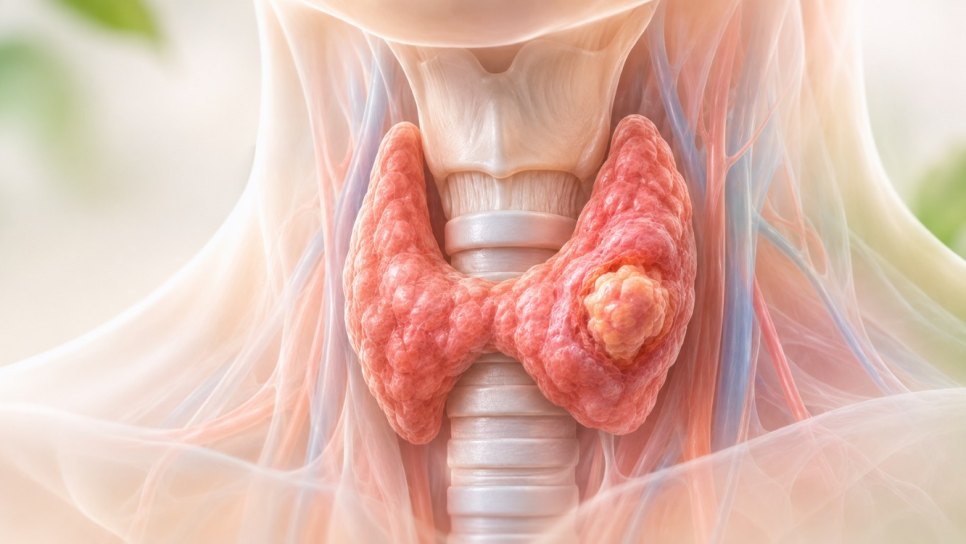
Medullary thyroid cancer is a neuroendocrine cancer that develops from the parafollicular C cells of the thyroid, which produce calcitonin. Papillary cancer arises from the follicular cells, which produce thyroid hormone. Because the cell of origin differs, the marker used in follow-up, the treatment approach and the genetic evaluation also differ.
| Medullary thyroid cancer | Papillary thyroid cancer | |
|---|---|---|
| Cell of origin | Parafollicular C cell | Follicular cell |
| Staining on pathology | Calcitonin, chromogranin, CEA positive; thyroglobulin negative | Arises from the thyroglobulin-producing follicular cell |
| Blood test in follow-up | Calcitonin and CEA | Thyroglobulin |
| Radioactive iodine | Mentioned in the guideline only for tumors that mix medullary and follicular components | An option used in papillary cancer follow-up |
The medullary column is based on the 2015 ATA guideline and the NCI summary. The papillary column is general knowledge; this article does not cover treatment or survival details of papillary cancer.
Figure 1 · From origin to follow-up
The cell of origin determines the marker and the follow-up
How is the diagnosis made?
In people with a thyroid nodule in whom medullary cancer is found on biopsy or on pathology after surgery, the guideline recommends a physical examination, measurement of serum calcitonin and CEA, and germline RET testing (Grade B).
- Biopsy: nodules of 1 cm and larger are evaluated by fine-needle biopsy according to ultrasound features; if the result is inconclusive or suspicious, calcitonin measurement in the washout fluid and immunohistochemistry are considered.
- Immunohistochemistry: tumors suggestive of medullary cancer are stained for calcitonin, chromogranin and CEA; thyroglobulin should be negative.
- Falsely high or low calcitonin: calcitonin can be falsely high or low in diseases other than medullary cancer; values that do not fit the clinical picture are interpreted with care.
What do calcitonin and CEA do in follow-up?
Calcitonin is a hormone made by C cells, and its blood level is usually elevated in medullary cancer. The guideline recommends measuring basal calcitonin and CEA together (Grade B). In follow-up after surgery, the course of these two values over time gives information about remaining or returning disease.
| Question | Finding |
|---|---|
| Why both together? | In advanced disease, CEA markedly higher than calcitonin, or both normal or low, suggests poorly differentiated disease |
| Age and sex | Calcitonin is higher in children under 3 and in males |
| Biochemical cure | This term is used when basal calcitonin is normal after an attempt at complete clearance of the neck lymph nodes; in one series 10-year survival was 97.7%, and about 3% had a biochemical recurrence within 7.5 years |
| Rising value | After one-sided surgery, a progressive rise of basal calcitonin above 150 pg/mL prompts additional imaging |
Source: 2015 ATA guideline. The measurement interval and what a value means at a given threshold vary by person; no numeric follow-up schedule is given in this article.
Can it be hereditary?
Yes. Hereditary disease is found in 1–7% of medullary cancers presumed to be sporadic, which is why the guideline recommends germline RET testing in all cases, including those presumed to be sporadic (Grade B). Of MEN2 cases, 95% are MEN2A; MEN2B makes up about 5% of hereditary medullary cancer. In hereditary disease, pheochromocytoma (a tumor of the adrenal gland) and hyperparathyroidism (overactive parathyroid gland) are also looked for.
| ATA risk group | RET change |
|---|---|
| ATA-HST (highest) | MEN2B and RET M918T |
| ATA-H (high) | RET C634 and A883F |
| ATA-MOD (moderate) | Other RET changes |
The timing of surgery by risk group and screening for pheochromocytoma are not described in this article; the genetics and endocrine surgery team decides these.
Which imaging is done after diagnosis?
The guideline recommends neck ultrasound in all medullary cancers (Grade C). If there is extensive neck disease, a sign of metastasis or a high calcitonin, additional imaging comes into play.
Figure 2 · Imaging at diagnosis
Ultrasound for everyone, extra tests in selected cases
The guideline does not recommend FDG-PET/CT or F-DOPA-PET/CT to detect distant metastases (Grade E).
How is treatment planned?
| Situation | Guideline and NCI summary |
|---|---|
| No lymph nodes or distant spread on ultrasound | Total thyroidectomy with central (level VI) neck dissection (Grade B) |
| Disease confined to the neck | Total thyroidectomy, central dissection and clearance of the involved lateral neck regions (Grade C) |
| After one-sided surgery | Completion thyroidectomy if there is a RET mutation, a high calcitonin after surgery or residual disease on imaging (Grade B) |
| Extensive regional or metastatic disease | Less extensive neck surgery may be appropriate; external beam radiotherapy and systemic therapy are considered (Grade C) |
| Advanced disease with a RET change | Pralsetinib received FDA approval in December 2020 for adults with advanced or metastatic medullary cancer carrying a RET change; 147 patients were in this group in the ARROW study |
Which option suits whom varies with the extent of disease, the calcitonin level and the genetic result; the decision is made by the multidisciplinary team together with the patient.
Common misunderstandings
- "Medullary cancer is a worse version of papillary cancer." No. They are two different diseases arising from two different cells. The NCI describes the outlook of medullary cancer as "intermediate"; a person's course depends on stage and on findings such as calcitonin.
- "The follow-up tests used in papillary cancer are the same in medullary cancer." No. The medullary tumor is thyroglobulin negative; calcitonin and CEA are used in follow-up.
- "If calcitonin is high, it is definitely medullary cancer." No. Calcitonin can be falsely high in other diseases; the diagnosis is made by pathology.
- "This article interprets my result." No. Your report and calcitonin value are interpreted only by the doctor who follows you, together with stage and other findings.
Where do you find these terms in your report?
- "Medullary carcinoma" or "medullary thyroid cancer": the part of the pathology report where the histologic type is written.
- Calcitonin, chromogranin, CEA, thyroglobulin: written as positive or negative in the immunohistochemistry results.
- "Calcitonin" and "CEA" in blood results: read together with the unit (such as pg/mL) and the reference range.
- "pN" and stage: lymph node findings and the overall stage.
- "RET" and the genetic report: the germline test result; decisive for hereditary disease.
What can you ask your doctor?
- How often will my calcitonin and CEA be measured, and what change would lead you to order additional imaging?
- Has germline RET testing been done, and what does the result mean for people in my family?
- Is an evaluation for pheochromocytoma and the parathyroid glands needed?
- What follow-up plan is recommended after surgery at my stage?
DROZDOGAN Academy Assessment
Medullary thyroid cancer is uncommon among thyroid cancers, but its follow-up is clearly different. From a physician's perspective, this part summarizes how far calcitonin follow-up and the contrast with papillary cancer can be relied on.
⚡ Why it matters
The follow-up logic familiar from papillary cancer cannot be carried over directly to medullary cancer. The marker, the genetic evaluation and the treatment options differ; knowing this helps patients and relatives ask the right questions.
✅ Strengths
There are measurable markers such as calcitonin and CEA, and the guideline gives clear recommendations and evidence grades for surgery, imaging and RET testing. A normal basal calcitonin is linked to high survival in a selected series.
⚠️ Limits
Calcitonin can be falsely high or low in other diseases. The survival figure comes from one specific series and cannot be applied to everyone. Numeric thresholds for the measurement interval and the speed of change are not given here because they were not verified.
🩺 Practical meaning for patient and doctor
Keep your calcitonin and CEA results together with their units and dates, and discuss the change over time with the doctor who follows you. Also treat the RET result as information that concerns family members.
❓ Open questions
The timing of measurements after surgery, the place of the speed of change in follow-up, and preventive surgery by risk group are not covered here; your doctor's plan, based on current guidelines, is what counts.
Bottom line: Medullary thyroid cancer develops from C cells and is followed through calcitonin and CEA; it differs from papillary cancer in origin, marker and genetic evaluation. This article is not medical advice; interpret your results only together with the doctor who follows you.
Frequently asked questions
- What is medullary thyroid cancer?
- A neuroendocrine cancer that develops from the parafollicular C cells of the thyroid, which produce calcitonin. It makes up 1–2% of thyroid cancers in the US.
- Why is calcitonin followed?
- Medullary cancer cells produce calcitonin, so its blood level gives information about whether disease remains or has returned. The guideline recommends measuring calcitonin and CEA together.
- Is medullary cancer worse than papillary?
- They are two separate diseases, and this article gives no comparative survival figures between them. The NCI describes the outlook of medullary cancer as intermediate; a person's course depends on stage and findings such as calcitonin.
- Why is genetic testing requested?
- Hereditary disease is found in 1–7% of cases presumed to be sporadic. The guideline therefore recommends germline RET testing in all cases.
- Is radioactive iodine used in medullary cancer?
- In the ATA guideline, radioactive iodine is mentioned only for tumors mixing medullary and follicular components; it is not a prominent treatment for medullary cancer itself.
- If calcitonin is high, is it definitely medullary cancer?
- No. Calcitonin can be falsely high in other diseases; the diagnosis is made together with pathology and the clinical picture.
Glossary
- Medullary thyroid cancer
- A thyroid cancer that develops from parafollicular C cells.
- Parafollicular (C) cell
- The cell in the thyroid that produces calcitonin.
- Calcitonin
- A hormone made by C cells; the blood marker of medullary cancer.
- CEA
- The second blood marker measured together with calcitonin.
- Thyroglobulin
- A protein made by follicular cells; it should not stain in medullary cancer.
- RET
- A gene that can carry a change in hereditary medullary cancer.
- MEN2
- A hereditary syndrome in which tumors can occur in other glands along with medullary cancer; it has MEN2A and MEN2B types.
- Biochemical cure
- A normal basal calcitonin after surgery.
- Central neck dissection
- Surgical removal of the lymph nodes of the central region around the thyroid.
Verified: the recommendations in the accessible parts of the 2015 ATA medullary thyroid cancer guideline (RET testing, calcitonin and CEA, imaging, extent of surgery, risk groups) and the origin, risk factor and pralsetinib information in the NCI summary. Only cited: part of an openly accessible copy of the guideline was read; the post-operative follow-up sections were not in that copy. The papillary cancer column is general knowledge. Not written because not verified: the timing of calcitonin and CEA measurements after surgery and the follow-up interval; calcitonin doubling-time thresholds; the timing of preventive thyroidectomy by risk group; the pheochromocytoma screening protocol; TSH suppression and the thyroid hormone target; treatment and survival details of papillary cancer; frequency in Türkiye; individual survival; overlap with drozdogan.com (not checked across the site). This article is not medical advice; a diagnosis cannot be made or a treatment decision taken from this information.
Who is this article for? Patients who want to understand their report and calcitonin follow-up, their relatives and health professionals. Decisions about your own situation are made only by the doctors who follow you.
References
- Wells SA Jr et al. Revised American Thyroid Association guidelines for the management of medullary thyroid carcinoma. Thyroid 2015;25:567–610 (PMID 25810047). pmc.ncbi.nlm.nih.gov
- National Cancer Institute (NCI). Thyroid cancer treatment (PDQ), health professional version. cancer.gov
Was this article helpful?
Your feedback helps us improve our content.