Neutropenic Fever in Chemotherapy: What Is It, and What Temperature Means Go to the ER?
In this article
Neutropenic Fever in Chemotherapy: What Is It, and What Temperature Means Go to the ER?
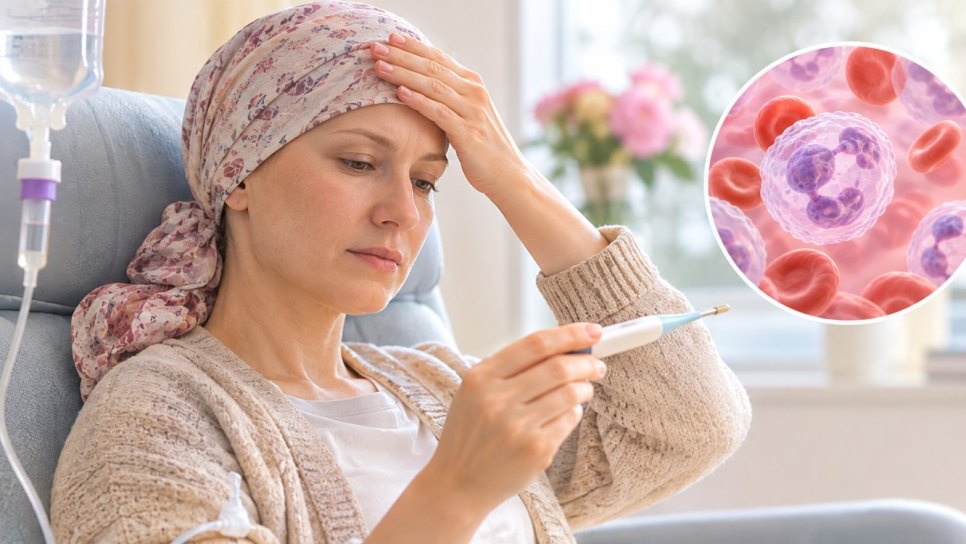
During chemotherapy, a fever is not something to wait out as "just a chill." Chemotherapy can lower neutrophils, the white blood cells that protect against infection, and during this period a fever is often the only sign of an infection. This article is general information: if you have a fever, do not wait to read it; call your oncology team or the emergency number you were given right away.
- What is neutropenic fever? A fever that appears while the neutrophil count is low; it is treated as an infection emergency.
- Which fever means the ER? At 38.0 °C (100.4 °F) or above, call your oncology team or emergency number right away; do not wait for the reading to reach 38.3 °C.
- What if there is no fever? Signs of infection such as shaking chills, cough or burning urination also call for a call; in severe neutropenia there may be no fever, or body temperature may drop.
- Before you call: do not take acetaminophen or aspirin without asking your health care team.
- In the ER: blood cultures are drawn, and the first antibiotic dose should be given within 1 hour of triage.
In brief, what does it tell us?
Neutropenic fever is a fever that appears after chemotherapy while the neutrophil count is low. Neutrophils are the cells that protect against infection; when their numbers fall, even a small infection can worsen quickly. That is why a fever during chemotherapy is handled not as something to watch and wait on, but as an emergency to call about right away.
| Term | Definition |
|---|---|
| Neutropenia | IDSA 2010: an absolute neutrophil count below 500 cells/mm³, or one expected to fall to that level within 48 hours. The ASCO/IDSA 2018 document writes neutropenia as below 1,000, severe neutropenia as below 500 and profound neutropenia as below 100 |
| Fever (diagnostic criterion) | A single oral temperature of 38.3 °C (101 °F), or 38.0 °C (100.4 °F) sustained over 1 hour; armpit and rectal readings are discouraged |
| Patient's threshold to act | CDC: call your doctor right away at 38 °C (100.4 °F) or above |
| Profound neutropenia | Neutrophil count below 100; confirming this level requires a manual reading of the blood smear |
Guideline definitions are meant for doctors making a diagnosis and are not hard-and-fast rules; the temperature limit and emergency number your oncology team gave you are the ones that apply to you.
Figure 1 · From chemotherapy to the ER
Low neutrophils, a silent infection and a fast response
Which fever means going to the ER?
The CDC says that during chemotherapy a temperature of 38 °C (100.4 °F) or higher means calling your doctor right away and treating it as a medical emergency. It also advises checking your temperature whenever you feel warm, flushed, chilled or unwell. The 38.3 °C criterion used for diagnosis is for doctors defining fever; at home you do not need to wait for that value.
Figure 2 · First steps when a fever appears
Measure, call, ask before taking a fever reducer, say so in the ER
Emergency services and referral routes vary by country and by center; the emergency phone number and instructions given by the center where you receive chemotherapy are what count.
Warning signs to call about even without a fever
In people with neutropenia, infection gives few signs; in severe neutropenia an infection can occur without fever, or body temperature can drop. So even if your temperature is normal, tell your health care team about the signs below.
- Shaking chills: violent shivering, or feeling feverish and flushed.
- Breathing: cough, sore throat, shortness of breath.
- Urine: burning or pain when passing urine, new lower back pain, blood in the urine.
- Digestion: worsening diarrhea or a change in stool odor.
- Skin and catheter site: a new rash, redness or swelling; redness or soreness at a catheter, tube or wound site.
- Mouth: soreness or swelling in the mouth or throat, ulcers or white patches.
When is the risk highest?
According to the CDC, the white blood cell count usually falls to its lowest level 7–12 days after you finish each chemotherapy dose and can last about a week. This is when the risk of infection is highest; you can ask your doctor about the timing for your own regimen.
What happens in the ER?
| Step | Guideline information |
|---|---|
| Rapid assessment | For people presenting with fever within 6 weeks of chemotherapy, assessment should take place within 15 minutes of triage (ASCO/IDSA 2018) |
| Blood tests | Complete blood count with differential, creatinine, urea, electrolytes, liver enzymes and bilirubin (IDSA 2010) |
| Cultures | At least 2 sets of blood cultures; from each lumen of a catheter if present and from a vein; cultures from other sites if there are symptoms, and a chest X-ray if there are breathing symptoms (IDSA 2010) |
| First antibiotic | ASCO/IDSA 2018: first dose within 1 hour of triage. IDSA 2010: urgently (within 2 hours) in every patient with fever and neutropenia |
| Treatment | Broad-spectrum intravenous antibiotics given quickly; more specific treatment if a source is found (OncoLink) |
The two guideline timeframes (2 hours and 1 hour) belong to different years and purposes; the shared message is that the antibiotic should not be delayed.
Can it be managed at home or as an outpatient?
Not everyone is managed this way. The ASCO/IDSA 2018 guideline starts with clinical assessment and then uses risk tools such as MASCC; a MASCC score of 21 or above counts as low risk. Outpatient management is considered only when safe conditions are met and the doctor agrees.
| Question | Finding |
|---|---|
| Fitness for outpatient care | Living within 1 hour or 30 miles (48 km) of the center; a family member, telephone and transport available 24 hours a day at home; ability to attend frequent visits; the doctor's agreement |
| Observation | At least 4 hours before discharge; then frequent assessment for at least 3 days |
| Admission suggested | People with acute leukemia induction or stem cell transplant; those colonized with certain resistant germs; those with a clear infection site or signs of severe sepsis |
| Re-evaluation | If fever does not settle after 2–3 days, returns after settling, new signs of infection appear, or oral medicines cannot be taken |
Source: ASCO/IDSA 2018 update (document accessed). Practice in Türkiye may vary from center to center.
Common misunderstandings
- "I can wait until the fever reaches 38.3 °C." No. 38.3 °C is the doctors' diagnostic criterion. During chemotherapy, for 38.0 °C (100.4 °F) and above the CDC says to call right away.
- "If I have no fever, I have no infection." No. In a person with neutropenia, infection gives few signs; shaking chills, cough or burning urination also call for a call even without fever.
- "Let me take a fever reducer first and see." No. Do not take acetaminophen or aspirin without asking your health care team; an infection may continue even if the fever comes down.
- "This article assesses my situation." No. If you have a fever, stop reading and call your team; the decision belongs only to the doctors who follow you.
Where do you find these terms in your records?
- "ANC" or "absolute neutrophil count": the number of neutrophils in the blood count result.
- The grade of "neutropenia": an assessment of how low the count is.
- Chemotherapy dates and cycle day: to understand when the counts may be lowest.
- Catheter or port information: a site that is watched separately for infection.
- Emergency phone number: written in the instructions your treatment center gave you.
What can you ask your doctor?
- What is my temperature limit, and whom should I call, at which number, at night or on a weekend?
- On my regimen, on which days are my neutrophils lowest?
- What steps should I follow before using a fever reducer?
- If I have to go to the ER, what should I bring and what should I tell the staff?
DROZDOGAN Academy Assessment
Neutropenic fever is one of the situations in which lost time costs the most during chemotherapy. From a physician's perspective, this part summarizes how guideline definitions are turned into a rule for the patient.
⚡ Why it matters
The fever definition in guidelines and the patient's threshold to act are not the same number. A patient can lose time waiting for 38.3 °C, yet the goal is to have the antibiotic given within hours.
✅ Strengths
Both guidelines give concrete numbers for the definition of fever and neutropenia, tests, antibiotic timing and outpatient criteria. The CDC and patient education sources give the same message: a fever during chemotherapy is an emergency.
⚠️ Limits
The guidelines do not treat their own definitions as hard rules. The definition of neutropenia differs between guidelines. Country- and center-specific emergency arrangements, the home measuring method and drug doses are not covered in this article.
🩺 Practical meaning for patient and doctor
The doctor should give the patient in advance a written temperature limit, an emergency phone number and which route to take when. The patient should make measuring temperature and reporting a fever at once a habit.
❓ Open questions
Which regimens carry a higher risk, prevention with growth factors and the best way to measure temperature at home are not covered in this article; these should be discussed with your doctor.
Bottom line: During chemotherapy, a fever of 38.0 °C (100.4 °F) or above is an emergency to call about right away because of low neutrophils; signs of infection are also taken seriously without a fever. This article is not medical advice; if you have a fever, call your oncology team or emergency number without delay.
Frequently asked questions
- What is neutropenic fever?
- A fever that appears after chemotherapy while the neutrophil count is low. It is treated as an emergency because signs of infection can be faint.
- At what fever should I go to the ER during chemotherapy?
- The CDC says to call your doctor right away at 38 °C (100.4 °F) or above. The temperature limit and emergency number your team gave you are what apply; learn them in advance.
- Can I take medicine to bring the fever down?
- OncoLink says not to take acetaminophen or aspirin without asking your health care team first. Call your team first.
- What should I do if I have no fever but have chills?
- Shaking chills, cough, burning urination, worsening diarrhea or redness at a catheter site are also signs of infection that should be reported to your health care team.
- How quickly are antibiotics given in the ER?
- ASCO/IDSA 2018 states the first dose within 1 hour of triage; IDSA 2010 states urgently, within 2 hours.
- Is every neutropenic fever managed in the hospital?
- No. Outpatient management can be considered in selected low-risk patients, but this decision belongs to the doctor and requires safe conditions.
Glossary
- Neutrophil
- A type of white blood cell that helps protect against infection.
- Neutropenia
- A low neutrophil count.
- Neutropenic fever
- A fever that appears while the neutrophil count is low.
- Absolute neutrophil count (ANC)
- The actual number of neutrophils in a blood count.
- Nadir
- The period after chemotherapy when blood cell counts are lowest.
- Triage
- Setting the order of urgency of patients in the emergency department.
- Blood culture
- A sample that looks for germs in the blood.
- MASCC score
- A scale that classifies risk in neutropenic fever; 21 and above counts as low risk.
- Sepsis
- A severe body response to infection that can affect the organs.
Verified: the definitions of fever and neutropenia, risk classification, initial tests and antibiotic timing in the IDSA 2010 guideline; the timeframes and eligibility criteria in the ASCO/IDSA 2018 outpatient document (via the document accessed); the CDC's 38 °C threshold and 7–12 day information; OncoLink's symptom list and acetaminophen warning. Only cited: the full text of the guidelines was not read, only the documents and summaries accessed; in the OncoLink text the home threshold appears both as "100.4 or greater" and "above 100.4," and here the CDC's "38 °C and above" was used. Not written because not verified: emergency referral arrangements in Türkiye; which chemotherapy regimens carry a high risk; prevention with growth factors; thresholds in children; whether to measure temperature by mouth or armpit at home; antibiotic regimens and doses; individual risk; overlap with drozdogan.com (not checked across the site). This article is not medical advice; a diagnosis cannot be made or a treatment decision taken from this information.
Who is this article for? People receiving chemotherapy, their relatives and health professionals. Decisions about your own situation are made only by the doctors who follow you.
References
- Freifeld AG et al. Clinical practice guideline for the use of antimicrobial agents in neutropenic patients with cancer: 2010 update by the IDSA. Clin Infect Dis 2011;52:e56–e93. academic.oup.com
- Taplitz RA et al. Outpatient management of fever and neutropenia in adults treated for malignancy: ASCO/IDSA clinical practice guideline update, 2018. infectiousdiseases.med.wayne.edu
- CDC. Preventing infections in cancer patients. cdc.gov
- OncoLink. Neutropenic fever. oncolink.org
Was this article helpful?
Your feedback helps us improve our content.