
Microplastics and Nanoplastics Are Everywhere: How Do They Affect Human Health?

In this article
Evidence is emerging that tiny plastic particles accumulate in organs and tissues throughout the body. We urgently need a deeper understanding of their effects on human health.
Microplastics are plastic particles 5 millimeters or less in diameter. Widespread in the environment, they may come from cosmetics or processes such as washing synthetic clothing. They can enter the body through ingestion or inhalation and may have harmful health effects.
About the Article Image: This shark sculpture installation expresses the damage we cause to nature in stark, direct terms. Art is not only about displaying beauty; this work also successfully uses political expression to address an important problem. It strikingly illustrates how human activity pollutes the world's waters and the creatures living in them.
6 Billion Tonnes of Plastic
The world is overflowing with 6 billion tonnes of plastic. Plastic waste totaled 353 million tonnes in 2019 and is projected to triple to more than a billion tonnes by 2060.
Plastics contain more than 10,000 chemicals, including carcinogens and endocrine disruptors. They enter the body as microplastics (less than 5 mm in diameter) and nanoplastics (less than 1 μm in diameter).

Microplastics and nanoplastics (MNPs) may be deliberately manufactured, such as microbeads in cosmetics and personal care products, or unintentionally released as larger products break down, including during synthetic clothing washing or tire wear. They occur throughout the planet—in oceans, air and the food supply.
Entering the Body Through Ingestion or Inhalation
MNPs enter mainly through ingestion or inhalation. People may swallow them in food or drinks stored or heated in plastic containers that release particles, or through toothpaste containing MNPs. One study found high infant exposure through formula prepared in propylene feeding bottles.
They Can Reach Almost Any Tissue
Biological effects have been studied for decades, mainly in laboratory rodents and human cells. Rodent studies show harmful effects on organs such as the gut, lungs and liver, as well as reproductive and nervous systems. More recently, MNPs have been found in human blood, lungs, placenta, breast milk and other tissues and organs.
Associations with Disease
Human health effects are only beginning to be documented. A recent report identified a potential link between MNPs in blood vessels and cardiovascular disease . Plastic was detected in surgically removed carotid atherosclerotic plaques from approximately half the cohort: polyethylene in 150 samples and polyvinyl chloride in 31. Researchers used electron microscopy to identify sharp-edged particles as MNPs. Plaque accumulation was strongly associated with subsequent cardiovascular disease. Over 34 months, the risk of nonfatal myocardial infarction, nonfatal stroke or death from any cause was 4.5 times higher in people with plaque MNPs than in those without.
Below is a mind map of microplastics' effects on human health:
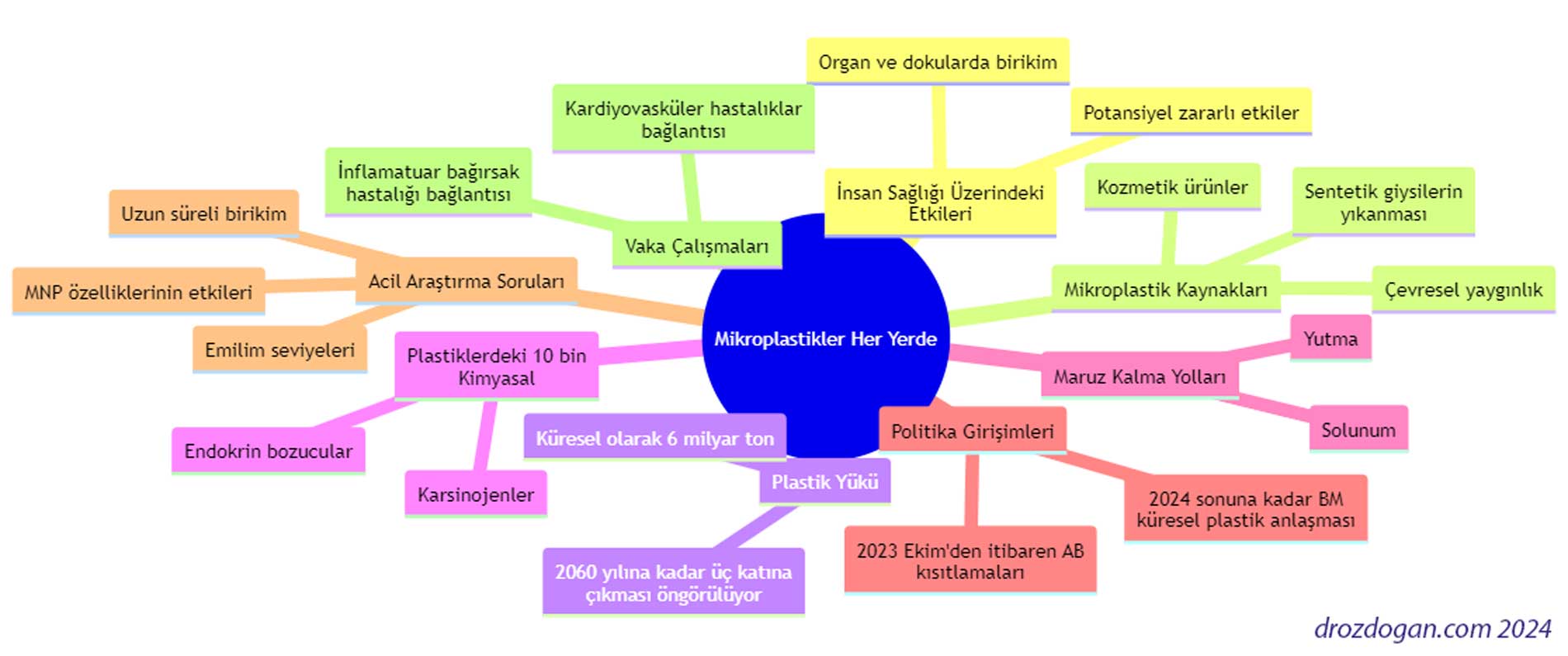
Another study examined a possible link between microplastics and inflammatory bowel disease . Researchers detected 15 types in human stool. Concentrations were higher in people with inflammatory bowel disease than healthy people and correlated with disease severity.
Mechanistic Studies Are Needed to Establish Causality
These studies do not establish a causal link between MNPs and disease, but underline the need for faster research. Urgent questions include how much is absorbed through ingestion, inhalation or skin; how much accumulates in different tissues over a lifetime; and how chemical composition, size and shape affect tissues. Mechanistic studies are also needed to determine how harm might occur, through systemic effects mediated by the immune system or microbiome , or direct cytotoxic effects. Research must also explore how environmental, social and economic factors influence exposure and health outcomes.
The Future of Microplastic Pollution
As the plastic burden becomes increasingly unsustainable, international public health initiatives aim to manage production, design and disposal more responsibly. Since October 2023, the European Union has restricted intentionally added microplastics, with a goal of reducing microplastic pollution by 30% by 2030. More broadly, on March 2, 2022, the United Nations Environment Assembly adopted a resolution supported by 175 countries to develop a global plastics treaty, aiming for a draft by the end of 2024.
The health risks of microplastic exposure are only beginning to be understood. More detailed, conclusive evidence about accumulation and harmful human effects will encourage the development and adoption of policies to reduce plastic's global impact and improve public and planetary health.
Sources
2. Kwon, D. Nature https://www.nature.com/articles/d41586-023-00975-5 (2023).
3. Jones, N. Nature https://www.nature.com/articles/d41586-024-00805-2 (2023).
4. Li, D. et al. Nat. Food 1, 746–754 (2020).
5. Liu, W. et al. Front. Public Health 11, 1103289 (2023).
6. Landrigan, P. J. Ann. Glob. Health 89, 23 (2023).
7. Marfella, R. et al. N. Engl. J. Med. 390, 900–910 (2024).
8. Yan, Z. et al. Environ. Sci. Technol. 56, 414–421 (2022).
9. UN Environment Programme. https://go.nature.com/3U5k867 (2 March 2022).
Was this article helpful?
Your feedback helps us improve our content.




Reader comments
Share your comment
Your name and comment are published only after administrator approval. Your email address is never shown to visitors.
Be the first to comment.