
Preoperative Radiotherapy for Rectal Cancer: Who Benefits, and Who Is Harmed?

In this article
Lower or Upper? How Does Tumor Height Affect Treatment Decisions in Rectal Cancer?
Rectal cancerdevelops in the final part of the large intestine. If it has spread into surrounding tissues—that is, if it is locally advanced —planning treatment becomes more complex. In such cases, both the timing of surgery and the need for additional treatment such as radiotherapy must be assessed carefully, because the most suitable approach may differ between patients.
Approximately 55–60% of rectal cancers are locally advanced at diagnosis.
In recent years, preoperative (neoadjuvant) radiotherapy and chemotherapy have become increasingly common to reduce local recurrence and improve long-term survival. However, new research suggests that this strategy does not benefit every patient equally and may even cause lasting losses in quality of life in some subgroups.
Published on May 7, 2025, in JAMA Network Open , a large study from Taiwan suggests that we should reconsider the benefit–harm balance of neoadjuvant radiotherapy, particularly according to tumor location within the rectum.
The study's main findings can be summarized as follows:
✅ Lower rectal cancer: A significant survival benefit with neoadjuvant radiotherapy.
⚠️ Middle rectal cancer: The survival difference was not statistically significant.
❌ Upper rectal cancer: Radiotherapy offered no survival benefit (HR: 1.54).

The Main Finding: Greater Benefit for Lower Tumors
Using the Taiwan National Cancer Registry, this retrospective cohort study included patients diagnosed and treated for locally advanced rectal cancer between 2014-2017: 4099 patients in total:
- 1436 patients received neoadjuvant radiotherapy + surgery
- 2663 patients underwent upfront surgery
Patients were followed for at least 3 years to compare important outcomes, including overall survival, local recurrence, and permanent stoma formation .
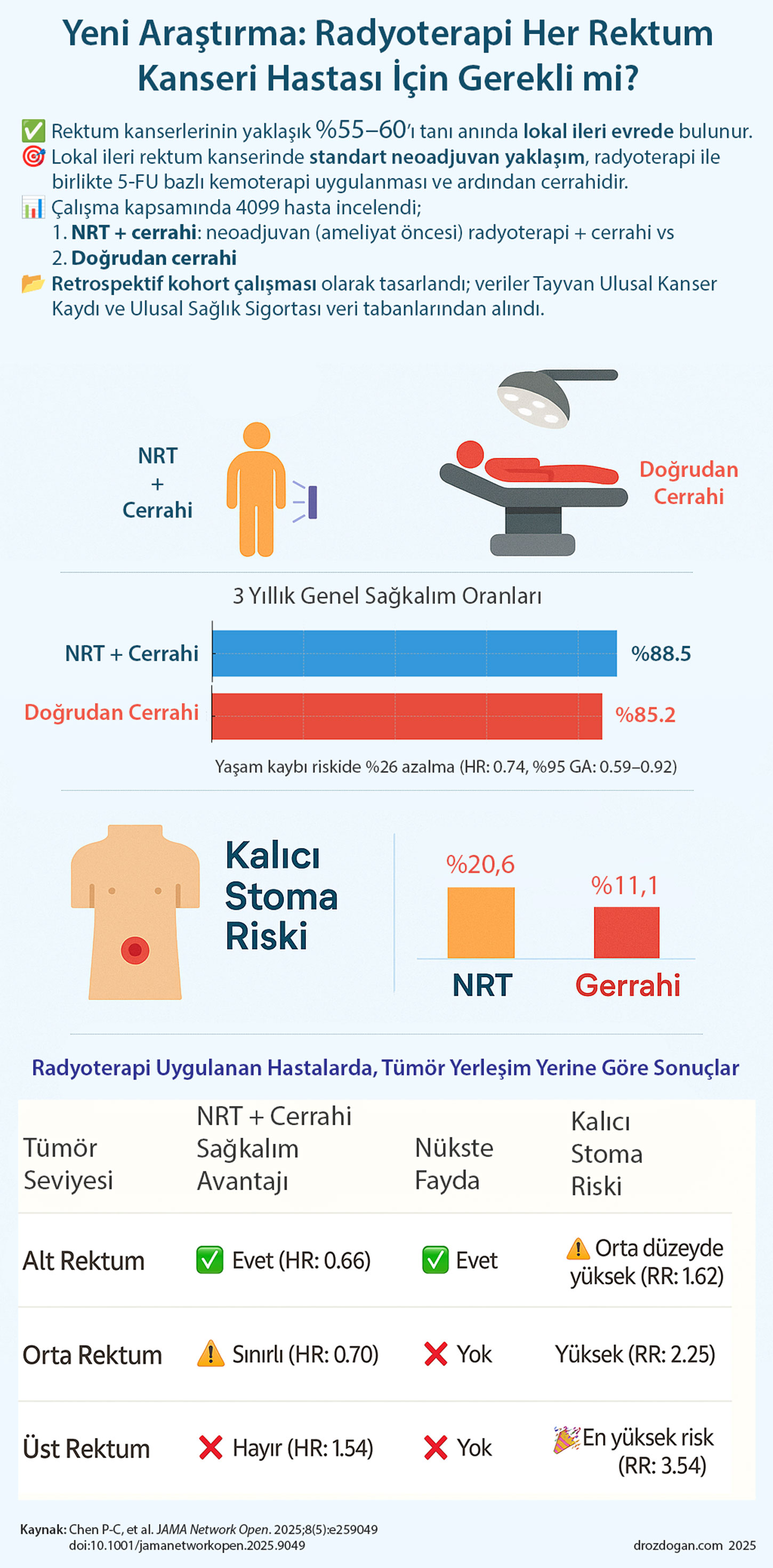

Key Study Findings
1. An Overall Survival Benefit:
- 3-year overall survival in the NRT + surgery group: 88.5%
- Surgery group: 85.2%
- HR: 0.74 (95% confidence interval: 0.59-0.92)
Overall, patients who received radiotherapy had a somewhat greater chance of living longer. This difference was statistically significant.
2. Similar Local Recurrence Rates:
- NRT group: 5.7%
- Surgery group: 6.6%
- The difference was not statistically significant.
3. A Higher Risk of Permanent Stoma:
- Permanent stoma rate in the NRT group: 20.6%
- Surgery group: 11.1%
- RR: 1.91 (CI: 1.62-2.25)
In other words, patients receiving radiotherapy had approximately 2 times the likelihood of a permanent stoma. This difference was significant and noteworthy.
How Should Clinical Practice Change?
This study suggests that the approach of giving radiotherapy to every patient with locally advanced rectal cancer should be reconsidered.
- Patients with lower rectal tumors benefit most from radiotherapy.
- For upper rectal tumors without lymph node involvement, surgery alone may be sufficient.
The NCCN guidelines in the US and ESMO guidelines in Europe also recommend careful planning of radiotherapy for upper rectal tumors.
Conclusion: Personalized Treatment Is Essential
A “one-size-fits-all” approach is no longer adequate in rectal cancer treatment.
- In the lower rectum: Radiotherapy may improve survival.
- Particularly in the upper rectum: Radiotherapy may cause permanent harm.
Treatment decisions should consider:
- The tumor's location within the rectum
- The risk of stoma formation
- The patient's expectations for quality of life.
🔬 Scientific evidence continues to guide us toward making this distinction more clearly.
Sources
Was this article helpful?
Your feedback helps us improve our content.




Reader comments
Share your comment
Your name and comment are published only after administrator approval. Your email address is never shown to visitors.
Be the first to comment.