
Simply Saying “Exercise” Is Not Enough: A Beneficial but Challenging Process for Cancer Patients

In this article
Physical Activity / Exercise for Cancer Patients
Exercise is an important recommended lifestyle component for cancer patients, but putting this recommendation into practice can be difficult for some. Evidence from programs for patients with breast cancer, in particular, shows the need for a more holistic approach. It is important to support patients in becoming motivated and adopting an active lifestyle.
Notable Studies on Exercise in Cancer Presented at ESMO 2024
1. The Effects of Exercise on Cancer
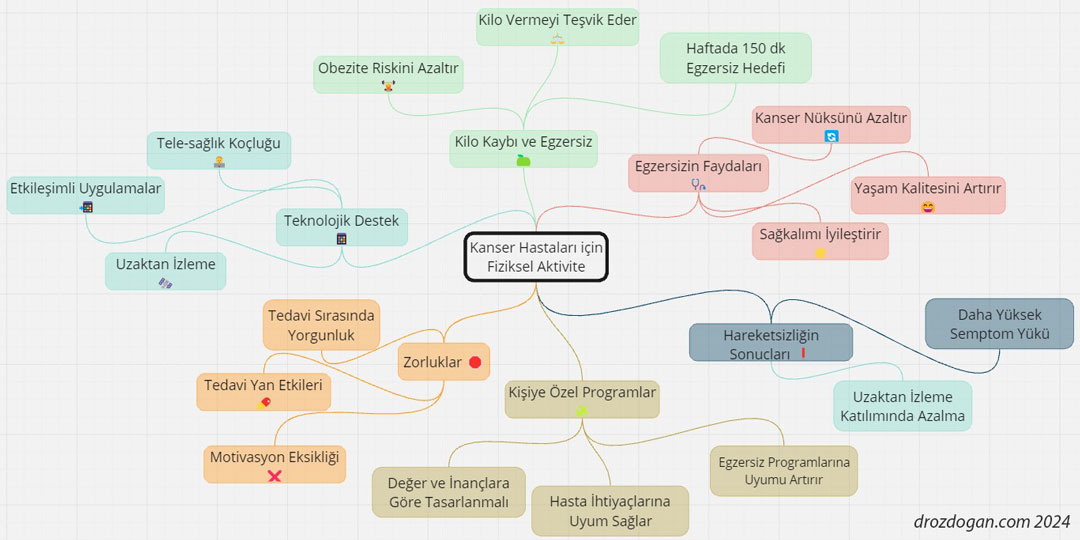
Doctors often recommend exercise for cancer prevention and treatment. It is also highly important for improving quality of life in people diagnosed with cancer. Observational studies in patients with breast cancer show that exercise has positive effects on disease outcomes .
Presented at the 2024 ESMO Congress, the OptiTrain Breast Cancer Trial was a 16-week intervention combining high-intensity interval training with resistance exercise or aerobic exercise. The study involved 240 women who began this exercise program at the start of chemotherapy. The program was found to have positive effects on the course of breast cancer. Overall survival and breast cancer-free survival outcomes were significant compared with the control group receiving standard care. In particular, the intervention combining high-intensity interval training and resistance exercise showed a marked effect on overall survival.
The Importance of Personalized Programs
Despite these benefits, programs must be designed to fit individuals' values and beliefs. This makes it easier for patients to follow the recommended exercise. In particular, patients with poorer disease outcomes and/or symptoms may struggle to continue exercising when they are fatigued or experiencing treatment side effects.
2. The Role of Technology
Certain technologies, such as videoconferencing or mobile phone applications, can facilitate patient engagement. They can be especially useful for people who live far from the hospital. A second study presented at the congress found that personalized exercise programs involving remote coaching and interactive learning significantly improved quality of life. The eMouvoir trial evaluated data from 684 patients with breast cancer over 12 months. On the 36-item short-form questionnaire, physical (p=0.03) and mental health (p=0.01) summary scores improved significantly at 4 months. However, this benefit did not persist for 1 year.
3. The Relationship Between Weight Loss and Exercise
A study of a telephone-based weight-loss intervention encouraging moderate or vigorous exercise examined 540 patients with early-stage breast cancer. In the Breast Cancer Weight Loss trial, patients receiving the weight-loss intervention significantly increased their time spent in moderate or vigorous exercise over 6 months compared with the control group. In the intervention group, the average increase per week was 40 minutes, while no such increase was observed in the control group.
Patients performing more than 150 minutes of moderate or vigorous exercise per week, compared with those performing less than 150 minutes, achieved greater weight loss. Longer follow-up is needed to assess whether increased exercise is associated with the risk of breast cancer recurrence and death. However, the weight-loss data are important, because obesity is known to increase recurrence risk. This gives patients strong motivation to become more active. Losing weight also offers a visible benefit that improves patients' quality of life.
4. The Harms of Physical Inactivity
Finally, not exercising was shown to be associated with a higher symptom burden (p<0.001). Lower adherence to remote patient monitoring (p<0.028) and less engagement with digital educational resources (p<0.001) were also common among inactive patients. This real-world study of 1,850 patients found that nearly 50% were physically inactive. These data emphasize the importance of conveying the benefits of exercise to patients through regular follow-up, monitoring and coaching.
Conclusion
The data presented at the congress show that simple recommendations may not be enough to help cancer patients adopt healthy lifestyle behaviors. A more structured approach is needed to help patients overcome common challenges. Healthcare professionals and everyone involved in cancer care should recognize exercise as an important aid in cancer prevention, symptom management and recovery. Programs should nevertheless be personalized according to individuals' personal needs, attitudes and goals. This will enable patients to motivate themselves and achieve lasting behavioral change. Finally, health technologies can offer important opportunities to identify individuals at risk of poor adherence and help them adopt an active lifestyle through timely interventions.
Sources
2. Franzoi MA, et al. Patient-reported health behaviors (PRHB) among 1850 patients enrolled in a remote patient monitoring (RPM) pathway. ESMO Congress 2024, Abstract 1836P
3. Rundqvist H, et al. Effects of a high-intensity exercise intervention on recurrence and survival: the OptiTrain breast cancer trial. ESMO Congress 2024, Abstract 232O
4. Vanlemmens L, et al. eMouvoir: Randomised phase 3 trial evaluating the impact of a personalized and remote physical activity (PA) for breast cancer survivors (BCS). Results on the Quality of Life (QoL). ESMO Congress 2024, LBA12
Was this article helpful?
Your feedback helps us improve our content.


Reader comments
Share your comment
Your name and comment are published only after administrator approval. Your email address is never shown to visitors.
Be the first to comment.