The Virus That Writes Backwards: Temin, Baltimore and Reverse Transcriptase, 1970
In this article
The Virus That Writes Backwards: Temin, Baltimore and Reverse Transcriptase, 1970
Yesterday we went from a family to a gene (Day 148): information travelled from a pedigree to DNA. Today information runs the other way. Can a virus living inside a cell write DNA from its own RNA? For decades this was an idea carried from one meeting hall to the next, often met with a smile. In the summer of 1970 two laboratories, a few weeks apart, brought an answer that fitted in the same pages.
From a chicken sarcoma to a hypothesis
We met the first link of this story on Day 97: the sarcoma Peyton Rous found in chickens in 1911, one that spread even through a filtrate. That virus, the Rous sarcoma virus (RSV), became Howard Temin's doctoral subject half a century later. According to the National Academy of Sciences memoir, Temin was a graduate student of Renato Dulbecco at Caltech in 1957, and the work he did in 1958-59 with Harry Rubin, a postdoctoral fellow in Dulbecco's laboratory, led him to the assumption that RSV had to integrate its genome into the host cell before producing virus. This "provirus" hypothesis guided Temin's research for about eleven years.
The idea was not readily accepted. According to the memoir, virologists were at first not persuaded by Temin's genetic and biochemical evidence. In Temin's own Citation Classic commentary, the proposal that RNA tumour viruses replicate through a DNA intermediate (1963-64) is described as conflicting with the central dogma, and as gaining general acceptance only after the 1970 papers. According to the Lasker Foundation's account he was openly laughed at in meetings. That last point comes from a single source; I convey only its flavour.
A talk in Houston, two papers in Nature
The Lasker Foundation's account sets the scene at the Tenth International Cancer Congress in Houston: his former colleague Harry Rubin had spoken against the provirus hypothesis; then Temin reported that RSV particles carry an enzyme that makes DNA from RNA. A meeting report in the 27 June 1970 issue of Nature also states that Temin suggested in Houston that RNA could serve as a template for DNA synthesis.
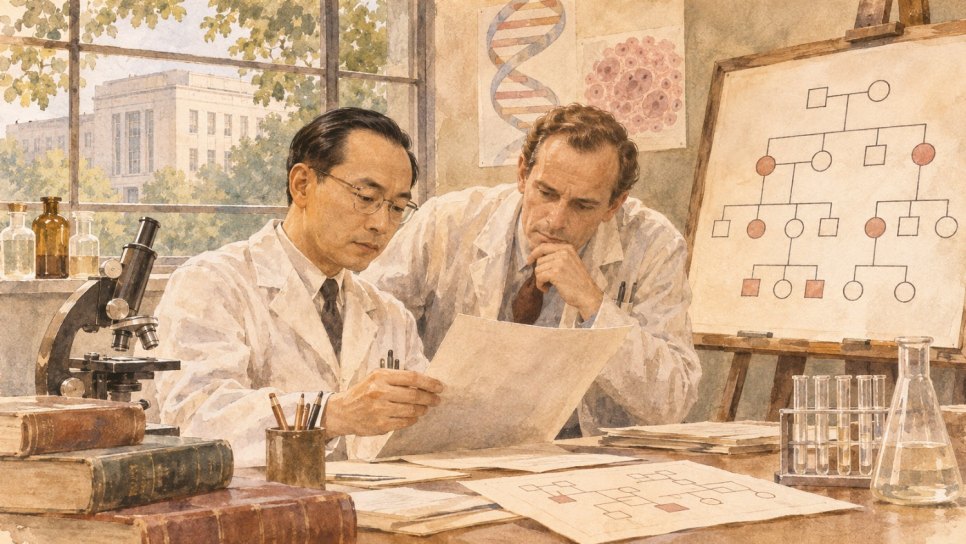
Temin's postdoctoral fellow Satoshi Mizutani was his partner in this work. According to the Lasker account, when detergent-treated virus particles were given ready-made building blocks, DNA formed, and an enzyme that destroys RNA blocked it; so the template was RNA. At MIT, David Baltimore, in the Lasker account's words a couple of weeks later, found the same activity in another RNA virus. Some sources give this virus as a mouse leukaemia virus; I could not read the text of Baltimore's paper, and its abstract says only "RNA tumour viruses".
The two papers appeared in the same issue. Baltimore's paper, titled "Viral RNA-dependent DNA polymerase", was published in volume 226 of Nature dated 27 June 1970 (pp. 1209-1211); according to the journal's page it had been received on 2 June 1970. Temin and Mizutani's paper, "RNA-dependent DNA polymerase in virions of Rous sarcoma virus", followed immediately (pp. 1211-1213); according to the memoir it was submitted to the journal on 15 June 1970. Even Baltimore's abstract says that "two independent groups" had found evidence of this enzyme.
Reverse transcriptase, retrovirus, provirus
Reverse transcriptase is an enzyme that synthesises DNA from an RNA template. The RNA viruses that carry such an enzyme formed the family later called retroviruses (Retroviridae). A retrovirus entering a cell uses the enzyme to make a DNA copy of its RNA genome; when this copy integrates into the host genome it becomes a "provirus". That is exactly what Temin proposed in 1959-64; what 1970 brought was that the proposal could now be proved with a working enzyme.
There is also the matter of the dogma. The "central dogma" is often read harshly, as saying information flows only from DNA to RNA to protein. Crick's 1958 statement said only that once information has passed into protein it cannot get out again; on RNA-to-DNA transfer he had chosen to "remain discreetly silent". In his article in Nature on 8 August 1970 (volume 227, pp. 561-563), Crick placed this transfer among the "special transfers": one that does not occur in most cells but may occur in special circumstances. So reverse transcriptase did not overturn the dogma; it corrected the popular, hardened reading of it. This is a quiet example of the "science correcting itself" motif: what was corrected was not an experiment but an interpretation.
An enzyme, a family, a prize
According to Temin's own account, the papers led to the term "retrovirus", to a theoretical framework for virus research and to a standard reagent in molecular biology. Temin received the 1974 Albert Lasker Basic Medical Research Award. The 1975 Nobel Prize in Physiology or Medicine, "for their discoveries concerning the interaction between tumour viruses and the genetic material of the cell", was shared equally between David Baltimore, Renato Dulbecco and Howard Martin Temin. Dulbecco had been Temin's mentor at Caltech; Baltimore had worked in association with him at the Salk Institute in 1965-68.
Reverse transcriptase later entered everyday life by two routes. In the early 1980s HTLV-I and HTLV-II were discovered and linked to leukaemia; in 1983 HIV was isolated. According to Britannica's summary, reverse transcriptase inhibitors were the first HIV treatments: nucleoside inhibitors such as AZT terminate the growing DNA chain, and non-nucleoside ones such as efavirenz bind the enzyme and change its shape. In the laboratory the enzyme is used to make complementary DNA (cDNA) from RNA; this cDNA can be amplified by PCR, and RT-PCR is used to measure messenger RNA quantitatively.
Costs and limits
The first limit is what the 1970 finding did not show. The two papers covered a chicken virus and a mouse virus (depending on the source); they did not prove a role for a retrovirus in human cancer. As on Day 97, balance is needed: most human cancers are not caused by retroviruses. Human retroviruses were recognised only in the 1980s; some were linked to cancer (the HTLVs), one to immune deficiency (HIV).
The second limit concerns fairness. Mizutani was the second author of the paper in which reverse transcriptase was reported together with Temin, and he was not among those honoured. Since a Nobel Prize can be shared by at most three people, a choice was made that put three names forward; I have not read an explanation of why Mizutani was left out. This is another variety of the series' "Nobel injustice" motif (Yamagiwa, Fibiger): here the issue is not that the prize was withheld, but whose name gets remembered.
The third is an irony in Temin's own life. According to the Linda Hall Library, Temin was a lifelong non-smoker who campaigned against smoking; in his Nobel address he named smoking the "single greatest cause of avoidable cancer". According to the National Academy of Sciences memoir he spoke against smoking at the Nobel ceremony. He lost his life on 9 February 1994, aged 59; the Linda Hall Library gives the cause as lung cancer, while the memoir says only "cancer". This is a poignant echo of the smoking story we followed on Day 125 (Doll, Hill) and Day 139 (the 1964 Surgeon General's report); nothing more than the sources set side by side.
What remained
- That information can flow from RNA to DNA
- The retrovirus family and the concept of the provirus
- The enzyme as a basic laboratory tool for cDNA and RT-PCR
- Targeting the enzyme in HIV treatment
What fell or weakened
- The hard reading of the central dogma as "there is no path from RNA to DNA"
- The general doubt about the provirus hypothesis
- The shortcut that "information flows one way"
From the provirus idea to the summer of 1970 and beyond: 1959-1994. The axis runs from 1955 to 1995. Green marks are dates on which several sources agree; amber marks show dates on which sources conflict (the date of the provirus hypothesis: 1959 or 1963-64); blue marks show dates resting on a single source. Dates known only by year are drawn mid-year. The four marks in the summer of 1970 lie very close together, a few weeks apart; the rows are therefore kept separate.
Reverse transcription in following a leukaemia
One present-day step of reverse transcription can also be shown from Turkey. Sercan and colleagues, from the Department of Medical Biology and Genetics of Dokuz Eylül University School of Medicine, described in a study published in December 2012 (Turkish Journal of Hematology; DOI 10.5152/tjh.2011.76) a low-cost, in-house method for monitoring BCR-ABL transcripts in chronic myeloid leukaemia. According to the abstract, few centres in Turkey could give a reliable RQ-PCR BCR-ABL result; the method could detect one BCR-ABL-positive cell among 10 to the power 5 cells. According to the text, cDNA was synthesised from total RNA with random primers and the quantitative PCR was run on that cDNA; that is, the step is reverse transcription. The article does not name the enzyme explicitly. BCR-ABL is the product of the fusion we saw in the Philadelphia chromosome on Day 137; this study is an attempt to make monitoring that fusion cheaper in Turkey with an in-house method. This is a single study; it does not represent general practice in Turkey.
From 1911 to today
What was verified and what remains uncertain
- Date of the provirus hypothesis: The National Academy of Sciences memoir writes that the 1958-59 work with Rubin led Temin to the assumption that RSV integrates its genome into the host; another biographical summary says 1959 (a page read from the address of the Nobel site's Temin biography). Temin's own Citation Classic commentary gives 1963-64, and the Linda Hall Library's article gives 1964. This is a conflict; probably a distinction between the "first idea" and the "DNA provirus" proposal, but the sources do not say so explicitly. Marked amber in the figure.
- Nature dates: The publication date, 27 June 1970, volume 226: Baltimore's paper's page, the memoir, the Lasker account and the meeting report in the same issue agree. The "received" dates are from single sources: for Baltimore 2 June (the journal's page), for Temin and Mizutani 15 June (the memoir). I could not reach the journal's own page for Temin and Mizutani's paper.
- Who was first? Britannica writes that the two announcements were independent, without giving an order. According to the Lasker account Baltimore's result came "a couple of weeks" after Temin's announcement in Houston; the dates of receipt by the journal favour Baltimore (2 June, 15 June). It depends on whether the yardstick is the congress talk or submission to the journal. I did not verify the exact date of Houston.
- Baltimore's virus: A history bibliography and the memoir speak of mouse viruses; the Nature abstract says only "RNA tumour viruses"; I did not read the paper's text.
- Mizutani: That he was a postdoctoral fellow and the experimental details (detergent, RNase) are from the Lasker account. I have not read an explanation of why he was left out of the Nobel; the "at most three people" rule is general knowledge.
- Spiegelman: The meeting report in the same issue of Nature writes that Spiegelman reported the product of polymerase reactions in tumour virus preparations to be DNA. I did not look into the details of his contribution; it does not appear in this article.
- Crick: The 1958 formulation and the 1970 article (8 August 1970, Nature 227:561-563) were read from the article itself; the words "reverse transcriptase" do not appear in that article.
- Nobel: The motivation and the three laureates are from the Nobel site; "mentor" and "worked in association" are from the Linda Hall Library (for Temin) and Baltimore's Nobel biography (Salk, 1965-68).
- Temin's passing: 9 February 1994, aged 59 (memoir, Linda Hall). The lung cancer cause is from Linda Hall; the memoir says only "cancer". That he never smoked is from a single source.
- The smoking speech: Linda Hall says "Nobel address", the memoir says "ceremony/banquet"; I settled for "Nobel ceremony" in the text.
- The Turkish study: The author list, institution and DOI are from the source; the journal name and the December 2012 date from the DOAJ record. I did not verify volume or pages. The article does not mention the words "reverse transcriptase".
- Yesterday's box: The Nature citations and date, Temin's provirus hypothesis and the 1975 Nobel promised in the "tomorrow" box of Day 148 were covered; Rous (Day 97) returned.
A Law, a Name: the "War on Cancer", 1971
Today the direction of an enzyme changed. Tomorrow the language of a nation changes: the National Cancer Act signed by President Nixon in 1971 is still remembered as the "War on Cancer". I will verify the scope of the law, the date it was signed and the role of Mary Lasker, and I will treat that historical name, in quotation marks, in a critical context.
Author's note: In this article I tried most of all to keep two things apart: who published first and who announced first. The sources do not put the two on the same scale, and neither did I. What I like in Temin's story is less a hypothesis turning into proof through an enzyme than how that hypothesis could be carried even while being laughed at; but since the details of that laughter come from a single source, I conveyed only its flavour.
Sources and Further Reading
- Temin HM, Mizutani S. RNA-dependent DNA polymerase in virions of Rous sarcoma virus. Nature 1970;226(5252):1211-1213 (citation verified; text not read).
- Baltimore D. Viral RNA-dependent DNA polymerase: RNA-dependent DNA polymerase in virions of RNA tumour viruses. Nature 1970;226(5252):1209-1211. doi:10.1038/2261209a0 (only the abstract was read).
- Temin HM. Citation Classic commentary on "RNA-dependent DNA polymerase in virions of Rous sarcoma virus." Current Contents 1977;(47), 21 November. garfield.library.upenn.edu (read with a summarising tool).
- National Academy of Sciences. Biographical Memoirs, volume 79 (2001): Howard M. Temin. nationalacademies.org (read with a summarising tool; author name not verified).
- Lasker Foundation. The backward enzyme. laskerfoundation.org (read with a summarising tool).
- Crick F. Central dogma of molecular biology. Nature 1970;227(5258):561-563 (read with a summarising tool).
- Our Virology Correspondent. Animal viruses: cells modified. Nature 1970;226:1201 (read with a summarising tool; meeting report).
- Nobel Prize. The Nobel Prize in Physiology or Medicine 1975: summary; Howard M. Temin and David Baltimore, biographical. nobelprize.org (read with a summarising tool).
- Britannica. Reverse transcriptase: discovery and impacts. britannica.com (read with a summarising tool).
- Linda Hall Library. Scientist of the Day: Howard Temin. lindahall.org (read with a summarising tool).
- Sercan HÖ, Öztürk I, Çalışkan C, Pehlivan M, Sercan Z. An in-house method for molecular monitoring of BCR-ABL. Turk J Hematol 2012. doi:10.5152/tjh.2011.76 (read with a summarising tool; volume and pages not verified).
- Mukherjee S. The Emperor of All Maladies: A Biography of Cancer. New York: Scribner; 2010 (general context; the relevant part was not reread for this article).
This article is Day 149 of the "365 Days of Cancer History" series and presents the discovery of reverse transcriptase as a historical reading. It is historical-popular content, not a diagnosis or treatment recommendation. For treatment decisions, consult your physician. The sources have been verified; details resting on a single secondary source, on an abstract only or on a text that could not be read are marked in the fact-check notes.
Was this article helpful?
Your feedback helps us improve our content.