A Syndrome That Began with a Question Mark: Li, Fraumeni and Four Families, 1969
In this article
A Syndrome That Began with a Question Mark: Li, Fraumeni and Four Families, 1969
Yesterday, on a ward, we asked whether a patient knows his own illness (Day 147). Today the question widens from one person to a family: in the same pedigree, across generations, why do cancers of unlike kinds appear? In 1969 two researchers asked it through four families, and they deliberately put a question mark in the title of their paper.
The records of a childhood disease
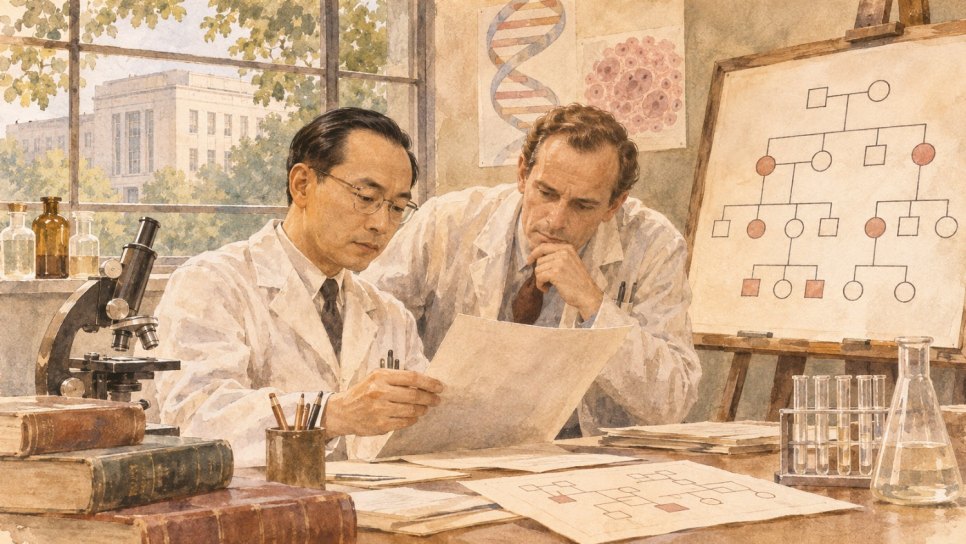
According to the account of the American Association for Cancer Research (AACR), what brought Frederick Li and Joseph Fraumeni together was a pattern noticed in records of rhabdomyosarcoma (a soft-tissue sarcoma that mostly affects children and adolescents). The scene in that account is this: two cousins living apart, both followed for rhabdomyosarcoma; the father of one had acute leukaemia, the mother of the other breast cancer; according to the account both were in their early twenties. Alone, this could have been a coincidence. According to the AACR account, when Fraumeni met Li he had been at the National Cancer Institute (NCI) for five years. In remarks Fraumeni made in 2008 at Li's retirement tribute, it is reported that Li noticed multiple cancer types in children and young adults in one family, and that a multicentre study of childhood cancers then under way made it possible to find other similar families. The cousins story does not appear in those remarks; it exists only in the AACR account (see the fact-check notes).
Two papers, one question mark
Li and Fraumeni first reported four families in the October 1969 issue of the Annals of Internal Medicine (volume 71, issue 4, pp. 747-752). The title of the paper was "Soft-tissue sarcomas, breast cancer, and other neoplasms. A familial syndrome?"; according to Fraumeni's account, it was Li who insisted on the question mark. A second paper appeared that year: the Journal of the National Cancer Institute, volume 43, issue 6, pp. 1365-1373 (one record gives 1 December 1969), titled "Rhabdomyosarcoma in children: epidemiologic study and identification of a familial cancer syndrome". According to Fraumeni, this title had no question mark.
The reception in the first years was suspicion. According to Fraumeni's account, genetics was then regarded as a fringe field, and familial cancers were thought to be specific to a single organ. The AACR account also writes that the work was met with scepticism because there was no biological marker. Other groups reported similar families too: in 1978 Lynch and colleagues reported a pedigree with hereditary sarcoma, breast cancer, brain tumour and leukaemia; in 1982 Pearson and colleagues described two families. I know these two reports only from their citations in the reference list of another paper; I did not read their texts.
Syndrome, family clustering, hypothesis
Saying "there is a lot of cancer in the family" does not define a syndrome: because cancer is a common disease, it clusters by chance in some families. Li and Fraumeni's proposal was more specific: a single predisposition, inherited in a family, bringing sarcoma, breast cancer and other tumours together. This was a hypothesis before it was evidence, like Boveri's chromosome hypothesis on Day 98. One of the steps that strengthened the hypothesis was the prospective follow-up of 1982: according to the AACR account, 16 new cancers were seen in the original four families. Then in 1988, in Cancer Research (volume 48, pp. 5358-5362, 15 September), a paper with seven authors reported 24 families (kindreds). According to its abstract, in these families 151 of the 923 blood relatives counted had cancer; 119 of those 151 (79 per cent) had fallen ill before age 45. Of the tumours, 50 were bone and soft-tissue sarcomas and 28 breast cancers; brain tumours (14), leukaemia (9) and adrenocortical carcinoma (4) were also in excess before age 45. Inheritance showed an autosomal dominant pattern. In this article the syndrome will be called Li-Fraumeni syndrome (LFS) for short. The same paper also writes that eight of the families had been reported before and that six people had a second cancer linked to radiotherapy.
From the family to the gene
There was still no marker. That changed in 1990. According to the AACR account, p53 had been identified in 1979 and was reclassified as a tumour suppressor in 1989. In the paper published in Science in 1990 (Malkin, Li, Strong, Fraumeni et al.), a germline p53 mutation was found in five Li-Fraumeni families, in all of those examined. The same year in Nature (volume 348, pp. 747-749), Srivastava and colleagues reported, in one Li-Fraumeni family, the same point mutation at codon 245 (aspartic acid in place of glycine) in the non-cancerous skin fibroblasts of four family members across two generations. My sources say nothing about the order or priority of the two groups, and I do not claim any.
What this meant was that a molecular answer to the 1969 question had been found: the families carried an inherited impairment in a tumour suppressor gene. That a single gene could lay the ground for so wide a spectrum of tumours was a biological explanation of a pattern that in 1969 had only been observed. We will return to the story of p53 itself and to the two-hit idea (Knudson, 1971) in the coming days.
Costs and limits
This knowledge has a cost: learning that a family carries the syndrome means giving a not-yet-ill person a probability. The information note for physicians of the Li-Fraumeni Syndrome Association gives the absolute, cumulative frequency of a first cancer as follows: for women 5-15 per cent by age 15, 40-50 per cent by 30, 75-90 per cent by 45, over 90 per cent by 60; for men, respectively, 15-25, 20-40, 40-60 and over 70 per cent. These ranges are the summary of a patient association; they contain no relative risk against the general population, and in people identified through family history the risk may look higher than in those found by chance. The same note says that to detect tumours early, whole-body MRI and brain MRI are recommended annually and abdominal ultrasound every three to four months in children, and that radiation-based tests are advised against "except when medically necessary"; for children it cites Kratz et al. (Clin Cancer Res 2017). The radiation caution is also consistent with the radiotherapy-linked second cancers in the 1988 paper. These are not this article's medical advice; decisions on surveillance and testing are taken with genetic counselling and a physician. Ethical questions such as testing in childhood and "the right not to know" also arise here; I draw this not from the sources but from the link I make to the truth-telling question of Day 147.
What remained
- The idea that many cancers of different kinds in a family can come from a single predisposition
- The value of family history as a diagnostic clue
- The link between a single gene (TP53) and a wide spectrum of tumours
- Cancer at a young age and the need for genetic counselling
What fell or weakened
- The assumption that "familial cancers are specific to one organ"
- The doubt that without a biological marker there is no syndrome
- Treating the cancers in a family as coincidence
From four families to 24, and from there to a gene: 1969-1990. The axis runs from 1965 to 1995. Green markers are dates on which several sources agree; blue markers show dates resting on a single source or only on a reference-list citation. In this article no dates conflict between sources, so no amber marker was used. Dates known only by year are drawn mid-year.
TP53 in a hundred patients
There is a verifiable link from Turkey. In a study published in the Turkish Journal of Oncology in 2020 (volume 35, issue 2), Özdemir and colleagues screened TP53 by next-generation sequencing and MLPA in 100 women who had tested negative for BRCA in 2016-2017 and been diagnosed with breast cancer before age 50. According to the abstract, a TP53 variant was found in 5 of the 100 patients (5 per cent); 4 (4 per cent) were pathogenic or likely pathogenic, and one was a variant of uncertain significance. The authors recommend TP53 testing for BRCA-negative breast cancer patients under 50, genetic counselling for carriers and multidisciplinary follow-up. The study is a sample of 100 patients and I read only its abstract, so it cannot be taken as an estimate of the frequency in Turkey. It is here to show that the line from a family to a syndrome and to a decision to test a gene is being worked on in Turkey too.
From 1969 to today
What was verified and what remains uncertain
- First paper: Annals of Internal Medicine, October 1969, volume 71, issue 4, pp. 747-752 (a dictionary of medical eponyms and a reference list; the text was not read). The figure "four families" appears in Fraumeni's 2008 remarks and the AACR account; the citation sources give no family count.
- Second paper: JNCI volume 43, issue 6, pp. 1365-1373 (one record dates it 1 December 1969); that the question mark was dropped comes from Fraumeni's account, not verified from the paper itself.
- The "648 children" figure: A figure from my memory; it was not found in the AACR account or the 1988 paper, so it was not used anywhere.
- The cousins story: It exists only in the AACR account; it does not appear in the text of Fraumeni's remarks. Single source.
- Li and Fraumeni meeting: The AACR account writes that Fraumeni had worked at the NCI for five years when he met Li; Fraumeni's remarks speak of a colleagueship of about 40 years. Neither gives an exact year.
- Lynch 1978 and Pearson 1982: Known only as citations from the reference list of a 1984 paper; their texts were not read.
- The 1988 paper: 24 families, 923 blood relatives, 151 with cancer (169 neoplasms), 79 per cent early, 50 sarcomas, 28 breast cancers; author list and citation from the source. There is no penetrance estimate in the abstract.
- p53 dates: 1979 and 1989 only in the AACR account (single source).
- The 1990 papers: Malkin et al. Science, five families (abstract); I did not verify month and page numbers. Srivastava et al. Nature 348:747-749, one family, codon 245 (abstract). The author list for Malkin looked truncated. Fraumeni's remarks describe this work as coming from "Friend and Malkin (MGH) and Louise Strong's families"; the AACR account says "Harvard and MD Anderson". Consistent, but the detail differs.
- Risk figures: From the Li-Fraumeni Syndrome Association's information note for physicians; a patient-association summary, not a peer-reviewed paper. No relative risk against the general population was given; the source has none.
- Surveillance recommendations: The same note; the table layout was garbled and I derived the pairing from the ages. The "Toronto protocol" is not mentioned in the note, so it was not named in the article.
- The Turkish study: Only the abstract was read; sample 100 women. Authors and date from the source.
- Yesterday's box: The year and journal of the first publication, the number of families and the year of the TP53 link, promised in the "tomorrow" box of Day 147, were covered.
The Virus Writes Backwards: Temin, Baltimore and Reverse Transcriptase, 1970
Today we went from a family to a gene. Tomorrow a journey in the opposite direction: the question of whether RNA can be written into DNA. I will verify the date and citation of the independent reports Howard Temin and David Baltimore published in Nature in 1970, Temin's earlier provirus hypothesis, and the 1975 Nobel Prize. Rous's chicken sarcoma of Day 97 will return here.
Author's note: The place where I tested myself most in this article was the numbers. I had in mind a figure that had settled in my ear, "648 children"; when I could find it in no source, I took it out. The story of this syndrome is itself the story of the distance between hypothesis and evidence, so I tried to separate my own memory from the source with the same care.
Sources and Further Reading
- Li FP, Fraumeni JF Jr. Soft-tissue sarcomas, breast cancer, and other neoplasms. A familial syndrome? Ann Intern Med 1969;71(4):747-752. doi:10.7326/0003-4819-71-4-747 (citation verified; text not read).
- Li FP, Fraumeni JF Jr. Rhabdomyosarcoma in children: epidemiologic study and identification of a familial cancer syndrome. J Natl Cancer Inst 1969;43(6):1365-1373 (citation verified; text not read).
- Li FP, Fraumeni JF Jr, Mulvihill JJ, Blattner WA, Dreyfus MG, Tucker MA, Miller RW. A cancer family syndrome in twenty-four kindreds. Cancer Res 1988;48:5358-5362 (read via a summarising tool).
- Malkin D, Li FP, Strong LC, Fraumeni JF Jr, et al. Germ line p53 mutations in a familial syndrome of breast cancer, sarcomas, and other neoplasms. Science 1990 (read via a summarising tool).
- Srivastava S, Zou Z, Pirollo K, Blattner W, Chang EH. Germ-line transmission of a mutated p53 gene in a cancer-prone family with Li-Fraumeni syndrome. Nature 1990;348(6303):747-749. doi:10.1038/348747a0 (read via a summarising tool).
- AACR. Advancing Molecular Epidemiology (Pioneers and Innovators). aacr.org (read via a summarising tool).
- Li-Fraumeni Syndrome Association. Fred Li retirement tribute with remarks by J. F. Fraumeni Jr. (2008). lfsassociation.org (read via a summarising tool).
- Li-Fraumeni Syndrome Association. LFS Fact Sheet for Medical Providers. lfsassociation.org (read via a summarising tool; a patient-association document).
- Özdemir TR, Özer Kaya Ö, Emiroğlu M, et al. The frequency and management of TP53 mutation carriers in Turkish patients with BRCA-negative breast cancer under 50 years of age. Turk J Oncol 2020;35(2). doi:10.5505/tjo.2020.2107 (read via a summarising tool).
- Mukherjee S. The Emperor of All Maladies: A Biography of Cancer. New York: Scribner; 2010 (general context; the relevant part was not re-read for this article).
This article is Day 148 of the "365 Days of Cancer History" series and presents the discovery of a hereditary cancer syndrome as a historical reading. It is historical-popular content, not a diagnosis or a treatment recommendation. Please consult your physician and a genetic counselling service about genetic testing, surveillance and treatment decisions. Sources have been verified; details that rest on a single secondary source, on a summary only, or on a text that could not be read are flagged in the fact-check notes.
Was this article helpful?
Your feedback helps us improve our content.