One Window, Nineteen Years: Cicely Saunders and St Christopher's, 1967
In this article
One Window, Nineteen Years: Cicely Saunders and St Christopher's, 1967
Yesterday we read the 1966 Nobel Prize as two halves (Day 145): the man who looked for the cause and the man who looked for the treatment, each of whom named the limits of what he knew in his own lecture. Today we look at the other side of that limit. What happens to a patient when a treatment is finished, or never worked? In most of the stories told in this series, the answer was left untold. In the summer of 1967 a door opened in south-east London, and the question became the name of a building, a research programme and a concept.
The promise of a window
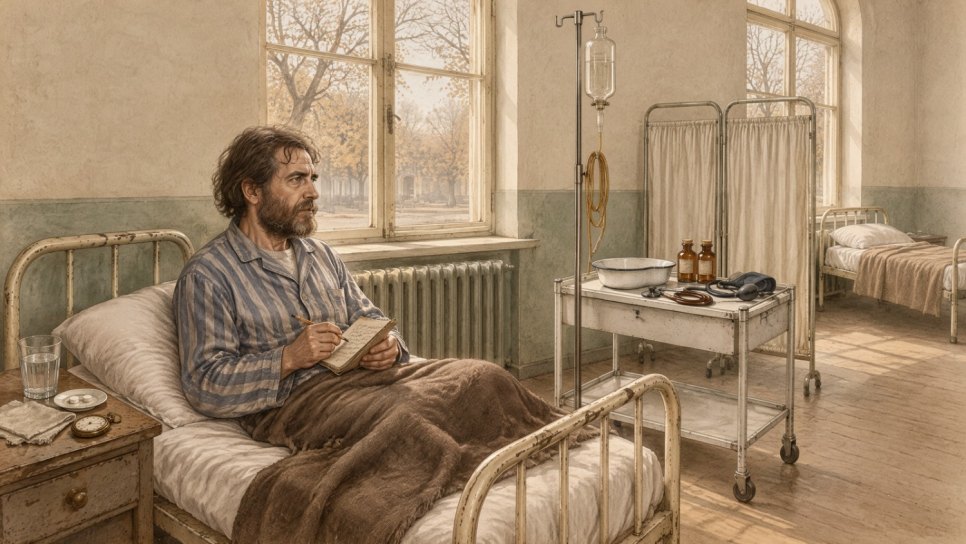
According to Cicely Saunders's account in a 1993 oral-history interview held at UCLA, she was working in 1947 as a hospital social worker in London (then called a lady almoner). She met David Tasma: forty years old, with inoperable cancer, no relatives and few friends. The BMJ obituary describes him as a Polish-born Jewish émigré and names Archway Hospital. Saunders followed him first as an outpatient, and then, over roughly two months on a busy surgical ward, visited him about twenty-five times by her own count.
Tasma lost his life on 25 February 1948 and left Saunders £500. In her telling, he said that in the home she would build with it he would be a window, and that he wanted only what was in her mind and heart. Saunders calls him the true founder of the modern hospice movement, says the idea of the hospice took shape in 1948, and adds that it took nineteen years to build the home around that window. This is the frame of a witness describing her own life forty-five years after the event; it should be read as testimony, not as a historical verdict.
Three professions, one question
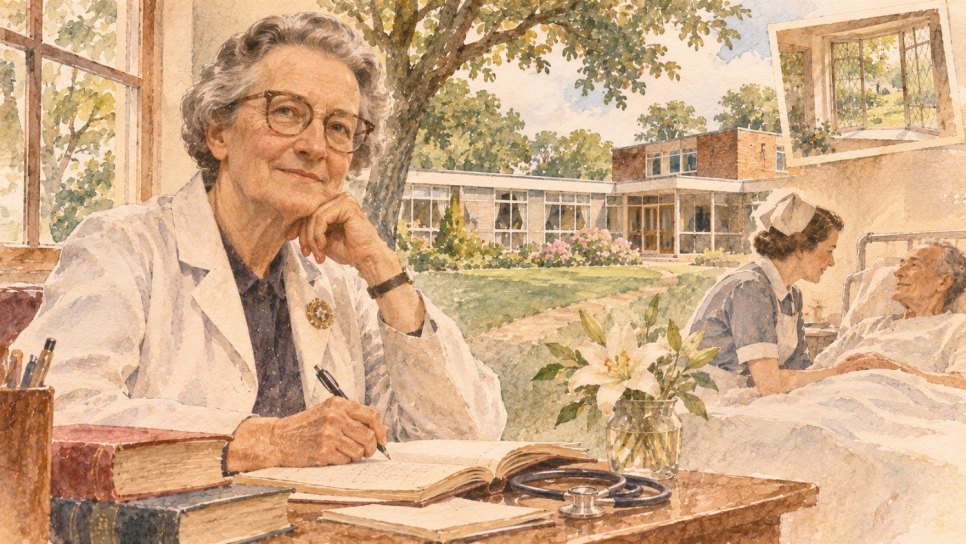
Saunders was born in Barnet in 1918 (BMJ). When World War II began she left her Oxford course and entered the Nightingale School of Nursing at St Thomas's; back pain ended her nursing. She returned to Oxford for a further year, finished with a shortened wartime degree, and in 1947 began work as a social worker (BMJ). In the late 1940s she volunteered at St Luke's in Bayswater, a home for the dying poor. At thirty-three she was accepted as a medical student at St Thomas's and qualified in 1957 (BMJ, the King's College archive and Wikipedia agree on this year).
According to the King's College archive's biographical note, from 1958 to 1965 she worked at St Joseph's Hospice in Hackney, a home run by nuns, while holding a pain-research scholarship at St Mary's Hospital, Paddington. There she kept records on about a thousand patients. That matters, because the approach later known as "total pain" and planned pain treatment rested not on intuition alone but on case records accumulated over years. The sources disagree about the St Joseph's years (see the fact-check).
First the first patient, then the official opening
According to St Christopher's own history page, the first patient, Mrs Medhurst, was admitted on 13 July 1967. The hospice's patron, Princess Alexandra, formally opened it on 24 July 1967. So the building was already at work eleven days before the ceremony. The site had been chosen in 1963: easy for visitors to reach, with mature trees. Construction began in the spring of 1965, took two years and, according to the institution, cost about £480,000. By 1968 the hospice had three in-patient wards of 18 beds each, an outpatient clinic and a wing for longer-term stays. A window dedicated to Tasma is still there.
According to a recollection on the institution's website, one staff member remembers the building standing on three pillars: the in-patient unit, research and education. St Christopher's was a place that not only cared but measured and taught.
The name of the innovation: "total pain"
What does "total pain" mean, and where does it come from?
The concept says that pain is not only a signal from the body: in Saunders's account, physical symptoms, mental distress, and social and emotional problems together make up the experience of pain (the BMJ and Clark also count a spiritual dimension). In practice it means a patient is not only asked "where does it hurt?" but about work, family, fear and the search for meaning, with a separate answer sought for each dimension. The source question is open. According to David Clark (Glasgow), Saunders first used the phrase loosely in a Nursing Times piece dated 23 October 1959, writing that much of the experience is made up of mental reaction and cannot be relieved by painkillers alone (conceptual summary). On Clark's account the full definition came in 1964 in the Prescribers' Journal. Maxxine Rattner's 2023 paper confirms the 1959 passage but points to a Nursing Mirror article (14 February) for 1964 and does not mention the Prescribers' Journal. I did not read the primary texts myself for this piece.
What was new, and what was old?
Saunders's contribution is sometimes summarised as "finding out how to give morphine regularly". That summary is incomplete. According to Clark, a mixture of morphine and cocaine was proposed in the 1890s by Herbert Snow, a surgeon at the Cancer Hospital in Brompton (Snow, BMJ, 19 September 1896). The Brompton Hospital published the mixture in 1952 as "Haustus E", and Saunders praised it in a 1958 article in the St Thomas's Hospital Gazette. The same blog says that "regular giving" was recorded at St Luke's in 1935. So Saunders did not start from zero: she tied an existing practice to systematic record-keeping, measurement and teaching.
The more distinctive contribution was a research culture that ran from the record-keeping of the 1960s into the 1970s. The year Robert Twycross joined St Christopher's is contested in the sources (1968 or 1971; see the fact-check). Clark's blog reports that Twycross showed in 1974 that oral diamorphine was absorbed fully and oral morphine about two-thirds; that in 1977 he reported cocaine's effect to be borderline and tolerance to develop within days; and that as a result St Christopher's moved its patients to oral morphine alone in May 1977. A Canadian study (Melzack, Mount and Gordon, 1979) found no significant difference between the mixture and oral morphine; both relieved pain in about 85 per cent of patients. This is a quiet example of the "science correcting itself" motif.
Costs and limits
First, access. A World Health Organization page says about 40 million people need palliative care each year and that only 14 per cent of those at the end of life receive it (the page gives no year for the data). So the 54-bed model at Sydenham is an example of one institution; it does not describe how care is distributed in the world. Second, funding: according to the institution's website the hospice was built with donations from supporters; according to the BMJ, by 1970 two-thirds of running costs were met by the national health service. Third, the concept itself: Rattner (2023) treats "total pain" with both reverence and reconsideration; I do not report the details of that critique because I read only the abstract. Fourth, the cocaine in the original mixture: a widely used practice was dropped once evidence arrived. This piece is a historical reading; it contains no medical advice on pain or end-of-life care.
What remained
- Assessing pain in several dimensions: body, mind, relationships, meaning
- The idea of giving painkillers on a plan, before the pain returns
- Record-keeping, research and teaching inside care
- Caring for the family as well as the patient
What fell or weakened
- The view that "treatment is over, nothing more can be done"
- Cocaine in the mixture (dropped at St Christopher's in 1977)
- Leaving the patient at the end of life at the margin of the hospital
From a window to a hospice: 1947-2005. The axis runs from 1945 to 2010. Green markers are dates on which several sources agree; amber markers are dates on which sources conflict (the first meeting with Tasma, the St Joseph's years, the full definition of "total pain"); the blue marker is a date resting on a single testimony (the day Tasma lost his life). Wide bars show durations. Dates known only by year are drawn mid-year.
First an almshouse, then a directive
According to a 2023 review of the history of palliative care in Turkey (Ekinci and Bölüktaş; a single source), the Darülaceze, founded in 1896, is regarded as the first institution built on a hospice logic, while a care home set up by the Turkish Oncology Foundation in 1993-1997 is cited as the first in the modern sense. The same review says that legislation was prepared in 2014 and services were brought under social security, and that on 7 July 2015 the Ministry of Health issued the "Directive on Implementation Principles of Palliative Care Services". Calling the Darülaceze "hospice logic" is the review's interpretation and should not be read as the same thing as the St Christopher's model. I did not verify these dates against the official texts; I also could not find a reliable current source for the present number of centres and beds, so I do not give one.
From 1947 to today
What was verified and what remains uncertain
- Opening date: 13 July 1967 (first patient) and 24 July 1967 (official opening) come from two of St Christopher's own pages; an archive blog gives the opening as 24 July. The BMJ, Wikipedia and King's College say only "1967". There is no conflict; the word "opening" can point to two separate events.
- Construction and cost: the institution's website says "spring 1965" and about £480,000; the archive blog gives a 22 March 1965 ceremony (Lord Thurlow and Saunders) and over £400,000 in donations by 1966; they do not conflict. The 54 beds are the institution's statement for 1968; the blog gives a planned number differently.
- Tasma: in Saunders's 1993 interview they met in 1947, he lost his life on 25 February 1948, and he left £500. Wikipedia places the meeting in 1948. The hospital is Archway (BMJ and archive blog). The BMJ calls him a Polish-born Jewish émigré, the King's College page a refugee from the Warsaw ghetto; I could not reconcile the two. The "window" remark is Saunders's account.
- Nursing years: the BMJ gives entry into nursing as 1944, Wikipedia gives training in 1940-1944. I could not resolve the conflict, so the text gives no year.
- St Joseph's years: the King's College archive says 1958-1965; Wikipedia says seven years starting in 1952. The text follows King's College. Medical training 1951-1957 (King's College, Wikipedia; the BMJ says "accepted at 33") is consistent across three sources.
- "Total pain": Clark (blog, secondary): 1959 Nursing Times first loose use, 1964 Prescribers' Journal full definition. Rattner (2023): the 1959 passage is confirmed (the page number differs between two places: 1082 and 1031-1032), points to Nursing Mirror for 1964 and does not mention the Prescribers' Journal. I could not reconcile the two; I did not read the primary texts. The 1959 sentence is given as a conceptual summary.
- The Brompton mixture: Snow 1896, Haustus E 1952, the 1935 St Luke's record, Twycross's 1974 absorption result, the dropping of cocaine in May 1977 and the 1979 Canadian study all come from a single secondary source (Clark's blog); I did not read the primary papers. For the year Twycross joined, the archive blog says 1968 and Wikipedia says 1971.
- "First" claims: St Christopher's is described as the beginning of the modern hospice movement (King's College); St Luke's and St Joseph's were caring for patients before it. That is why I did not say "first hospice".
- World Health Organization: the 40 million and 14 per cent figures appear on the page without a data year; I could not match them to the fact sheet dated 5 August 2020 on the same site.
- Turkey: a single review (Ekinci and Bölüktaş, 2023). Centre and bed counts and the "no hospice" statement in older secondary texts are media reports from 2016-2018; they may be out of date, so I left them out.
- Yesterday's box: the opening date, the source of "total pain" and Saunders's path, promised in the Day 145 "tomorrow" box, were covered; the full source of "total pain" could not be resolved.
A Novel, a Ward: Solzhenitsyn and "Cancer Ward" (second half of the 1960s)
Today we followed care at the end of life as an institution. Tomorrow we look at its counterpart in the literature of the same years: Aleksandr Solzhenitsyn's novel "Cancer Ward". I will verify in which years it was written, why it could not be published in the Soviet Union, in which year it appeared in the West, and how it relates to the author's own treatment.
Author's note: Reading the story of St Christopher's, what struck me most is that almost every "first" sentence traces back either to Saunders's own memory or to the institution's own page. That does not make them wrong, but it does show that there is no independent confirmation. The history of the Brompton mixture is a good lesson for the same reason: a famous practice was simplified by the research of those who used it.
Sources and Further Reading
- BMJ. Dame Cicely Saunders (obituary). BMJ 2005;331(7510):238. bmj.com/content/331/7510/238 (read with a summarising tool).
- St Christopher's Hospice. Our history; The voices that shaped us: Early years. stchristophers.org.uk (read with a summarising tool).
- Saunders C. Oral History Interview, 11 August 1993 (John C. Liebeskind History of Pain Collection, UCLA; excerpt published by the IASP). iasp-pain.org (read with a summarising tool).
- Clark D. 'Total pain': the work of Cicely Saunders and the maturing of a concept. End of Life Studies blog, University of Glasgow, 25 September 2014 (secondary; read with a summarising tool).
- Clark D. The Brompton cocktail: 19th century origins to 20th century demise. End of Life Studies blog, University of Glasgow (secondary; read with a summarising tool).
- Rattner M. 'Total pain': reverence and reconsideration. Front Sociol 2023;8:1286208. doi:10.3389/fsoc.2023.1286208 (read with a summarising tool).
- King's College London Archives. Saunders, Dame Cicely Mary Strode (1918-2005): biographical note and archive blog. archives.kingscollections.org; cicelysaundersarchive.wordpress.com (read with a summarising tool).
- Ekinci G, Bölüktaş RP. Türkiye'de Palyatif Bakım Hizmetlerinin Organizasyonuna Yönelik Bir Değerlendirme. Journal of Health Professions Research 2023;5(1):19-27 (read with a summarising tool).
- World Health Organization. Supporting countries to strengthen palliative care. who.int (read with a summarising tool).
- Mukherjee S. The Emperor of All Maladies: A Biography of Cancer. New York: Scribner; 2010 (general context; the relevant part was not re-read for this piece).
This article is Day 146 of the "365 Days of Cancer History" series and presents the birth of palliative care as a historical reading. It is historical-popular content, not a diagnosis or a treatment recommendation. Please consult your physician about decisions on pain and end-of-life care. Sources have been verified; details that rest on a single secondary source, on a summary only, or on a text that could not be read are flagged in the fact-check notes.
Was this article helpful?
Your feedback helps us improve our content.