A Law, a Name: The National Cancer Act and the "War on Cancer", 1971
In this article
A Law, a Name: The National Cancer Act and the "War on Cancer", 1971
Yesterday the direction of an enzyme changed (Day 149). Today we look at a name that entered a nation's language: in 1971 the US Congress wrote a national programme for cancer, and the name that stuck to it does not even appear in the text of the law. We will use that name as a historical proper name, in quotation marks and in a critical context. At one end of the story stands Mary Lasker, whom we met on Day 130; at the other, a balance sheet that is still argued over.
After the Moon, cancer
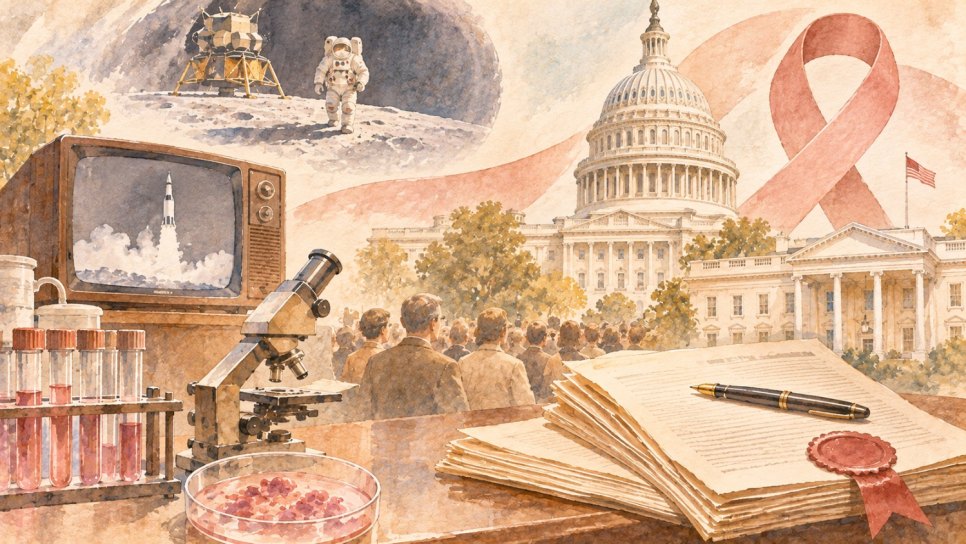
On 20 July 1969 humans landed on the Moon. According to the Lasker Foundation, Mary Lasker took this as a yardstick: if a nation could go to the Moon, it could build a large programme for cancer too. Before the year was out she founded the Citizens Committee for the Conquest of Cancer, with Sidney Farber (Days 122 and 123) and Solomon Garb as its co-chairmen. Its target was 1976, the bicentennial of the United States.
According to the Lasker Foundation, a full-page advertisement ran on 9 December 1969 in The New York Times and the Washington Post. Its headline addressed the President directly; in conceptual summary: Mr. Nixon, you can cure cancer. The advertisement conveyed Farber's belief that a cure was near and that only will and money were missing; in small print it warned that, unless new treatments were found, 34 million Americans then alive would lose their lives to cancer.
What Lasker wanted was a cancer agency separate from the NIH, answering directly to the President like NASA and the Atomic Energy Commission. According to the National Library of Medicine's account, the NIH director James Shannon opposed this: he favoured distributing money for basic research through the NIH rather than having Congress earmark it. Sol Spiegelman, who directed the Institute of Cancer Research at Columbia, compared the approach to going to the Moon without knowing Newton's laws of gravity (conceptual summary, NLM). This objection would accompany the whole story of the law.
From a resolution to a signature
According to the Lasker Foundation, Senator Ralph Yarborough introduced a Senate resolution (Senate Resolution 376) in March 1970 to create a Panel of Consultants on the Conquest of Cancer; the Senate adopted it unanimously in April. The panel, as NCI describes it, consisted of 13 laymen and 13 scientists; its chairman was Benno Schmidt. Its report, "A National Program for the Conquest of Cancer", was transmitted on 25 November 1970 according to NCI; the Lasker Foundation gives 10 December 1970. The report proposed an independent National Cancer Authority (Lasker Foundation).
According to the Nixon Library's chronology, in the State of the Union address of 22 January 1971 Nixon made cancer a national priority and promised 100 million dollars for research. Three days later S. 34, which envisaged an independent authority, was introduced; it did not pass. On 11 May 1971 Senators Dominick and Griffin introduced the administration's bill; according to NCI the text that became law is S. 1828. The Nixon Library shows that on 7 July 1971 the Senate approved the "Conquest of Cancer" bill. The vote counts (79 to 1 in the Senate, 350 to 5 in the House on 9 December) come only from the Lasker Foundation.
The signature came on 23 December 1971. The Lasker Foundation writes that the ceremony took place at the White House with about 250 guests (single source). Nixon's statement that day named Benno Schmidt as first chairman of the President's Cancer Panel and reported that the biological-weapons research facilities at Fort Detrick were being converted into a cancer research centre.
What did the law establish?
According to NCI's account, the law established NCI in its present form: the NCI director is appointed by the President; the annual budget request goes directly to the President and from there to Congress, without being changed by the HHS Secretary, the NIH director or the board. This route is called the "bypass budget" or "professional judgment budget". The three-member President's Cancer Panel reports directly to the President; the National Cancer Advisory Board has 23 members (5 ex officio, 18 appointed by the President). The law made room for 15 new centres (with a ceiling of 5 million dollars per centre per year), for cancer control programmes and for an international data bank.
The money was written as authorisation: for fiscal years 1972, 1973 and 1974, 20, 30 and 40 million dollars for cancer control and 400, 500 and 600 million dollars for all other programmes. I added the total myself: 420 + 530 + 640 = 1.59 billion dollars; this matches the NLM's figure of "1.59 billion dollars over three years". What matters is that the independent agency Lasker wanted was not created: the law left NCI inside the NIH but opened a budget route to the President. The NLM describes this as a compromise.
A name that is not in the law
NCI and the NIH Record write that Nixon declared a "war on cancer". The Nixon Library's subject guide says the opposite: the law was never called a "war on cancer", neither in its text nor in the administration's language. The only trace in the guide is the subject line of a White House tape of 31 July 1972: "War on Cancer" and its effect on the President's popularity. Nixon's statement of 23 December confirms this: the text contains words such as "battle", "campaign", "assault", "crusade" and "attack", and "war" appears only in the comparison that cancer takes more lives in the country each year than were lost in battle in World War II. The law's official language is "conquest".
According to the Lasker Foundation it was the 1969 advertisement that popularised the name; this too is a single source. I could not find who first used the word in this sense, and I am saying that I could not. This series deliberately avoids military metaphors; we cite the name only as a historical fact. Language also has a cost: when a disease is given such a name, an expectation of a date is left behind, and when the date passes, the balance sheet is read like a defeat.
Costs and limits
The first limit is expectation. The committee had named 1976 as its target; the cure did not arrive by then. According to the NIH Record the law funded basic cancer research, not care or prevention; at the end of the 1970s disappointment grew, and some groups wanted the money to turn towards public health and prevention. Scientists such as James Watson argued that progress ran through understanding the basic biology of the disease. Nixon too was cautious: in conceptual summary, he said he did not want to raise false hopes by signing the law (from the text of the speech on the Cancer History Project).
The second limit is the numbers. In 1986 Bailar and Smith reported in the NEJM that between 1950 and 1982 the number of lives lost to cancer and the crude and age-adjusted rates had risen, while reported survival rates had improved. In 1997 Bailar and Gornik found the 1994 rate (200.9 per 100,000 people) 6.0 per cent higher than in 1970; the rate had peaked around 1991 and fell about 1.0 per cent by 1994. The authors consider the effect of treatment research on the overall burden limited and say the most promising path is prevention; they also acknowledge real gains in childhood cancers, Hodgkin disease and palliative care. These figures cannot be read apart from the smoking story of Days 125 and 139: lung cancer was rising in that period.
There was also an unexpected gain: according to the NIH Record the search for a cancer vaccine did not succeed, but the effort advanced understanding of the genetic basis of cancer; in 1976 Bishop and Varmus showed that normal genes can turn into genes that cause cancer.
What remained
- The idea of a central national programme for cancer
- NCI's direct budget route to the President
- The network of cancer centres and the President's Cancer Panel
What fell or weakened
- The expectation of a single "date of the cure", such as 1976
- The Moon analogy: what was missing was not only will and money
From the advertisement to the signature: 1969-1971. The axis runs from July 1969 to January 1972. Green marks are dates on which several sources agree; amber marks are dates on which sources conflict (transmission of the report: 25 November or 10 December); blue marks show dates resting on a single source. Dates known only by month are drawn mid-month.
A state plan for cancer control
I am not tying Turkey directly to the 1971 law; I am only drawing a comparison. According to the Turkish Cancer Control Plan 2013-2018, published by the Ministry of Health of the Republic of Türkiye, Public Health Institution of Türkiye, Department of Cancer, the first National Cancer Control Programme was published in 2008 and covered 2008-2013; the 2013-2018 plan was prepared as the second phase, in cooperation with the WHO. The plan traces state-level organisation to the "Kanserle Savaş Dairesi" set up in 1983 by decree law (KHK) 181; this is the name of an institution and is cited as a historical proper name. Türkiye joined the International Association of Cancer Registries (IACR) in 1989; registry centres opened in İzmir and Diyarbakır in 1992. For early detection the plan reports 197 Cancer Early Diagnosis, Screening and Training Centres (KETEM), at least one in every province.
So: a central plan, registries, early-detection centres and an emphasis on prevention, the very parts discussed in America in 1971. I cannot read the direction of any relationship between them from this document; I read only its first hundred thousand characters.
From 1937 to today
What was verified and what remains uncertain
- Date of signature: 23 December 1971, Public Law 92-218 (NCI and Nixon's statement of that day). No conflict.
- Bill number: NCI gives the enacted text as S. 1828; the Lasker Foundation writes that the Senate approved S. 34 on 7 July; the Nixon Library calls the bill S. 1848 in one place and S. 1828 elsewhere. I could not resolve which text passed the Senate.
- Votes: Senate 79-1 (7 July) and House 350-5 (9 December) come only from the Lasker Foundation; not confirmed by a second source.
- The advertisement: The date (9 December 1969) is from the Lasker Foundation; the NLM says only "December 1969" and gives the headline as "Mr. Nixon: You can cure cancer". I did not see the form "Mr. President", repeated in many accounts, in these two sources. The figure of 34 million is single-sourced.
- Date of the panel report: 25 November 1970 (NCI, "transmitted") and 10 December 1970 (Lasker Foundation). I think the difference may lie between transmission and public presentation, but I read no source saying so; amber in the figure.
- Lasker's role: The details of the advertisement, the selection of panel members and the State of the Union speech are from the Lasker Foundation; NCI's page on the law and Nixon's statement do not mention Lasker. The foundation writes the account of its own founder; I could not verify it against a primary document.
- "War on Cancer": NCI and the NIH Record attribute it to Nixon; the Nixon Library says neither the law nor the administration used the name and that it appears in the subject line of a 31 July 1972 tape; in Nixon's signing statement "war" appears only in the World War II comparison. I could not find the origin of the term.
- Number of centres: NCI gives authority for "15 new centres"; the NLM writes "17 comprehensive centres"; I read no source explaining the difference.
- Budget: 1.59 billion dollars is an authorisation; I did not verify actual appropriations. The total is my own sum and matches the NLM's figure. In Nixon's statement the extra 100 million dollars raise the operating level from 180 million dollars in the first half of fiscal year 1972 to 337.5 million dollars.
- Spiegelman and Watson: The analogy is from the NLM, Watson's view from the NIH Record; both are conceptual summaries. I did not use the "medical Vietnam" comparison in the NIH Record because the former FDA official who made it is unnamed.
- Bailar figures: only the abstracts of the two papers were read; author names did not appear on the 1986 page, the citation is from the common bibliography.
- The Turkish plan: The first hundred thousand characters of the document were read. I had assumed the earlier plan was 2009-2015; the document says 2008-2013, and I followed the document. "Kanserle Savaş Dairesi" is an institution's name.
- Yesterday's box: The scope, date of signature and Lasker's role promised on Day 149 were covered; the name was used in quotation marks, in a critical context.
Two Hits: Knudson, Retinoblastoma and the Arithmetic of Inherited Cancer, 1971
Today a nation built money and an organisation for cancer. Tomorrow the same year, a calculation made with pen and paper by a statistician: why does a childhood eye tumour appear in one eye in some children and in both eyes in others? I will verify Alfred Knudson's 1971 paper, the "two-hit" idea and its relation to the familial syndromes of Day 148.
Author's note: What surprised me most in writing this was that the law that gave a nation its name for the effort carries almost nothing of that name in its own text or in the President's own statement. This series avoids military language; today I approached the name only as a historical one, asking when, by whom and with what expectation it was used. Part of the answer, who coined it, I still do not have.
Sources and Further Reading
- National Cancer Institute. The National Cancer Act of 1971 (Public Law 92-218). cancer.gov/about-nci/legislative/history/national-cancer-act-1971 (read with a summarising tool; the text of the law was not read directly).
- Nixon R. Statement about the National Cancer Act of 1971, 23 December 1971. The American Presidency Project, presidency.ucsb.edu (read with a summarising tool).
- Richard Nixon Presidential Library. War on Cancer subject guide. nixonlibrary.gov (read with a summarising tool).
- Lasker Foundation. Catalyst for the National Cancer Act: Mary Lasker. laskerfoundation.org (read with a summarising tool).
- National Library of Medicine. Cancer Wars. profiles.nlm.nih.gov/spotlight/tl/feature/cancer (read with a summarising tool).
- NIH Record. Article on the National Cancer Act. nihrecord.nih.gov/node/26041 (read with a summarising tool; title and author of the article not verified).
- Cancer History Project. Speeches, footage, and dispatches from Dec. 23, 1971. cancerhistoryproject.com (read with a summarising tool).
- Bailar JC, Smith EM. Progress against cancer? N Engl J Med 1986;314(19):1226-1232. doi:10.1056/nejm198605083141905 (only the abstract was read).
- Bailar JC, Gornik HL. Cancer undefeated. N Engl J Med 1997;336(22):1569-1574 (read with a summarising tool).
- Ministry of Health of the Republic of Türkiye, Public Health Institution of Türkiye, Department of Cancer. Türkiye Kanser Kontrol Planı 2013-2018. Ankara; 2016 (read with a summarising tool; first 100,000 characters).
- Mukherjee S. The Emperor of All Maladies: A Biography of Cancer. New York: Scribner; 2010 (general context; the relevant part was not reread for this article).
This article is Day 150 of the "365 Days of Cancer History" series and presents the National Cancer Act as a historical reading. It is historical-popular content, not a diagnosis or treatment recommendation. For treatment decisions, consult your physician. The sources have been verified; details resting on a single secondary source, on an abstract only or on a text that could not be read are marked in the fact-check notes.
Was this article helpful?
Your feedback helps us improve our content.