The Patient Who Wrote Cancer Ward: Solzhenitsyn, 1954-1968
In this article
The Patient Who Wrote Cancer Ward: Solzhenitsyn, 1954-1968
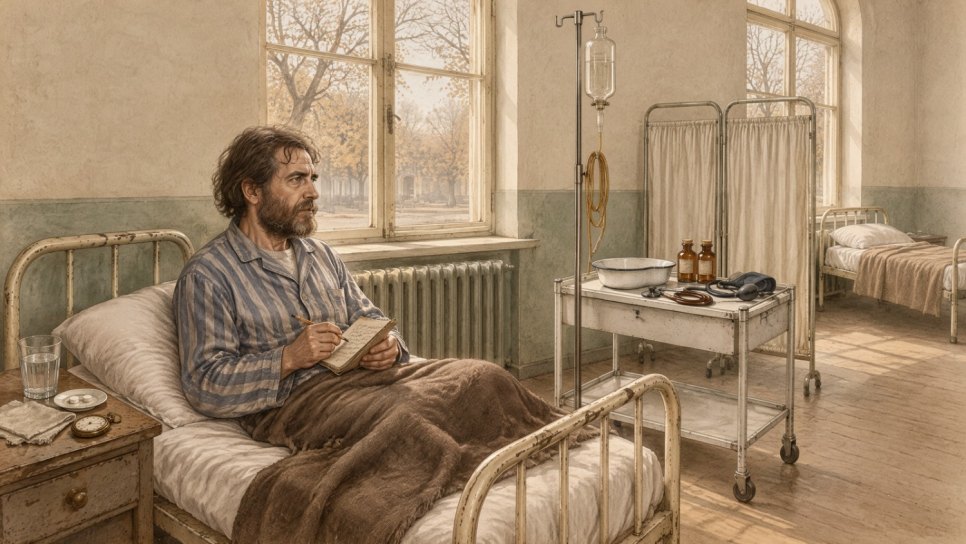
Yesterday we looked at the door of St Christopher's, which admitted its first patient on 13 July 1967 (Day 146). Today we look at the other side of those same years: the fictional ward of a novel. According to Paul Crichton's 2007 reading in the BMJ's Medical Classics series, the novel describes a Soviet cancer hospital with no palliative care, where patients are discharged before they lose their lives, to improve the statistics. The man who wrote it was not merely inventing: in 1954 he had himself been a patient in a clinic of the same kind.
From Kok-Terek to Tashkent
According to the autobiographical text Aleksandr Solzhenitsyn wrote for the Nobel Foundation in 1970, he lived in exile in Kok-Terek, in southern Kazakhstan, from March 1953 to June 1956. According to the Solzhenitsyn Center, the first day he spent without an armed guard was 5 March, the day Stalin lost his life. In exile he taught mathematics and physics at a primary school and wrote prose in secret. In the same text, in his own words (conceptual summary): his cancer had advanced quickly, by the end of 1953 he was very close to losing his life, he was then able to reach a cancer clinic in Tashkent, and during 1954 he was cured.
The details are scattered across sources. According to the annotation in New York University's literature and medicine database, Solzhenitsyn was operated on for a tumour while imprisoned and was not told the diagnosis; after a recurrence he received radiotherapy in Tashkent and recovered. The name of the diagnosis conflicts between sources: the Solzhenitsyn Center's timeline says seminoma and writes that doctors gave him three weeks; an essay speaks of "a rare stomach cancer" and of a recurrence treated with radiation in Tashkent in spring 1954. I could not reconcile the two (see the fact-check notes).
The novel that could not be printed
According to the Solzhenitsyn Center the novel was written between 1963 and 1967; an encyclopaedia page puts its completion in mid-1966 (see the fact-check notes). The same page says the manuscript was sent to the magazine Novy Mir by June 1966, that the editor, Tvardovsky, equivocated and asked for cuts, and that the author arranged samizdat circulation in Russia the same year. A file in the OSA Archivum at the Hoover Institution confirms that the prose section bureau of the Moscow Writers' Organization discussed the novel in 1966; the record gives no day, no participants and no outcome. A few years later, in June 1968, a Soviet dissident bulletin records that Novy Mir had banned the novel and that the secretariat of the Writers' Union had blocked publication.
In September 1967, according to Time, Solzhenitsyn confronted about thirty Writers' Union officials led by Konstantin Fedin; he said that the delay at Novy Mir raised the risk of clandestine copies reaching the West. The same magazine writes that the Soviet authorities refused to print the novel after a long dispute. The copies did reach the West: according to Time, in autumn 1968 the Bodley Head, Farrar, Straus & Giroux and Dial Press were preparing editions, and the author stated publicly that he had not given these publishers permission. The novel appeared in the West in 1968: the English translation the same year from Dial Press in New York, while the Times Literary Supplement in London published unauthorised extracts in April 1968 (a dissident bulletin and Wikipedia both confirm this). The publisher of the first Russian edition is disputed: one source names Posev in Germany, another Paris, a third Italian and other European publishers.
Inside the ward
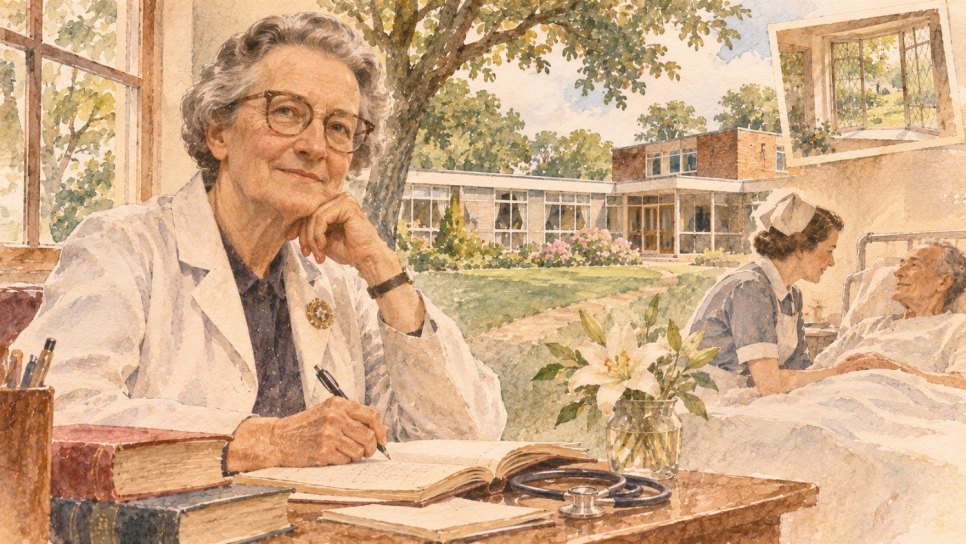
According to an encyclopaedia page, the novel is set in spring 1955 in Ward 13 of a cancer clinic in Tashkent; Crichton writes it as "the late 1950s". The protagonist, Oleg Kostoglotov, is a semi-autobiographical man who has left the Gulag, been sent into exile and received cancer treatment. According to the Solzhenitsyn Center's account, Kostoglotov comes from Leningrad, has no formal education and is unmarried; so he is not the same as the author. The head physician of the ward, Ludmila Dontsova (Crichton calls her the lead oncologist), according to the Center's account develops cancer from the radiation doses she gives her patients. This recalls Grubbé (Day 92) and Curie (Day 95) in this series, but it is fiction, not documentation.
Telling the truth and paternalism
The novel's main weight for medical ethics is the question of who knows what. According to Crichton, doctors rarely say what they think; euphemism, vague wording and outright lies are routine on ward rounds, whose main purpose is to raise morale, while some doctors are more candid in private. When Dontsova herself falls ill she avoids the details of her illness. According to the Solzhenitsyn Center, Dontsova prescribes Kostoglotov's hormone therapy, and Zoya warns the patient that it will leave him impotent. So consent, knowledge of a side effect and a physician's right not to know about her own illness sit side by side in one novel. In the annotation in the NYU database, Jack Coulehan (1998) writes that this paternalism reflects Soviet medicine but that similar practices were seen in American medicine of the 1950s. The same question brings to mind the distance between the consent principle of the Nuremberg Code on Day 121 and everyday clinical practice.
The same years, two different gazes
Set beside yesterday's article, a contrast appears by itself: at St Christopher's (Day 146) the patient was looked at through the idea of "total pain", that is, with physical, psychological, social and spiritual dimensions, whereas on the ward Crichton read, the purpose of the round was to protect morale. The contrast should not be exaggerated. One is the history of a real institution, the other a fictional hospital in a novel; reading the two as a comparison measuring the medicine of two countries would be wrong. What they share is that the question of listening to the patient's own voice was raised in the same years in two different places, one as an institution, the other as literature. In Solzhenitsyn's case that voice was heard when a patient, years later, put his own tumour and treatment into writing.
Costs and limits
First, this is a novel: Crichton's reading that patients were discharged before losing their lives, for the sake of the statistics, interprets a picture within fiction; it is not a measured picture of Soviet oncology. I found no real-life model for Dontsova. Second, the author's own recovery is the story of one patient and cannot be generalised; moreover an encyclopaedia page ties the remission to a root extract used in folk medicine, whereas the author's own text and the medical readings point to the Tashkent clinic and radiotherapy. No herbal product should be read from this article as a treatment recommendation. Third, the course of an illness in a novel is not a clinical description; Kostoglotov's treatment and recovery give the reader no basis for generalising about how the disease runs. This article is a historical and literary reading; it contains no diagnosis or treatment.
What remained
- The testimony of a writer who was himself a patient
- The question of a physician who may also be ill, and of the right to know
- The question of consent and of telling the patient about side effects
- Making the absence of care at the end of life visible
What fell or weakened
- The assumption "the doctor knows, the patient does not ask"
- Treating it as normal to hide the diagnosis from the patient
- The habit of speaking of cancer in euphemism, without naming it
From exile to the Western edition: 1953-1970. The axis runs from 1950 to 1975. Green markers are dates on which several sources agree; amber markers show dates on which sources conflict (the writing years, the publisher of the first Russian edition); blue markers show dates resting on a single source. Wide bars show durations. The St Christopher's row comes from Day 146. Dates known only by year are drawn mid-year.
The 1998 regulation on telling the diagnosis
A written answer in Turkey to the question "what does the physician say?" is the Patient Rights Regulation published in the Official Gazette no. 23420 of 1 August 1998. According to the text I read, Article 15 says the patient will be informed about the likely causes and course of the illness, the planned procedure, the alternatives and the complications; Article 19 says that in a grave situation, where giving the information would seriously upset the patient's state of mind and worsen the illness, the diagnosis may be withheld, the decision belonging to the physician; Article 20 allows the patient to forbid being given information; Article 24 requires the patient's consent for medical interventions. So something like the euphemism of the ward corresponds, in the 1998 text, to the exception under which a diagnosis may be withheld, while Dontsova's avoiding the details of her own illness comes close to the right to refuse information. This is not a matching but a parallel the reader may draw. I read the text from a copy on a legislation site, not from the official source, and did not check later amendments. I could not verify the details of the Turkish translation of the novel (translator, year of edition); nothing in this article rests on a Turkish edition.
From 1953 to today
What was verified and what remains uncertain
- Writing years: the Solzhenitsyn Center timeline says 1963-67; the Wikipedia page on the novel gives completion as mid-1966 and shows the manuscript sent to Novy Mir by June 1966. There may be no contradiction (parts may have been completed in different years); the sources do not explain it.
- Moscow discussion: the OSA Archivum record says only "1966" and "prose section bureau of the Moscow Writers' Organization". The same Wikipedia page says "17 November 1966, Central Writers' Club"; the day and venue were therefore left out of the text.
- Ban and refusal to publish: a dissident bulletin (June 1968) writes that Novy Mir banned it and that the secretariat of the Writers' Union blocked publication; Time (September 1968) reports that the authorities refused to print after a long dispute, and the September 1967 meeting with the Writers' Union. The Wikipedia page on the novel says "banned in Russia in 1967"; I did not compare this date or the two accounts above with a primary document.
- Western editions: the year 1968 is consistent across several sources (Solzhenitsyn Center, Britannica, NYU record, OpenLibrary). First Russian edition: the cover caption on the Wikipedia page of the novel gives Posev in Germany; the Solzhenitsyn Center timeline says Paris; Britannica says "Italian and other European publishers". I could not resolve it. Somewhere the Wikipedia page on Solzhenitsyn dates the publication to 1966 but its bibliography says 1968; I did not take 1966. For the English translation, Dial Press 1968 agrees with the NYU record and Time; Time also names the Bodley Head and Farrar, Straus & Giroux and writes that the author stated he had not given these publishers permission. I did not verify the translators' names.
- Diagnosis: the Solzhenitsyn Center says "seminoma", an essay (The Millions) "a rare stomach cancer"; I could not reconcile them. That the tumour was removed surgically in the camp and the diagnosis was not told comes from the NYU record; so does the radiotherapy in Tashkent after the recurrence.
- Treatment: the author's own words in the Nobel text: he was cured in Tashkent in 1954. Radiotherapy appears in the NYU record and in The Millions (spring 1954). The Wikipedia page on the novel ties the remission to an "Issyk-Kul root" extract; I followed the author's own account and the radiotherapy.
- Setting and time of the novel: Wikipedia says spring 1955, Tashkent, Ward 13; Crichton says "the late 1950s, Uzbekistan". A small conflict; I gave both in the text.
- Dontsova: I found no real-life model. The Solzhenitsyn Center writes that she develops cancer from the radiation doses she gives her patients; Crichton says only that she avoids the details of her own illness. The Center's page does not describe what follows.
- Nobel: the year 1970 comes in the text at the Nobel Foundation only from the copyright line and address, while the Solzhenitsyn Center writes the prize and that he could not attend the ceremony. The day and month of the award were not verified; it is drawn mid-year on the axis.
- Patient Rights Regulation: Official Gazette no. 23420 of 1 August 1998; article numbers and content were read from a copy on a legislation site and not compared with the official text or later amendments.
- Yesterday's box: the writing years, the reason it could not be published, the year of Western appearance and the link to the author's treatment promised in the "tomorrow" box of Day 146 were covered; no primary document could be read on "the reason it could not be published"; Time and the dissident bulletin are both contemporary secondary or journalistic accounts.
A Pattern in Four Families: Li, Fraumeni and the Hereditary Cancer Syndrome, 1969
Today we read cancer from a ward, through the patient's eyes. Tomorrow we look at a story that repeats across generations in a single family: the syndrome described by Frederick Li and Joseph Fraumeni in 1969. I will verify the year and journal of the first publication, how many families they studied, and the year in which the link between this syndrome and the TP53 gene was established.
Author's note: What I watched most closely in this article was the line between fiction and document. Solzhenitsyn's own tumour is one sentence in the Nobel text; Kostoglotov's tumour is a whole in the novel. It is easy and tempting to mix the two, so I tried to keep apart which information is the author's own word and which is the reader's interpretation. I also took many details of the novel only from secondary readings.
Sources and Further Reading
- Solzhenitsyn A. Biographical (1970). nobelprize.org, Literature 1970 (read via a summarising tool).
- Aleksandr Solzhenitsyn Center. Timeline; Cancer Ward. solzhenitsyncenter.org (read via a summarising tool).
- Crichton P. Cancer Ward. BMJ Medical Classics. BMJ 2007;335(7621):673. doi:10.1136/bmj.39329.524942.34 (read via a summarising tool).
- Coulehan J. Cancer Ward (annotation, 5 March 1998). NYU Literature, Arts, and Medicine Database. medhum.med.nyu.edu (read via a summarising tool).
- A Chronicle of Current Events. No. 2, 30 June 1968: About Solzhenitsyn. chronicle-of-current-events.com (read via a summarising tool).
- OSA Archivum. AS 237: Transcript of a Discussion of Solzhenitsyn's "Cancer Ward" (1966). catalog-legacy.osaarchivum.org (record summary read).
- Time. The Writer as Russia's Conscience. 27 September 1968 (read via a summarising tool).
- The Millions. Holding a Vigil for a People's History: an Appreciation of Solzhenitsyn's Cancer Ward. themillions.com (read via a summarising tool).
- T.C. Sağlık Bakanlığı. Hasta Hakları Yönetmeliği, Resmî Gazete 1 August 1998, no. 23420 (read via a summarising tool from the copy at alomaliye.com; not the official source).
- Mukherjee S. The Emperor of All Maladies: A Biography of Cancer. New York: Scribner; 2010 (general context; the relevant part was not re-read for this article).
This article is Day 147 of the "365 Days of Cancer History" series and presents the medical and ethical context of a novel as a historical reading. It is historical-popular content, not a diagnosis or a treatment recommendation. Please consult your physician about treatment decisions. Sources have been verified; details that rest on a single secondary source, on a summary only, or on a text that could not be read are flagged in the fact-check notes.
Was this article helpful?
Your feedback helps us improve our content.