
What Should We Understand From the 2022 Nobel Prize in Physiology or Medicine?

In this article
Humanity has always been interested in its origins. Where do we come from, and how are we related to those who came before us? What distinguishes modern humans (Homo sapiens) from other hominins?
The Nobel Prize in Physiology or Medicine, the world’s most prestigious medical award, found its 2022 recipient. At the Max Planck Institute for Evolutionary Anthropology in Germany, Svante Pääbo was recognized for discoveries concerning the genomes of extinct hominins (Neanderthals and Denisovans) and human evolution .
Through his pioneering research, Svante Pääbo achieved something seemingly impossible: sequencing/identifying the genome of the Neanderthal, an extinct relative of present-day humans. He also made the sensational discovery of a previously unknown hominin, Denisova. Importantly, Pääbo discovered that, following migration out of Africa approximately 70,000 years ago, Homo sapiens received gene flow from these now-extinct hominins. This ancient flow of genes into present-day humans has physiological relevance today, for example by influencing how our immune system responds to infections.
Pääbo’s groundbreaking research gave rise to an entirely new scientific discipline: paleogenomics. By revealing genetic differences that distinguish all living humans from extinct hominins, his discoveries provide a foundation for investigating what makes us uniquely human.
Dr. Paabo and his team developed ways to analyze ancient DNA damaged by centuries of exposure to chemicals and DNA from other organisms. In 2010, he successfully sequenced the Neanderthal genome. The results showed that 4 percent of the genomes of people of European and Asian ancestry are also found in Neanderthals.
He also identified the origin of a 40-thousand-year-old finger bone found in a Siberian cave in 2008. DNA isolated from the bone resembled neither Neanderthals nor modern humans. This new group was named Denisovans. Denisovan genes are present in billions of people alive today.
Where Do We Come From?
Our origins and what makes us unique have preoccupied humanity since ancient times. Paleontology and archaeology are important to studying human evolution. Research has provided evidence that anatomically modern humans, Homo sapiens , first appeared in Africa approximately 300,000 years ago. Our closest relatives, the now-extinct Neanderthals, evolved outside Africa and inhabited Europe and western Asia from approximately 400,000 to 30,000 years ago. Around 70,000 years ago, Homo sapiens groups migrated from Africa to the Middle East and spread from there to the rest of the world. Homo sapiens and Neanderthals thus coexisted across much of Eurasia for tens of thousands of years. But what do we know about our relationship with extinct Neanderthals? Genomic information can provide clues. By the late 1990s, almost the entire human genome had been sequenced, a major achievement that enabled further studies of genetic relationships among human populations. However, investigating the relationship between present-day humans and extinct Neanderthals would require sequencing genomic DNA from archaic specimens.
What Do These Discoveries Mean for Modern Medicine?
- Dr. Paabo’s work on the Neanderthal genome has many implications for modern medicine. Although the human genome contains only a small proportion of “ancient genes”, these genes are known to influence the risk of many diseases, from schizophrenia to COVID-19. For example, people living at high altitudes, such as Tibet, have adapted to these regions thanks to ancient genes.
- Knowledge of Neanderthal and Denisovan genomes is important for discovering human-specific genes. In September 2022, a gene variant found in humans was discovered to enhance the development of laboratory-grown brain tissue structures.
- Discovering human-specific genes may open the way to new treatments for diseases caused by multiple gene abnormalities, such as cancer.
*
Below is the 2022 Nobel Prize in Physiology or Medicine’s graphical summary :

Figure 1. DNA is located in two cellular compartments. Nuclear DNA contains most genetic information, while the much smaller mitochondrial genome is present in thousands of copies. After death, DNA degrades over time until only small amounts remain. It also becomes contaminated by DNA from sources such as bacteria and contemporary humans.
*

Figure 2. A. Pääbo extracted DNA from bone specimens from extinct hominins. First, he obtained a bone fragment from Neandertal in Germany, the place that gave Neanderthals their name. He later used a finger bone from Denisova Cave in southern Siberia, the region that gave Denisovans their name. B. A phylogenetic tree showing evolution and relationships between Homo sapiens and extinct hominins. The tree also shows the gene flows discovered by Pääbo.
*
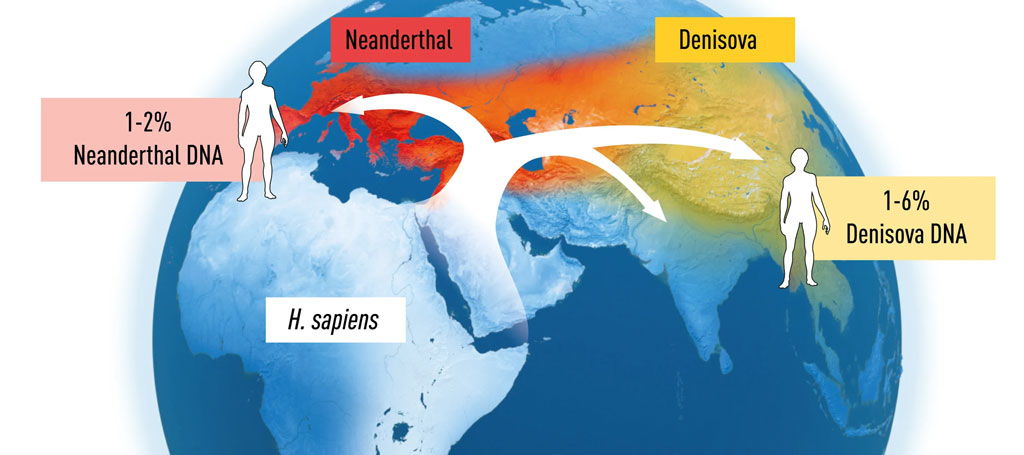
Figure 3. Pääbo’s discoveries provided important information about the world’s population distribution when Homo sapiens migrated out of Africa and spread worldwide. Neanderthals inhabited western Eurasia and Denisovans the east. Interbreeding occurred as Homo sapiens spread across the continent, leaving traces in our DNA.
*

Figure 4. Pääbo’s groundbreaking work provides a foundation for explaining what makes us uniquely human.
*
Svante Pääbo was born in Stockholm, Sweden, in 1955. He defended his doctoral thesis at Uppsala University in 1986 and worked as a postdoctoral researcher at the University of Zurich, Switzerland, and later the University of California, Berkeley, USA. In 1990, he became a professor at the University of Munich, Germany. In 1999, he founded the Max Planck Institute for Evolutionary Anthropology in Leipzig, Germany, where he remains active. He also works at the Okinawa Institute of Science and Technology in Japan.
Sources
2. Illustrations: © The Nobel Committee for Physiology or Medicine. Illustrator: Mattias Karlén
Was this article helpful?
Your feedback helps us improve our content.




Reader comments
Share your comment
Your name and comment are published only after administrator approval. Your email address is never shown to visitors.
Be the first to comment.