
70 Percent of Cancer Deaths Can Be Prevented

In this article
A new global analysis highlights the substantial burden of premature deaths from cancer worldwide. This burden could potentially be avoided through prevention, early detection, and timely treatment.
3 Main Findings of the Study
| DATA | EXPLANATION |
| More than 10 million people worldwide died from cancer in 2023. | This accounts for approximately 10% of all deaths worldwide. |
| Cancer is the MOST COMMON CAUSE of premature death between ages 30-69. | It accounts for approximately 25% of deaths in this age group. |
| Premature cancer deaths are more common in developing countries. | In these countries, premature cancer deaths account for approximately 40% of all premature deaths. |
Half of Cancer Deaths Occur Prematurely
According to the analysis, more than half of cancer deaths in 2020—5.28 million out of 9.96 million—occurred prematurely (before age 70) , resulting in approximately 183 million years of life lost to cancer worldwide.
More than two-thirds of premature cancer deaths—3.6 million, or 68%—could potentially have been prevented through lifestyle changes or early detection efforts, such as cancer screening, dietary changes, or smoking cessation. Approximately one-third—1.65 million, or 31%—could have been treatable.
Many cancer deaths are likely preventable in theory, but the precise number remains unclear. Moreover, "theoretically preventable" does not mean we can actually achieve this in practice.
Cancer Prevention Requires Major Effort and Investment
Conducted by the World Health Organization's International Agency for Research on Cancer (IARC) and partners, the study estimates premature deaths from 36 cancers in 185 countries.
The Lancet Global Health published the findings on September 26, 2023. Alongside the Lancet Commission report "Women, Power, and Cancer," they highlight the "underrecognized" cancer burden among women worldwide.
Cancer ranks among the top three causes of premature death in women in almost every country worldwide. According to the Lancet Commission report, however, a major reason is the "failure to prioritize" cancer prevention!
Of approximately 5.3 million premature cancer deaths in 2020, 2.9 million occurred in men and 2.3 million in women. The researchers stated that 1.5 million premature deaths among women could potentially be avoided through prevention or detection, while the remaining 800,000 could be avoided "if all women everywhere had access to optimal cancer care."
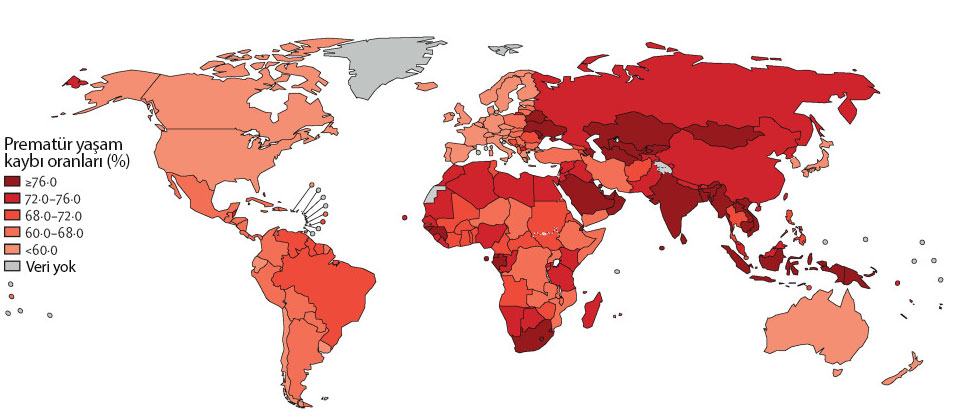
The image above is a world map showing the proportion of cancer deaths across all ages that occur prematurely, between ages 30-69. Dark red represents countries with the highest proportions, while light red represents those with the lowest.
Statistics Differ by Human Development Index
Lung cancer was the leading cause of preventable premature years of life lost in countries with medium to very high Human Development Index (HDI) scores, while in low-HDI countries, cervical cancer was the leading cause.
HDI rankings are calculated from life expectancy, education, and gross national income. There are 4 tiers: very high, high, medium, and low.
In low-HDI countries, 72% of cancer deaths among women occurred prematurely, compared with 36% in very high-HDI countries.
Overall, across all four HDI tiers, colorectal and breast cancers were the main treatable cancers .
4 Main Causes of Cancer
Reducing exposure to four major risk factors— tobacco smoking, alcohol consumption, high body weight and infections (HPV, Helicobacter, and hepatitis B)—remains key to reducing potentially preventable premature cancer deaths.
Worldwide, countries show marked inequalities in progress toward reducing premature deaths from noncommunicable diseases, including cancer.
Greater investment in cancer prevention programs can reduce the prevalence of major cancer risk factors and be linked with vaccination coverage, early diagnosis and screening, and timely treatment. It can and should address existing cancer inequalities worldwide.
The researchers nevertheless acknowledge limitations in the methodology and underlying assumptions. For example, some premature cancer deaths classified as preventable might also be avoided through curative treatment.
The findings describe premature mortality (death rates) in 2020 but do not indicate how much progress will be made in cancer control over time.
The study provides a useful overview of how a large proportion of premature cancer deaths could be avoided using existing primary and additional treatments.
However, estimates of the effects of different risk factors and interventions often rely on observational, nonrandomized studies, which can lead to various misunderstandings.
Access to observational or randomized data is also often limited in regions such as Africa, Latin America, and Asia, where cancer cases are increasing. Applying data mainly from North America and Europe to these understudied regions may therefore be difficult because of genetic, environmental, socioeconomic, and cultural differences.
Debate nevertheless continues over "whether modifiable risk factors are truly modifiable." For example, how can we completely eliminate "physical inactivity," and what would this look like in practice?
In conclusion, some of these cancers can indeed be prevented, and the proportion may be high, but the precise estimate of 70% generally remains theoretical. Preventing cancer or reducing cancer numbers requires major effort and investment.
*
Related topic: Exercise Is a Cancer Drug!
Sources
Was this article helpful?
Your feedback helps us improve our content.




Reader comments
Share your comment
Your name and comment are published only after administrator approval. Your email address is never shown to visitors.
Be the first to comment.