
A Revolution in Oncology: First FDA Approval for TIL Therapy – Lifileucel for Melanoma

In this article
For adults previously treated with a PD-1-blocking antibody and, if BRAF V600 mutation-positive, a BRAF inhibitor (with or without a MEK inhibitor), who have unresectable or disseminated melanoma , the autologous tumor-derived T-cell immunotherapy lifileucel (Amtagvi, Iovance Biotherapeutics, Inc.) received accelerated United States Food and Drug Administration (FDA) approval on 16 February 2024.
What Is TIL Therapy?
TIL therapy is an immunotherapy in which specialized T cells obtained from a patient's own tumor—tumor-infiltrating lymphocytes—are expanded in the laboratory and then returned to the patient to treat cancer. It offers a new approach by directly fighting the tumor with an individualized treatment.
Related topic: Tumor-Infiltrating T Cells and Their Importance in Cancer
Melanoma is a skin cancer subtype that tends to grow and spread aggressively. When melanoma is metastatic , it has spread to other parts of the body and can be particularly challenging to treat. Despite major advances with immunotherapies and anti-BRAF drugs over the past 10 years, some patients continue to experience disease progression and face limited options. Scientific and medical innovations nevertheless continue to bring light to this difficult situation. One is lifileucel, a personalized cell therapy that fights metastatic melanoma by using T cells obtained directly from the patient's own tumor tissue .
This groundbreaking approach uses lymphocytes (TILs) isolated from cancerous tissue and prepared individually for each patient. CAR T-cell therapy and other cell-based treatments differ from lifileucel, which uses T cells obtained directly from the tumor rather than from the patient's blood. This marks a turning point in oncology and offers new hope to patients with treatment-resistant metastatic melanoma.
Accelerated FDA Approval Based on a Study of 89 Patients
Lifileucel's safety and effectiveness were evaluated in a global, multicenter, multicohort, open-label, single-arm trial in patients with unresectable or metastatic melanoma previously treated with a PD-1-blocking antibody and, if BRAF V600 mutation-positive, a BRAF inhibitor with or without a MEK inhibitor.
Of the 89 patients receiving lifileucel, two were excluded because the treatment did not meet the required quality standards and five because of issues concerning comparability with other samples.
How Was TIL Therapy Administered?
Before treatment, patients received a special chemotherapy regimen to make room for new T cells to establish themselves and multiply. First, cyclophosphamide was given at 60 mg per kilogram daily for two days, together with the protective drug mesna to reduce side effects. Treatment then continued with fludarabine at 25 mg per square meter daily for five days. After this chemotherapy, IL-2 (aldesleukin) was injected at 600,000 IU/kg every 8 to 12 hours, for up to six doses, to enhance treatment effects and support T-cell expansion in the body. The mean lifileucel dose was 21.1× 10^9 viable cells, and the mean number of IL-2 doses was six.
Results
The main factors used to assess lifileucel's success were objective response rate (ORR) and duration of response (DoR).
- Median time to the initial response to lifileucel was 1.5 months.
- Efficacy was assessed using data from 73 patients receiving lifileucel within the recommended dose range of 7.5 x 10^9 to 72 x 10^9 viable cells. In these patients, the objective response rate was 31.5% (confidence interval from 21.1% to 43.4%).
- Median response duration was not reached: some patients had responses lasting at least 4.1 months, but the maximum duration was not determined.
Side Effects
The prescribing information contains a Boxed Warning for treatment-related mortality, prolonged severe cytopenia, severe infection, and cardiopulmonary and renal impairment. The most common adverse effects (≥20%), in decreasing frequency, were chills, fever, fatigue, tachycardia, diarrhea, febrile neutropenia, edema, rash, hypotension, alopecia, infection, hypoxia, and dyspnea.
The recommended lifileucel dose is between 7.5 x 10^9 and 72 x 10^9 viable cells.
How Do CAR T-Cell and TIL Therapies Differ?
Both approaches are described in oncology as living drugs or cellular therapies . The differences between CAR T-cell and TIL therapy are listed below. CAR T-cell therapy has so far received FDA approval only for hematological cancers, originating in blood or bone marrow.
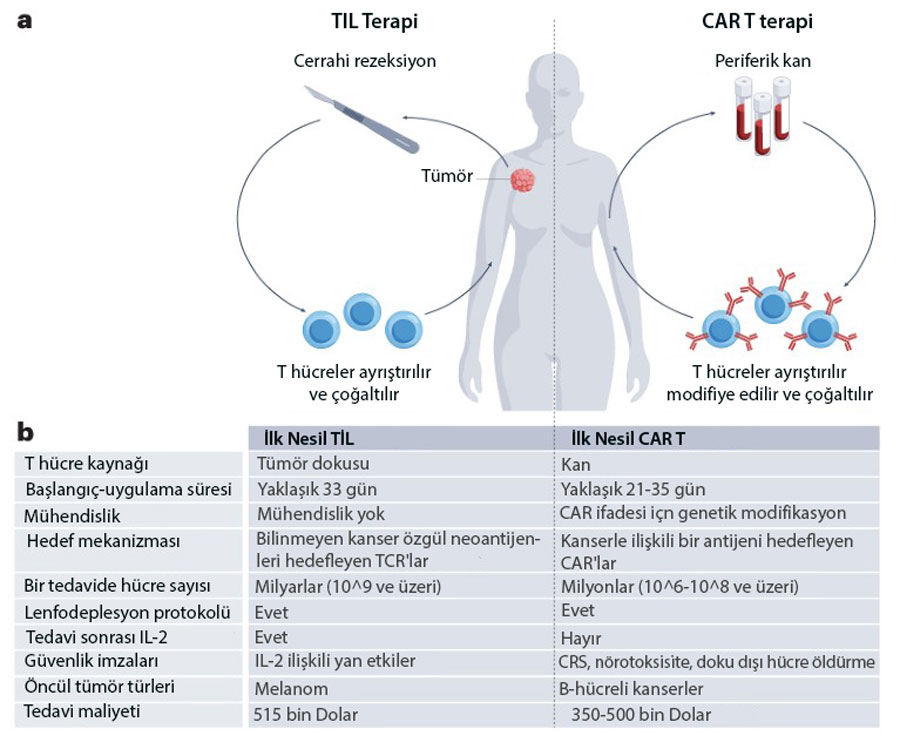
- TIL therapy uses T cells obtained directly from tumor tissue and expanded, whereas CAR T therapy genetically modifies T cells obtained from peripheral blood to express special receptors (CARs) targeting a cancer-associated antigen.
- TIL therapy uses tumor-derived T cells without genetic engineering, while CAR T therapy genetically alters T cells to express a CAR specific to the cancer target.
- TIL therapy is generally recommended for solid tumors such as melanoma, while CAR T therapy is used more often for hematological malignancies such as B-cell cancers.
- The duration of intravenous administration is approximately 33 days for TIL therapy, compared with around 21-35 days for CAR T therapy.
Commentary
The approval of ipilimumab for melanoma in 2011 marked a turning point in cancer treatment, and immunotherapies subsequently began to be used in many cancer types. Lifileucel's FDA approval, again putting melanoma treatment at the forefront, enables cellular therapies to enter the range of effective treatment alternatives not only for melanoma but across a broad spectrum of cancers. This advance lays the groundwork for discovering more effective ways to fight cancer and opening new doors for patients seeking hope.
Sources
Was this article helpful?
Your feedback helps us improve our content.




Reader comments
Share your comment
Your name and comment are published only after administrator approval. Your email address is never shown to visitors.
Be the first to comment.