
Another New Target Takes the Stage in Cancer Immunotherapy

Immune System cells have the important task of continuously scanning our body for cells that, for various reasons, have acquired malignant features—that is, have become cancerous—and destroying them. However, some cells that acquire malignant features can evade this mechanism for various reasons.
Tumor cells develop various strategies to evade the immune system's antitumor effects: they can reduce their own antigen presentation or turn the tumor microenvironment to their advantage by producing immunosuppressive cytokines (such as IL-10 and TGF-β) that suppress immune cells. They also recruit immune cells with immunosuppressive and immunoregulatory properties to the tumor microenvironment. Cancer immunotherapies also target these pathways through which tumor cells suppress immune cells. Understanding the mechanisms tumor cells use to perform this function is therefore important for developing effective immunotherapies.
T Cells and natural killer (NK) cells require an activating signal (co-activation) at the same time as antigen presentation in order to become active. If this co-activation is inhibitory (co-inhibition) rather than activating, T cells become anergic: they do not attack cells carrying the presented antigen. Examples of elements that activate the immune system against cancer by inhibiting these immune checkpoints include CTLA-4 (cytotoxic T lymphocyte-associated antigen 4), PD-1 (programmed cell death 1) and its ligand PD-L1. The monoclonal antibodies developed against these have shown clinical benefit in 15 different types of malignancy, and their use is becoming increasingly widespread. Discovered in 2009, TIGIT has entered early clinical trials as a new immune checkpoint target in cancer immunotherapy.
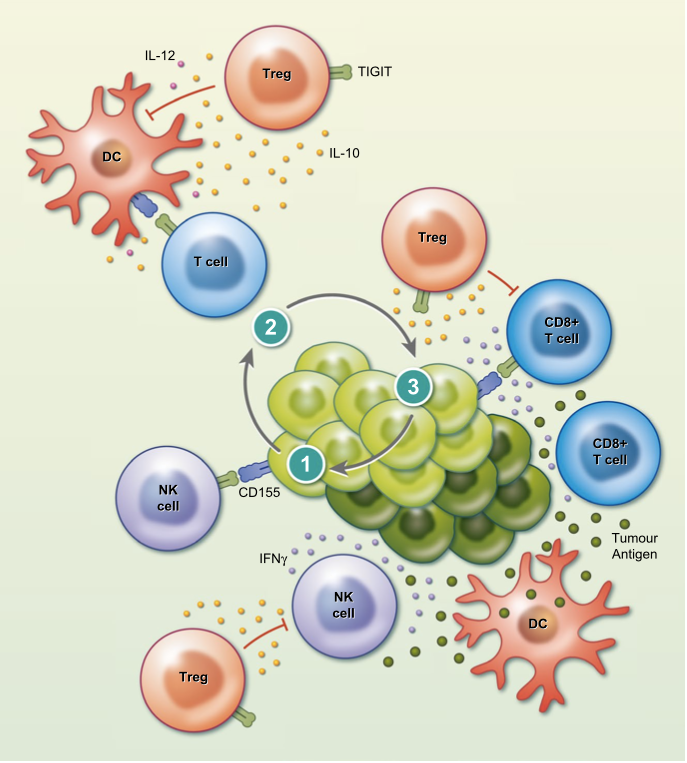
TIGIT and DNAM-1 are found on the surfaces of T cells and NK (natural killer) cells, and their shared ligand is CD155. When CD155 on the surface of an antigen-presenting or tumor cell binds to DNAM-1 on cytotoxic T cells, it enhances T-cell activity. By contrast, CD155–TIGIT binding causes co-inhibition, resulting in the suppression of T cells and other immune cells. There are 3 main mechanisms in this process:
- TIGIT can cause dendritic cells to become inactive; it increases the release of immunosuppressive cytokines while reducing IL-12 and interferon-gamma release. This also reduces the other adaptive immune response.
- Normally, NK cells break down tumor cells and increase the release of antigens into the surrounding environment. Antigen-presenting cells then process and present these antigens, increasing the adaptive immune response. However, TIGIT reduces NK cell activity.
- TIGIT directly suppresses tumor-specific CD8+ T cells. This reduces tumor-cell destruction and inhibits antigen presentation. In addition, T regulatory (Treg) cells expressing TIGIT can suppress cytotoxic T cells, NK cells and dendritic cells at different stages.
The Table Below shows immune checkpoint elements and the immune-system cells on which they are found.

Sources
Was this article helpful?
Your feedback helps us improve our content.




Reader comments
Share your comment
Your name and comment are published only after administrator approval. Your email address is never shown to visitors.
Be the first to comment.