Avery and DNA: How a Pneumococcus Experiment Pointed to the Molecule of Heredity, 1944
In this article
Avery and DNA: How a Pneumococcus Experiment Pointed to the Molecule of Heredity, 1944
On Day 117 we saw how the shared language that describes disease was built: tumor, node, distant spread. Today we move away from tumors, because one of the questions that comes closest to cancer was asked not in a tumor laboratory but in a room studying the capsule of a pneumonia bacterium: by what molecule is a cell's trait, a piece of hereditary information, carried from one place to another? This piece tells the answer to that question and keeps the promise I made at the end of Day 117: I will test against sources how this story really connects to the history of cancer.
Griffith's surprising mouse
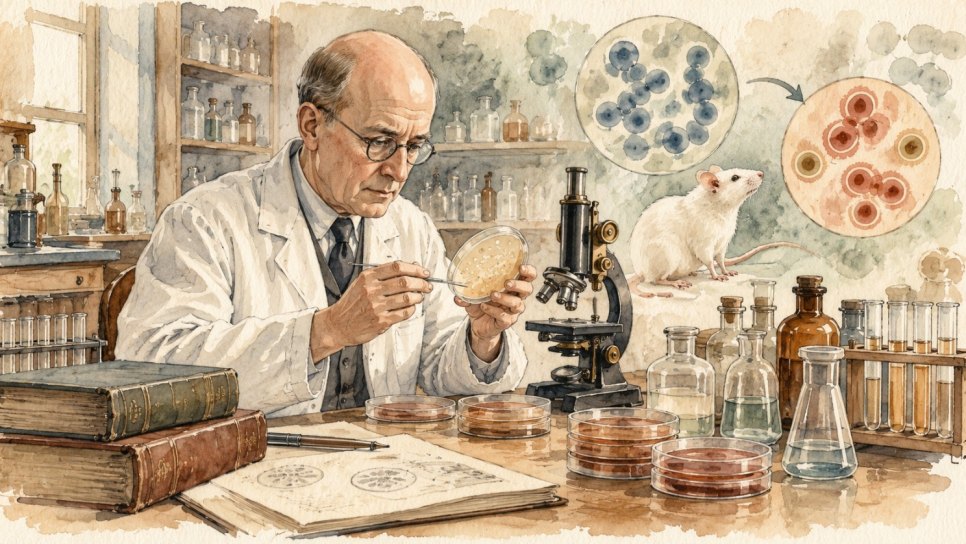
In 1928 the British bacteriologist Frederick Griffith published an experiment with the pneumococcus, the bacterium of pneumonia. It had an encapsulated, disease-causing form (type III) and an unencapsulated, harmless form (type II). Griffith showed that when heat-inactivated encapsulated bacteria were mixed with live unencapsulated ones, the live bacteria acquired a capsule and could cause disease; he had seen this both in mice and in the test tube. Something was passing from the heat-inactivated cells to the live ones and changing a hereditary trait. Griffith called it the "transforming principle". What it was remained unclear.
This finding stayed a riddle for sixteen years. The question was the chemical identity of the substance that changed a bacterium's capsule: protein, carbohydrate, lipid, nucleic acid? The common view of those years was that hereditary information could be carried by proteins, since proteins were thought to be very varied and complex; DNA looked like a "too simple" molecule made of four building blocks.
One laboratory, one substance, three authors
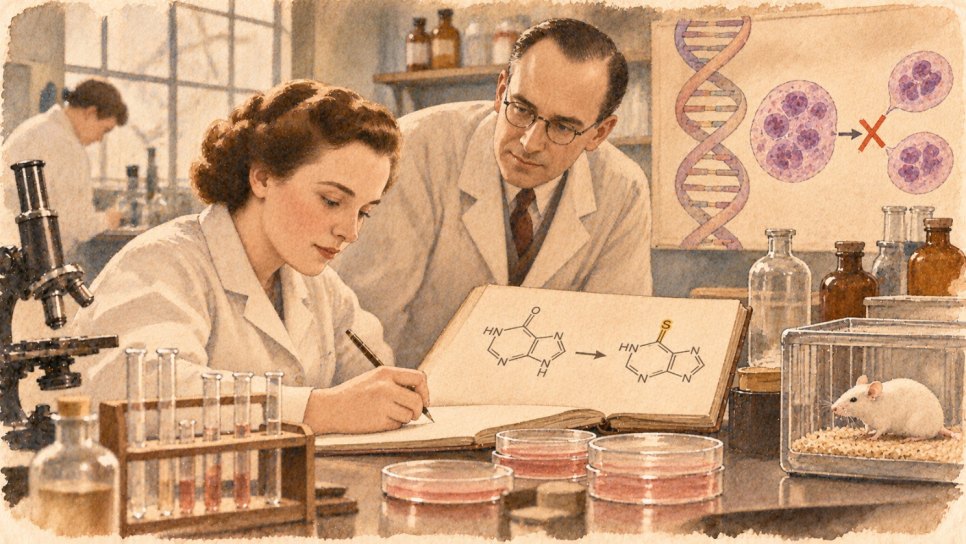
From 1940 Oswald Avery took the question up again at the Hospital of the Rockefeller Institute. Avery had worked at this hospital since 1913 and for thirty-five years had dealt almost only with the pneumococcus. Maclyn McCarty joined the laboratory in 1941; Avery and McCarty refined the preparation techniques developed by Colin MacLeod and isolated a biologically active substance from pneumococci. Transformation could not at first be reproduced reliably; once it became reliable, they showed that with the highly purified substance they could obtain lasting type III colonies from type II cultures. Enzymes that break down proteins and lipids did not inactivate the substance, and neither did the enzyme that breaks down RNA; the substance had a high molecular weight and reacted strongly to the Dische test used for DNA. The conclusion: the transforming principle was DNA.
In early April 1943 the three researchers presented their findings to the Institute's Board of Scientific Directors. A 14-page letter that Avery wrote to his brother Roy on 13 May 1943 is known; it is reported to convey both his excitement about the work and his worry that the findings would not be accepted. He is said to have written that he thought the substance might behave like a virus or a gene (conceptual summary). Avery had taken skepticism into account from the start; a study he had carried out years earlier with his colleague Alphonse Dochez had stirred controversy. So he submitted the finding to months of internal review at the Hospital, and in the paper he stated openly that the activity might come from a very small amount of some other substance accompanying the DNA (conceptual summary). The paper published in 1944 in the Journal of Experimental Medicine (volume 79, issue 2, pages 137-158) argued that the substance was DNA, while framing its interpretation with caution.
Why was it not accepted at once?
The first reaction was mixed. Some contemporaries saw at once that transformation carried genetic material between bacteria and that this material was most likely DNA; many were unconvinced, thinking DNA too simple to carry heredity. Avery's colleague at the Institute, Alfred Mirsky, argued that the active agent was a protein bound to DNA, and that some protein might have remained during purification and contaminated the DNA. The objection was not absurd: H. Bentley Glass of Cold Spring Harbor describes, in 1946, that purification was not complete enough to convince everyone that no protein remained (conceptual summary). The same year two new papers by Avery and McCarty showed that the enzyme that breaks down DNA (DNase) destroyed the activity; McCarty later wrote that these data left little room for skeptics (conceptual summary).
What followed came like a chain. Erwin Chargaff, after reading the 1944 paper, turned his laboratory from lipoproteins to nucleic acids and by 1950 had shown that base ratios in DNA vary from species to species: DNA was more complex than assumed. In 1952 the bacteriophage experiment of Hershey and Chase showed that only DNA enters the bacterium from the virus, and many counted it as the final confirmation; Watson and Crick's structure paper of 1953 followed (on a later day of the plan). In 1944 conditions the circulation of publications was limited and the journal had a narrow readership; even so, the paper is reported to have received more than three hundred citations by 1954.
WHAT IS GENETIC MATERIAL?
The molecule that carries the hereditary traits of a cell or an organism from one generation to the next is called genetic material. The 1944 experiment showed that in bacteria this is DNA: purified DNA could transfer the trait of one pneumococcal type to another.
This finding is an experiment done in the laboratory with a bacterial species. It cannot be generalized at once to human cells; the evidence of the following decades supplied the generalization.
The link to cancer history: what is there, what is not
Combing the sources, I found nothing showing that the 1944 paper was about cancer: Avery worked with the pneumococcus, and the summary sources I used contain no discussion of cancer. I have not read the paper itself; so I say that the link lies not inside the paper but around it.
The link is this, and it is my own reading: on Day 98 we saw Boveri's hypothesis that cancer might arise from chromosomal imbalance, on Day 99 Yamagiwa's tumor produced with tar, on Day 97 Rous's sarcoma transmitted by a virus. All three narratives left the same question open: what keeps a cell cancerous, what is passed on to later cells as it divides? A hereditary change can be asked about concretely only once the molecule of heredity is known. The 1944 experiment showed that in bacteria this molecule is DNA; the question that turned into cancer was whether a change in DNA could start cancer in human cells, and the answer came much later. So 1944 is not an answer for cancer but the moment a question moved.
I should also state the limit of this link plainly: that DNA is the molecule of heredity does not prove that cancer arises from a change in DNA. That proof came much later, with oncogenes and tumor suppressor genes, and will be told separately on later days of the series. What 1944 did was to make the question askable.
There is also a heavier link, and it is not an interpretation but a record: Avery lost his life on 20 February 1955 in Nashville, from extensive liver cancer found at an operation at the end of the summer of 1954; he was 77.
COST: A PIONEER LEFT WITHOUT A PRIZE, AND THE DILEMMA OF CAUTION
Avery was not awarded the Nobel Prize. A secondary source (Gregory Petsko) writes that Avery's team was nominated repeatedly after 1944 and that Mirsky worked against this recognition for years; but I could not verify the years of nomination or the committee's reasons from this source. So I cannot answer "why it was not awarded" with certainty. The "wrong Nobel" motif we have followed through the series (Day 99 Yamagiwa, Day 102 Fibiger) returns here in another form: this time a pioneer who was never awarded.
The second dilemma is Avery's own caution. The paper presented its result in language that was not overclaiming; this was scientific honesty, but it also left readers a door saying "it could be another substance". I cannot say whether this caution delayed acceptance: the same secondary source calls the claim that Avery's work was not appreciated in his lifetime "nonsense" and writes that by 1952 it was generally accepted that genes are made of DNA.
What remains
- That DNA is the molecule of heredity, through the independent evidence of the following decades
- The model of testing a result by several independent methods (enzymes, chemical tests)
- A question that emerged from a bacterium and touches cancer too: what is a hereditary change?
What fell or was overcome
- The assumption that "only protein can carry heredity"
- The expectation that a single experiment would close every doubt: a chain of tests from 1944 to 1952 was needed
- The objection that the purified substance might still be contaminated with protein (weakening steadily after 1946)
From the transforming principle to DNA. The axis runs from 1928 to 1952; ticks mark decades. Orange boxes are the precursor and the confirmations that followed, green boxes are Avery's team. Scale approximate.
The road of this experiment to Turkey
I could not reach a verified source on when and by whom Avery's experiment was first recognized in Turkey, so I give no date or person. The general inference is this: no laboratory that today examines the DNA changes in a patient's tumor could have been set up without knowing that the molecule of heredity is DNA. In the part of the series devoted to Turkey, the country's history of molecular diagnosis will be tested against sources.
FROM 1928 TO 1953
WHAT WAS CONFIRMED, WHAT CONFLICTS
- Date of the paper: A historical review (2024) gives the paper as 1 February 1944, J Exp Med volume 79 issue 2, pages 137-158. Another source (NLM) says the manuscript was submitted in December 1943 and published "in spring 1944". The two may be mixing the journal issue date with the submission date; since I did not read the paper myself, I could not resolve the conflict.
- The letter: The date of 13 May 1943 and the 14-page detail come from a single secondary source (a science magazine article; the whole requires membership). The NLM page says only "May 1943". I did not reach the full text of the letter and summarized its content conceptually.
- Avery's age: The NLM biography says born 21 October 1877, lost his life on 20 February 1955 in Nashville; that corresponds to 77. A Harvard page writes 76. I went with the dates.
- Cause of his loss of life: "Extensive cancer of the liver", found after an operation during a vacation on Deer Isle in late summer 1954 (NLM biography). A single source.
- Nobel: The only record I found for Avery in the Nobel nomination archive is from 1938: by G. van der Schueren (Louvain), for "the role of carbohydrates in bacterial immunity". I could not verify the years of nomination for the DNA finding or the committee's reasons. The claim that "Mirsky blocked it" rests on a single secondary source (Petsko); I passed it on as an interpretation, not as fact.
- Lasker 1947: The NLM writes that Avery received the 1947 Lasker Award; a Harvard page notes that the citation praised studies of the antigenic structure of bacteria, not the DNA finding. I took this detail second-hand.
- MacLeod's role: The NLM writes that Avery and McCarty refined MacLeod's preparation techniques and that MacLeod moved to New York University in 1940; I did not detail MacLeod's full contribution as an author of the paper in this piece.
- The 1946 papers and the 1954 citations: From the NLM's "After the Discovery" page; I did not read the original papers. "More than 300 citations" is reported as Lederberg's view.
- Griffith and the letter quotation: I did not read Griffith's 1928 paper itself; the detail is from the 2024 review. The quoted line in the letter of 13 May (virus or gene) is a secondary fragment; I did not give it verbatim.
- Out of scope: Hotchkiss's later work, the molecular mechanism of transformation and Avery's earlier polysaccharide work will be covered later or not at all; not verified here.
The Long Shadow of Hiroshima (1945)
Today we saw the molecule of heredity in a bacteriology laboratory. Tomorrow we go to August 1945: Hiroshima, and how radiation becomes visible in the human body as cancer after years have passed. I will test the dates and figures against sources before writing.
Author's note: What I tried hardest to avoid in writing this piece was tying the 1944 experiment to cancer by force. There is no such link in the sources; the link lies in the molecule by which the cancer question can be asked. I did not read Avery's paper or letter in the original; the account rests on the 2024 historical review, the NLM's Avery archive pages and secondary writing.
Sources and further reading
- Avery OT, MacLeod CM, McCarty M. Studies on the chemical nature of the substance inducing transformation of pneumococcal types. J Exp Med 1944;79(2):137-158. doi:10.1084/jem.79.2.137. (Citation from the 2024 review; the paper itself was not read.)
- Greenspan NS. Historical Highlight: The Chemical Characterization of the Pneumococcal Transforming Principle. 2024 (PMC10906958).
- U.S. National Library of Medicine, Profiles in Science. The Oswald Avery Papers: "DNA as the 'Stuff of Genes'", "After the Discovery" and "Biographical Overview" pages (online).
- Petsko G. Writing on the Nobel Prize and Avery; Harvard page "The River Divides into Thousands of Branches" (online, secondary).
- The Scientist. "The Transforming Principle" (only the opening could be read).
- Nobel Prize Nomination Archive. Oswald T. Avery, Physiology or Medicine, nomination of 1938 (nobelprize.org).
- Mukherjee S. The Emperor of All Maladies: A Biography of Cancer. New York: Scribner, 2010. (Not separately verified for this piece.)
This piece is Day 118 of the "365 Days of Cancer History" series and tells the history of the demonstration that DNA is the molecule of heredity. It is a historical-popular account, not a diagnostic or treatment recommendation. Consult your physician about your own health. Sources have been verified; details resting only on a secondary source are marked in the fact-check notes.
Was this article helpful?
Your feedback helps us improve our content.