The Cobalt "Bomb": The Beam Source That Replaced Radium and the Noise in Its Name (1951-1954)
In this article
The Cobalt "Bomb": The Beam Source That Replaced Radium and the Noise in Its Name (1951-1954)
Yesterday a drug had produced remissions in childhood leukemia by imitating a building block of the cell. In the same years something was changing in radiotherapy as well: the source of the beam. On Day 92 we saw the X-ray tube, on Day 94 radium. Now a machine steps onto the stage and the press calls it a "bomb". The sources do not say outright where the name came from; they do say what the beam changed in treatment. In this article I tell the two separately, because the question of who was "first" also has more than one answer.
A physicist, a machine shop
Harold Johns took up his post at the University of Saskatchewan in 1945 as Canada's first full-time cancer physicist (according to the Encyclopedia of Saskatchewan). The university had treated its first patient with the betatron in 1949 (29 March 1949); the cobalt idea was added alongside it in those years. It is said that Johns learned of the cobalt-60 source at Chalk River Laboratory in 1946; another source records that in July 1949 he requested about 1,000 curies of cobalt-60.
Cobalt-60 was obtained by irradiating natural cobalt-59 with neutrons in the NRX reactor at Chalk River. The body of the machine was built by John MacKay of the Acme Machine and Electric company in Saskatoon. Sylvia Fedoruk carried out the calibration that made the machine's dose calculable before any patient was irradiated.
Eleven weeks of calibration
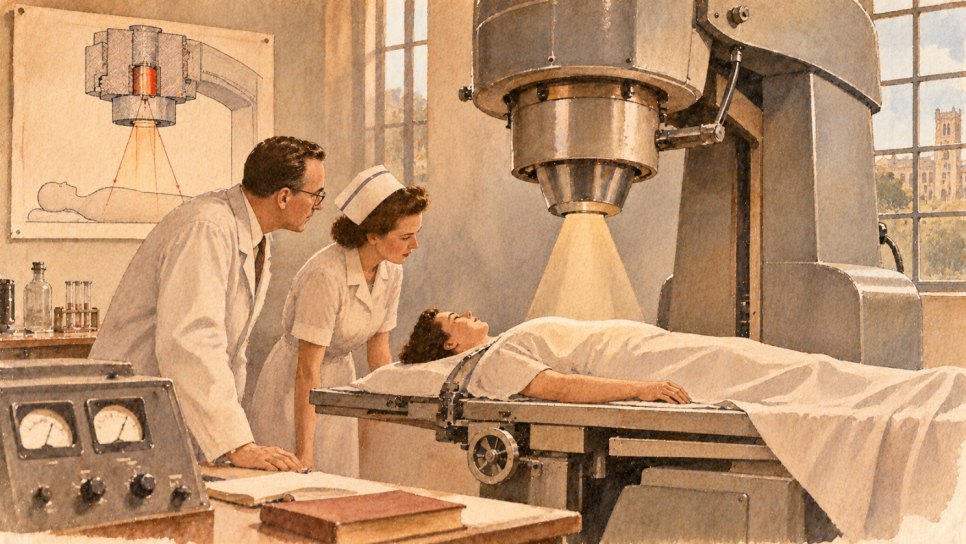
According to the Encyclopedia of Saskatchewan, the unit was installed in the cancer wing of University Hospital on 17 August 1951. It weighed about 0.9 tonnes; the source was 2.5 centimeters in diameter and 1.25 centimeters thick, with a strength of about 1,000 curies. According to the University of Saskatchewan's exhibit, a steel-encased lead cylinder hung from an overhead carriage; the beam descended through a treatment cone to the tumor, and a collimator made of lead bars enlarged or reduced the beam field to fit the tumor. The collimator was designed by MacKay and Johns.
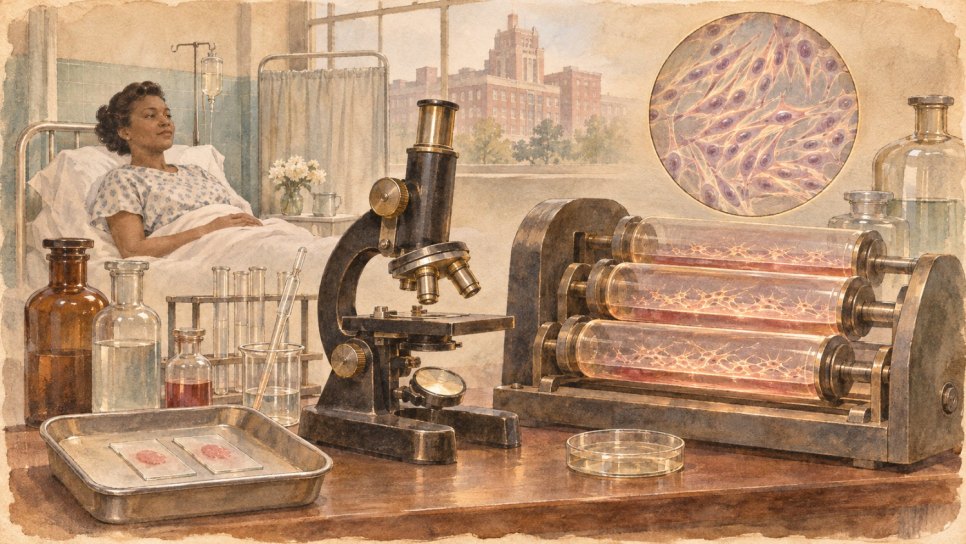
According to the university's timeline, the first patient was treated on 8 November 1951, after eleven weeks of calibration: a woman with advanced cervical carcinoma. Her age is 43 in one source and 40 in another; her survival is "another 47 years" in one and "to age 90" in another. I do not pick a single figure in this article. Cervical cancer is on stage again: on Day 93 we saw Wertheim's operation, on Day 94 the first use of radium; on Day 126 a cervical sample turned into HeLa in the same year.
The same autumn, two cities
The same autumn another machine was being readied in Ontario. According to the Western News article, the cobalt-60 source was installed at Victoria Hospital on 16 October 1951; staff of the National Research Council had calibrated the source in advance. The first cancer treatment took place on 27 October 1951 under the clinical direction of Ivan Smith. This machine was the work of Atomic Energy of Canada Ltd. and the Eldorado Mining Company, and according to the same article it was called the "Eldorado Cobalt Bomb".
From here comes the first question of "first": the first treatment with cobalt-60 took place in London on 27 October and in Saskatoon on 8 November. The University of Saskatchewan, for its part, presents its machine as the "world's first calibrated cobalt-60 unit". Western News calls Johns the "inventor" of cobalt machines while also noting that Saskatoon's first treatment came after London's. So I limit the "first" claims: the first recorded treatment is in London, the claim of the first unit calibrated over eleven weeks is in Saskatoon. How the two groups were related is also told differently in the sources; the detail is in the fact-check box.
The rivalry in the press is on record too. The Saskatoon Star-Phoenix answered the London Free Press's claim of "the world's first cobalt bomb" with an editorial titled "The Cobalt 'Bomb'". The date of the editorial conflicts within the source (7 March and 7 November 1951); since the machines were installed between August and October 1951, I think it cannot have been March and that it was November.
The tumor instead of the skin
The problem of radium units is summarized in the 1951 Nature paper by Johns and his team: small radium sources give little radiation; to obtain an adequate dose rate the source has to be brought within a few centimeters of the tumor, and then the skin receives more dose than the tumor, and the dose falls steeply with depth. The same paper carries the title "1,000-curie cobalt-60 units". A strong, high-energy source can be placed far from the patient; the dose reaches deep while the skin is relatively spared. I take this detail about sparing from a photo caption in the University of Toronto magazine and from general radiation physics; I did not read the body of the original paper.
Cobalt-60 emits two gamma rays (1.17 and 1.33 MeV; about 1.25 MeV on average). The earlier X-ray tubes were in the 50-150 keV range and could treat only superficial tumors. Radium was strong but scarce: according to a secondary source, in 1937 a gram cost 25,000 dollars and there were about 50 grams in the world for teletherapy. Cobalt made the dose rate and depth reaching the tumor no longer dependent on the scarcity of radium.
Why "bomb"?
None of the sources I read explains why the name was given. What is known is this: in 1951 the London Free Press spoke of "the world's first cobalt bomb"; the Saskatoon newspaper answered with an editorial; and in 1952 Maclean's magazine published an article titled "The Atom Bomb That Saves Lives". In the same years another "cobalt bomb" idea was also in circulation: Leo Szilard described the concept of a doomsday weapon in a radio program on 26 February 1950 (according to a secondary source; Szilard was not proposing that such a weapon be built). I found no source that links the two usages. I think there may be a link, but that is an inference.
The metaphor carried by the name conflicts with the series' language rule; I use it only as a historical name, in quotation marks. Stuart Houston and Sylvia Fedoruk later described the machine as "a ploughshare rather than a sword" (University of Saskatchewan exhibit).
The third story: Grimmett
A third story, independent of Ontario and Saskatoon, is in Houston. The British medical physicist Leonard Grimmett had come to M.D. Anderson. According to a summary of Peter Almond's biography of Grimmett, Grimmett may have been the first person to publish, in 1950, the design of a cobalt-60 unit; Almond also argues that J. S. Mitchell's 1946 paper started the cobalt era. Grimmett lost his life to a heart attack at the age of 49 on 27 May 1951, before the machine was finished. The unit was moved from Tennessee to Houston under police escort in September 1953; the first patients were treated on 22 February 1954 (M.D. Anderson's own history page). The cobalt had been irradiated to 800 curies in Canada.
R. Lee Clark's view was that the original idea and design belonged to Grimmett and Gilbert Fletcher; Canada, for its part, later claimed to be "first". I do not resolve this conflict: who first published the design, who treated the first patient, and who installed the first calibrated unit are three separate questions, and each answer points to a different place.
Cost and limits: the source runs down, the evidence stays incomplete
First, the source itself. The half-life of cobalt-60 is 5.27 years; sources have to be replaced about every five years, radioactive waste results, and the machines are expensive and need specialist support (according to a secondary source). In Houston the designer of the machine had lost his life and never saw it working.
Second, the evidence. The Saskatoon unit treated 6,728 patients in 21 years, but the sources do not give these patients' outcomes. The University of Saskatchewan's exhibit writes that the cure rate in cervical cancer rose from about 25 percent to 75 percent; I could not confirm this with an independent source, and I do not attribute it to a single machine, because staging, surgery and care changed in the same years too. The long life of the first patient is an impressive story, not evidence.
Third, the technology that replaced it. Linear accelerators produce higher-energy radiation without radioactive waste and have partly replaced cobalt units; even so, cobalt units remain in wide use because they are reliable and simple to maintain (according to a secondary source).
What remains
- A megavoltage beam placed far from the patient that reaches deep
- The habit of giving a dose only after calibration
- Cobalt-60 units still in use today
What fell or was limited
- The place of radium in teletherapy
- The low-energy X-ray tube alone for deep tumors
- The habit of attributing the first treatment to a single person or city
Time from installation to first treatment on cobalt-60 units, autumn 1951. Bar length is proportional to the number of days. For Saskatoon, installation was 17 August and the first patient 8 November 1951 (Encyclopedia of Saskatchewan and the University timeline); for London the source was installed on 16 October and the first treatment took place on 27 October (Western News). The London source had been calibrated in advance; the Saskatoon calibration took 11 weeks. This difference may explain how London treated earlier although installed later; that is an inference. Houston's installation day is not in the sources, so it is not drawn.
Cobalt at Çapa
I could not find a verified source on when the first cobalt teletherapy machine came to Türkiye. Two texts on the history of radiotherapy published in the Turkish Journal of Oncology mention a cobalt-60 afterloading device: one says it was installed at Çapa in 1964, "third in the world"; the other writes that it entered service at the end of the 1960s. The two do not agree, and both are brachytherapy devices, not teletherapy "bombs". I could not reach the titles and authors of the texts because access to the site is restricted. A general inference (not from a source): cobalt-60 devices are still used in many countries today; for the patient what matters is less the name of the machine than the oversight of planning and calibration.
From 1946 to today
What was confirmed, what conflicts
- Johns's cobalt idea: The ASTRO article says he learned of it at a Chalk River meeting in 1946, the Encyclopedia of Saskatchewan says he requested about 1,000 curies in July 1949, and Wikipedia (secondary) says he asked the National Research Council for cobalt-60 in 1949. There is no single date that joins them; they may be two separate events.
- Saskatoon first patient: 8 November 1951 (Encyclopedia of Saskatchewan and the University timeline); a reader comment under the University of Toronto magazine says 11 November, unconfirmed. University news items say only "November 1951". The patient's age is 43 (University) or 40 (Encyclopedia); survival "another 47 years" or "to age 90".
- London first treatment: 27 October 1951 (Western News, Wikipedia). The hospital name is Victoria Hospital in Western News; Wikipedia gives a children's hospital in London; I did not resolve it. Details such as the Eldorado A model, Roy Errington and Donald Green are only in a reader comment; unconfirmed.
- The order of "first": Western News counts London as the world's first cobalt-60 treatment but names Johns the "inventor". The University of Saskatchewan maintains the first-calibrated-unit claim. I reported both and passed no judgment.
- Editorial date: The Star-Phoenix "The Cobalt 'Bomb'" piece is given on the same page as both 7 March and 7 November 1951. Preferring November is an inference.
- The name "bomb": No source gives its reason. The University timeline says Maclean's picked up earlier usage; the University of Toronto magazine attributes the name to Maclean's; Wikipedia writes that it was called that "jokingly" in 1952. The sources do not agree. The Szilard link is my inference; the Szilard date (26 February 1950) is a secondary source.
- Grimmett: The wording "the first person to publish the design in 1950" is from a summary attributed to Almond (Brad Roth's Medium post); I did not read the book. The date of his loss of life (27 May 1951, age 49) is from the M.D. Anderson page. The year Grimmett came to M.D. Anderson conflicts: 1948 (summary) and 1949 (institution page).
- The relation of the two groups: The ASTRO article says Johns's group built prototypes together with colleagues in London; Wikipedia (secondary) writes that two groups designed and built separate machines and does not say which was built first.
- Houston: That the machine was moved from Tennessee in September 1953 and that the first patients were treated on 22 February 1954 is from M.D. Anderson's own page; the installation day is absent.
- Machine details: 0.9 tonnes, 2.5 cm diameter, about 1,000 curies: Encyclopedia of Saskatchewan. The collimator: University exhibit. I read only the abstract page of the Nature paper.
- The cure-rate claim: "From 25 percent to 75 percent" is only in the University exhibit; its basis is unclear, and I did not take it into the text as a finding.
- Radium price and quantity: From Wikipedia (secondary); I did not see it in a primary source.
- Türkiye: The identity of the two texts (title, author) could not be verified; the dates (1964; the end of the 1960s) conflict.
The Code of DNA (1953)
So far we have seen the building blocks of the cell (Day 127), the idea of heredity and cancer (Day 98), and the source of the beam. In 1953 a one-page paper proposed the structure of a molecule in the middle of this chain. Who proposed it, what place did Rosalind Franklin's data hold in this story, and what does it have to do with cancer? Tomorrow I will tell it after verifying the dates and the records.
Author's note: The name "bomb" is the noisiest part of this article, but it tells only one thing: a change of source. Where the records did not agree, instead of saying who was first I divided the question in three: first design, first treatment, first calibrated machine. I marked the publications I did not read in the fact-check box and in the sources.
Sources and Further Reading
- Johns HE, Bates LM, Epp ER et al. 1,000-Curie Cobalt-60 Units for Radiation Therapy. Nature 1951;168:1035-1036 (only the abstract page was read).
- University of Saskatchewan. "Cobalt-60" exhibit and timeline (cobalt60.usask.ca; read; institutional and secondary).
- Encyclopedia of Saskatchewan. "High-Energy Cancer Treatment" entry (esask.uregina.ca; read; secondary).
- Battista J. Cobalt-60 celebrates 60 years. Western News, 2011 (read; secondary).
- University of Toronto Magazine. "This 'Bomber' Actually Saved Countless Lives" (read; secondary).
- M.D. Anderson Cancer Center. The Legacy of R. Lee Clark: Gilbert Fletcher and Radiotherapy (read; institution page).
- Almond PR. Cobalt Blues: The Story of Leonard Grimmett. Springer, 2012 (book not read; its summary from Brad Roth's Medium post, secondary only).
- Turkish Journal of Oncology, two texts on the history of radiotherapy (onkder.org, pdf.php?id=973 and id=826; partly read; title and author could not be verified).
- Mukherjee S. The Emperor of All Maladies: A Biography of Cancer. New York: Scribner, 2010. (Not separately verified for this article.)
This article is Day 128 of the "365 Days of Cancer History" series and tells the emergence of cobalt-60 teletherapy machines around 1951 as a historical event. It is historical-popular content; it is not a diagnosis or treatment recommendation. Consult your physician for decisions about your health. Sources have been verified; details that rest only on a secondary source are noted in the fact-check notes.
Was this article helpful?
Your feedback helps us improve our content.