Henrietta Lacks and HeLa: The Cell Line Named After a Woman, and the Question Nobody Asked (1951)
In this article
Henrietta Lacks and HeLa: The Cell Line Named After a Woman, and the Question Nobody Asked (1951)
Yesterday we split the word "first" into criteria. Today the same word attaches itself to a cell line that came out of a patient's hospital bed, and we return to yesterday's question: why was HeLa named after a woman, and did that woman know the sample had been taken? The short answer has two parts. The name comes from the first two letters of Henrietta Lacks's first and last names; every secondary source I read says the sample was taken without her knowledge and consent, while Hopkins's own page does not describe any consent process. The details are more scattered than we might expect.
A lump, a hospital, a treatment
Henrietta Lacks was born on 1 August 1920 in Roanoke, Virginia, as Loretta Pleasant; some sources give the date as 2 August. She spent much of her childhood in Clover, largely with her maternal grandfather. In 1941, so that her husband Day Lacks could work at the steel plant at Sparrows Point, the family moved to Turner Station near Baltimore. She was the mother of five children.
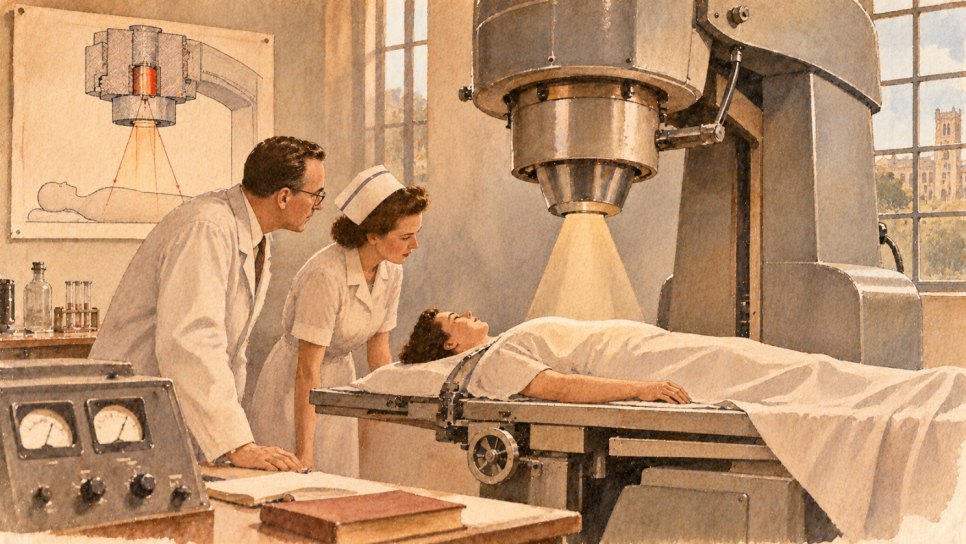
According to a secondary source, on 29 January 1951 she went to the Johns Hopkins Hospital because she felt a "knot" in her abdomen. The hospital's own page records that the gynecologist Howard Jones found "a large, malignant tumor" on her cervix, and that according to medical records she began radium treatments, which it describes as the best treatment then available for this disease (day 94 for radium and brachytherapy). If we recall the first two fronts of cervical cancer, Wertheim's operation (day 93) and the Pap smear (day 103), Lacks's treatment falls on the radiotherapy branch of that chain.
Two small pieces of tissue
According to the sources, two small samples were taken from the cervix during treatment: one from the tumor, one from nearby healthy tissue. The samples were sent to George Otto Gey, who headed the tissue culture laboratory nearby. The patient did not know a sample had been taken and had not consented to it; Britannica Kids and other secondary sources agree on this. The hospital's page does not describe a consent process; it says only that at the time the practice was "acceptable and legal."
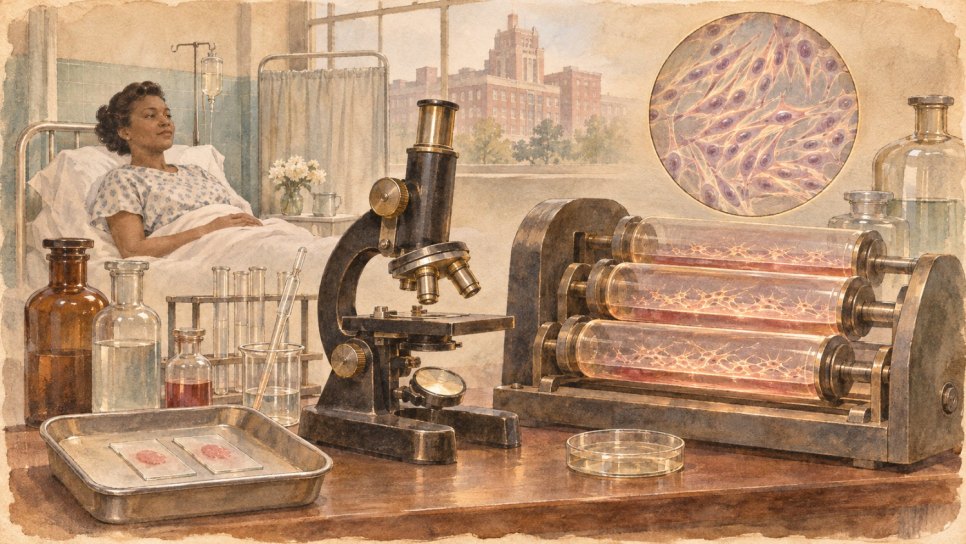
Gey and his wife Margaret had spent years trying to keep human cells multiplying continuously in the laboratory; every earlier sample had stopped dividing after a few divisions. Lacks's tumor cells, in Hopkins's wording, doubled about every 20 to 24 hours. Gey's laboratory assistant Mary Kubicek put the cells into culture in roller tubes, and the cell line was called HeLa, using the first two letters of the first and last names, which according to secondary sources was meant to protect the donor's identity.
Henrietta Lacks lost her life on 4 October 1951, at the age of thirty-one. A partial autopsy showed that the cancer had spread through her body. She was buried in an unmarked grave in the family cemetery at Clover; the exact spot is not known, and a headstone was placed there in 2010.
A paper, a factory, a correction
Gey, Coffman and Kubicek's short report, "Tissue culture studies of the proliferative capacity of cervical carcinoma and normal epithelium," appeared in volume 12 of Cancer Research in 1952, pages 264-265. I did not read this report; I took its citation and description from a medical-history catalog. The catalog notes that when it was published nobody knew why the cells could multiply without limit. That "why" will come back from another direction in later days.
The word "first" has to be tied to a criterion here too. HeLa is described in the sources as the first human cell line that could be propagated continuously; earlier human cultures, including Gey's own older attempts, were short-lived. I have not tested this "first" against an independent source; I can say only that it holds under the criterion "continuously multiplying."
The first large use of the cells came with the polio vaccine work. According to Scientific American, a HeLa "factory" at Tuskegee, Alabama, directed by Russell W. Brown, head of the Carver Research Foundation, with cell culture supervisor Norma Gaillard improving the procedure, was set up in April 1953; about 400,000 glass tubes were prepared for the field trial of the Salk vaccine, which began on 26 April 1954. The cells went by air to about two dozen medical laboratories. The article's title attributes this work to "hidden Black scientists"; the source of the cells was a Black patient. The two are parts of the same story.
The self-correction of science stepped in here as well. Stanley Gartler showed, in a 1967 review and in Nature in 1968, that 18 human cell lines believed to be independent had identical genetic markers, and that they may have been contaminated with HeLa. Later Walter Nelson-Rees developed a method to identify contaminated lines. I report this part only from secondary sources.
"Consent" is three separate questions
In this story "consent" is more than a single concept. The first is consent to treatment: did the patient agree to radium for the tumor in her cervix? The sources I read do not discuss it. The second is consent to a research intervention: this was the main subject of the principles written at Nuremberg in 1947 (day 121). The third is consent to tissue taken during treatment turning, without the patient's knowledge, into research and later into genetic information. I am drawing this three-way distinction myself; the sources do not put it in these words. According to Hopkins, asking this third question was not required in 1951; today it is at the center of the legal and ethical debate. The American reception of the Nuremberg principles was also weak in the 1950s: many researchers found them unworkable (Lederer).
Cost and limits: not only a matter of law
First, context. While saying that the practice was legal at the time, Johns Hopkins acknowledges, after reviewing its relations with the family over more than 50 years, that it "could have, and should have, done more." In the New York Times summary on Carl Zimmer's site, Lacks is described as a poor Black woman, and it is written that the family was left out of these studies for 62 years. I cannot separate the individual shares of race and poverty from these sources; I note them as context, not as a causal claim.
Second, the family. The family learned of the cell line in 1973 (according to the NYT summary, when a researcher asked for blood samples from her children) or in 1975 (according to the main text of a secondary source); the public learned the source of the cell line in March 1976 through Michael Rogers's articles in the Detroit Free Press and Rolling Stone, though the articles gave the name wrongly as "Helen Lane." I have set out the conflicting dates in the fact-check box.
Third, the genome. In March 2013, researchers from the European Molecular Biology Laboratory published a HeLa genome sequence; no one in the family knew. The family objected, and the data were withdrawn. According to the words of her granddaughter Jeri Lacks Whye reported in the NYT, the family's main concern was privacy: information about her children and grandchildren could be derived from the sequencing (conceptual summary). In August 2013 the NIH and the family announced an agreement: the data would be held in the NIH's database of genotypes and phenotypes, researchers would apply and file annual reports, and two family members would sit on a six-member access committee. The agreement gives the family no share of commercial products. Richard Sharp, a bioethicist at the Mayo Clinic, described it in the NYT as a one-off solution and said a broader policy was needed (conceptual summary).
What remains
- The idea of a continuously multiplying human cell line, and its culture methods
- Shared cell material used in virus studies and vaccine trials
- The question of who owns tissue and what the patient should know
What fell or was limited
- The assumption that no one needs to ask about an extra sample taken during treatment
- The assumption that shortening a name hides the donor
- The assumption that genome data belong only to a cell line
The path of the cell line and who knew what, on one timeline. The top row shows what happened to the cell line, the bottom row the situation of Henrietta Lacks and her family. Red: did not know or was not informed; orange: learned partly or wrongly; green: agreement with the family. The gap between 1973 and 1975 varies by source, so both years are written together in a single cell. The column headings are date ranges, not equal spans of time.
Looking at the cell line in our own laboratory
I did not find a verified source on how this story played out in Türkiye; I am not inventing a local link. I can offer a general inference: every laboratory that works with cell lines needs to ask about the origin and history of the line. Both scientific reliability (the contamination Gartler showed) and an ethical reckoning with the source depend on it. I did not examine Turkish legislation on the use of tissue and data in this piece.
From 1920 to today
What was confirmed, what conflicts
- Hopkins page: Diagnosis and biopsy 1951, radium treatment, loss of life on 4 October 1951 (at age 31), Gey's finding that the cells divided every 20-24 hours, the practice described as "acceptable and legal," the statement that more could have been done in relations with the family. The page gives no birth date, biopsy day, or name of the person who took the sample.
- Birth date: 1 August 1920; a secondary source notes that some records say 2 August. The reason for the change from "Loretta" to "Henrietta" is unknown.
- First visit: 29 January 1951 rests on a book page quoted by a secondary source (Skloot 2010); I did not read the book. Another passage quoted in the same source refers to 1950; the timeline does not fully agree with itself.
- Date of the sample: One secondary source says "8 February 1951"; Britannica Kids says "February 1951," and another summary says the sample was taken during the radium procedure. Whether the sample came from a biopsy or from the radium procedure is not settled in the sources; I used "during treatment."
- After her life ended, and the grave: The partial autopsy, the unmarked grave at Clover and the 2010 headstone come from a secondary source (Wikipedia); I did not check primary records.
- Diagnosis: Squamous (epidermoid) carcinoma in 1951; according to the secondary source, changed to adenocarcinoma in a 1970 re-evaluation. I did not see this change in a primary source.
- Gey 1952: Cancer Res 12:264-265, citation from the historyofmedicine.com entry. The report was not read; the statement that the reason "was unknown" comes from that entry.
- Name: That HeLa comes from the first two letters of the first and last names is the same in two sources. "To hide the donor" appears in a single source (an Eppendorf summary); who named it varies between sources (Gey; Gey and Kubicek).
- Tuskegee: The Scientific American article gives April 1953 and 26 April 1954, about 400,000 tubes, and the names of Brown and Gaillard. Another summary says "in 1952 HeLa helped Salk"; I did not resolve this conflict. Puck and Marcus's 1955 cloning appears in only one secondary source; I did not include it.
- Gartler: Natl Cancer Inst Monogr 1967;26:167-195 and Nature 1968;217:750-751 (from the Wikipedia page on Gartler; I did not open the primary texts). Another summary dates Gartler's work to 1968, another to 1967. The year "1966" was not verified. I gave no year for Nelson-Rees.
- When the family learned: The NYT summary says 1973, the main text of a secondary source says 1975 (1973 in a footnote of the same source). Public disclosure: March 1976, Michael Rogers (Detroit Free Press 21 March, Rolling Stone 25 March); the origin of the name "Helen Lane" is unclear, and another source says the name was used in a letter before 1973.
- 2013: Hudson and Collins, Nature 2013;500:141 (only the citation and abstract were read). The details of the agreement come from Zimmer's NYT summary; I could not open the NIH's own news page.
- Out of scope: Later legal cases about the cell line, the influence of the 2010 book, its relation to HPV, and the whole scientific legacy of the cell line.
Elion, Hitchings and 6-Mercaptopurine (1951)
It had been seen that molecules resembling the cell's own building blocks could work in cancer (day 122). In 1951 two researchers tried this idea systematically on new building blocks. What did this approach achieve, and for which disease was it first tried? I will tell it tomorrow, after verifying the dates.
Author's note: In this piece I kept on the same page both the scientific contribution of the cell line and the exclusion of a woman and her family; I did not tell one in a way that replaces the other. Where the sources conflict on dates, I did not rule; I gave the range and the source. I marked the citations I did not read in the fact-check box.
Sources and Further Reading
- Johns Hopkins Medicine. "Honoring Henrietta" (hopkinsmedicine.org/henriettalacks), read.
- Hudson KL, Collins FS. Biospecimen policy: Family matters. Nature 2013;500:141 (only the citation and abstract were read).
- Zimmer C. A family consents to a medical gift, 62 years later. New York Times, 7 August 2013 (the summary page on the author's site was read).
- Gey GO, Coffman WD, Kubicek MT. Tissue culture studies of the proliferative capacity of cervical carcinoma and normal epithelium. Cancer Res 1952;12:264-265 (citation from historyofmedicine.com; full text not read).
- Scientific American. "Hidden Black Scientists Proved the Polio Vaccine Worked," on HeLa production at Tuskegee (read).
- Lederer S. NIH bioethics course presentation on the history of consent norms, 2019 (read; course slides, secondary).
- Britannica Kids and ASU Embryo Project, entries on "HeLa Cell Line" (read; secondary).
- Skloot R. The Immortal Life of Henrietta Lacks. New York: Crown, 2010 (not read; information from secondary accounts).
- Mukherjee S. İmparatorluğun Kralı / The Emperor of All Maladies: A Biography of Cancer. New York: Scribner, 2010. (Not separately verified for this piece.)
This piece is day 126 of the "365 Days of Cancer History" series and recounts the origin of the HeLa line from Henrietta Lacks's cells in 1951 as a historical event. It is popular history; it is not a diagnostic or treatment recommendation. Consult your physician for decisions about your health. Sources have been verified; details that rest only on a secondary source are marked in the fact-check notes.
Was this article helpful?
Your feedback helps us improve our content.