Elion, Hitchings and 6-Mercaptopurine: A Drug That Imitates the Cell's Building Block (1951)
In this article
Elion, Hitchings and 6-Mercaptopurine: A Drug That Imitates the Cell's Building Block (1951)
Yesterday we asked whom a cell line belonged to. Today's question is where a drug came from. On Day 122 we saw that molecules resembling the cell's own building blocks could work in leukemia. Around 1951 two researchers applied the same idea systematically, this time to the purines, the building blocks of nucleic acids. In which disease was the drug first tried, what did it do, and what did it not solve? First, let us mark the places where the sources do not agree with one another.
A biochemist, a laboratory assistant
George Hitchings joined the Wellcome Research Laboratories in Tuckahoe, New York, in 1942 as a biochemist; he hired Gertrude Elion in 1944. The Science History Institute's page describes Elion's post as laboratory assistant, the National Academy of Sciences memoir describes it as biochemist; I have noted this small discrepancy in the fact-check box. Elion graduated in chemistry from Hunter College in 1937 and held a master's degree from New York University from 1941. She never completed a doctorate: she began evening classes at Brooklyn Polytechnic but did not want to leave her job to become a full-time student.
According to the memoir, Elion's grandfather lost his life to cancer in the summer of 1933; watching an illness that lasted several painful months pushed her toward chemistry and toward working on cancer treatment. This is a motivation reported through Elion's own account; I do not present it as a cause on its own.
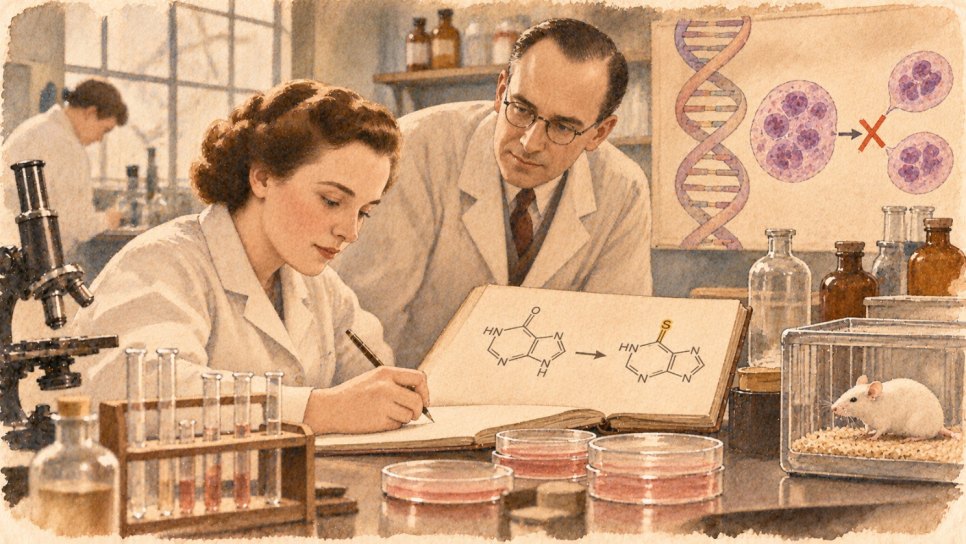
Hitchings's premise, as Elion described it in her 1988 Nobel lecture, was this: antagonists of the nucleic acid bases could stop the division of rapidly dividing cells. In other words, a cell could be deceived by a look-alike of its own building block. This was a hypothesis; its proof would come only at the bedside, and only in part.
To see why the hypothesis was attractive, it is enough to look back at Day 122: there, molecules resembling folic acid had produced temporary regressions in children with leukemia. Adenine and guanine are among the building blocks of DNA and RNA, and a rapidly dividing cell is the cell that needs these blocks most. This explanation is not an explicit sentence from the sources but a link drawn from general biochemistry; I add it as the intuitive rationale for the hypothesis.
Sulfur in place of oxygen
The first test was a bacterium: Lactobacillus casei. According to the Nobel lecture, by 1951 more than a hundred purines had been tried in this screening system. In 1948 2,6-diaminopurine had strongly inhibited the bacterium, and adenine had reversed that effect; the molecule was indeed taking adenine's place. In humans it produced two good remissions in adults with chronic granulocytic leukemia, but caused severe nausea, vomiting and bone marrow suppression in two other patients; animal toxicity also led the team to abandon this drug.
In the next step sulfur was substituted for the oxygen at position 6 of guanine and hypoxanthine, and inhibitors emerged: 6-mercaptopurine (6-MP) and thioguanine. According to the NCI's book on the history of drugs, 6-MP was the molecule that inhibited L. casei most strongly in a study that screened about a hundred compounds, and its effect on mouse tumors was reported in 1953. The paper describing the synthesis appeared in volume 74 of the Journal of the American Chemical Society, 1952, pages 411-414 (Elion, Burgi, Hitchings; citation as given by the catalog, I did not read the paper).
Burchenal and the children
6-MP and thioguanine were found effective against rodent tumors and leukemias at the Sloan-Kettering Institute in New York. Joseph Burchenal started the clinical trials quickly. According to the NCI book, the trials began in April 1952; by March 1953, 107 patients with various advanced cancers had been enrolled, among them 45 children and 18 adults with acute leukemia. Of the 45 children, 15 had good remissions lasting from weeks to months; the children generally tolerated the drug well and severe toxicity was rare. Burchenal's paper, "clinical evaluation of 6-mercaptopurine in leukemia and allied diseases", appeared in volume 8 of Blood, 1953; I give the page range as the catalog does (965-999), and I did not read the paper.
According to Elion's Nobel lecture, before 6-MP childhood leukemia had only methotrexate and steroids; median survival was 3-4 months and the share of those alive at one year was 30 percent. With 6-MP, complete remissions were seen in children, most relapsed after varying intervals, and median survival rose to 12 months; a few stayed in remission for years together with steroids. The same lecture states that the drug was approved in the United States in 1953, a little more than two years after its synthesis. In the same year a group from Stanford reported its first experience (Stanford Medical Bulletin, November 1953; the paper was not read). The National Academy of Sciences memoir says that approval came at the end of the year and seven months before the full efficacy data were published.
How "rational" was "rational design"?
Hitchings and Elion's method is often described as "rational drug design" as opposed to trial and error; the Science History Institute page tells it this way too. But two things are intertwined here: a hypothesis (deceiving the cell with its own building block) and the screening of more than a hundred molecules on a bacterium. The design guided the choice of candidates; what selected the drug came from the screen and then from the result at the bedside. How 6-MP works inside the cell was clarified in later years; the evidence came before the mechanism.
There is also a claim of a "first": the memoir cites 6-MP as the first purine antagonist found useful for acute lymphoblastic leukemia in children. I did not test this against an independent source; it rests only on this memoir and the Nobel lecture. The preceding link carrying the same idea is the antifolates of Day 122.
Cost and limits: remission was not a cure
First, duration. Remissions were mostly temporary; in the NCI book good remissions run from weeks to months, and in the Nobel lecture most patients relapse. The Nobel lecture says that today, maintenance with 6-MP and methotrexate for a few years after multidrug induction can cure about 80 percent of children (Elion's statement of 1988, not tested against current data). That is, the gain came not from a single drug but from the combination and from years.
Second, toxicity and the evidence base. 2,6-diaminopurine caused severe nausea, vomiting and bone marrow suppression. For 6-MP the first series was small and uncontrolled; approval was given before the full efficacy data were published. It was later understood that in some people a difference in the enzyme TPMT raises the risk of severe bone marrow suppression, which is why testing is advised for dose adjustment (according to a secondary source; I did not read the drug label).
Third, whose name. Hitchings and Elion shared the 1988 Nobel Prize in Physiology or Medicine with James Black; Elion had no doctorate. This is the reverse of the series' motif of Nobel injustice, yet part of the same problem: to which work, to whom and when a prize is given still requires looking at the details.
What remains
- The idea of stopping a dividing cell by imitating its building block (antimetabolite)
- Years-long maintenance treatment with 6-MP and methotrexate
- Other drugs derived from the same chemistry: azathioprine, allopurinol
What fell or was limited
- The assumption that the length of a remission means a cure
- The assumption that a single drug would suffice
- The assumption that the same dose gives everyone the same effect
Patients given 6-MP up to March 1953. Bar length is proportional to the number of patients. The numbers come from the NCI's book on the history of drugs (a secondary source); I did not read Burchenal's paper. I am not setting the definition of "good remission" myself; the source gives it and speaks of remissions lasting weeks to months. The bars show different subsets and are not added on top of one another; the source does not give the breakdown of those remaining within the 107.
The same drug, different bodies
I could not find a verified source on this drug's arrival in Türkiye or its local use; I am not inventing a local link. I can write a general inference: that the same dose does not give the same effect in everyone is not specific to one country; this is why it matters that the physician who adjusts the dose follows the patient's blood counts and, where needed, enzyme tests. The practical conclusion for patients and families is this: during maintenance treatment, blood tests requested at regular intervals are not a formality but a safety step learned from the history of this drug.
From 1942 to today
What was confirmed, what conflicts
- Starting year: The NCI book says "the 6-MP story began in 1949"; the Academy memoir writes that a purine that inhibited mouse leukemia up to 1949 was the precursor of 6-MP; the Science History Institute says antimetabolites were synthesized in 1950, encyclopedia.com says purine drugs were developed "by 1951", and the Nobel lecture says more than a hundred purines were screened by 1951. The 1951 in the series title is the "coming-together year" of these last two sources; it is not presented as the year of the synthesis of 6-MP.
- Year of synthesis: None of the sources I read gives a year for the synthesis of 6-MP. The Nobel lecture places approval "a little more than two years" after synthesis and microbiological study; this suggests around 1950-51 but is not an exact year. JACS 74:411 (1952) is cataloged as the paper describing the synthesis of 6-MP; I did not read the paper.
- First clinical use: The Academy memoir writes that Burchenal treated four patients with chronic granulocytic leukemia with the 1949 precursor and obtained remission in two. The Nobel lecture gives the same number for 2,6-diaminopurine (two good remissions in adult chronic granulocytic leukemia, severe toxicity in two patients). I infer that it is the same trial; the sources do not explicitly join them.
- Start of the trial: The NCI book says April 1952; the Academy memoir says approval came "about 10 months after the start of clinical trials". The two do not agree; I did not resolve it. The Nobel lecture gives no trial date.
- Approval: 1953 (Nobel lecture, encyclopedia.com and Wikipedia's mercaptopurine page); the memoir says "end of the year". Day and month not confirmed.
- Numbers: 107 patients, 45 children, 18 adults with acute leukemia, good remission in 15 of 45 children (NCI book, secondary). Burchenal et al., Blood 1953;8:965-999 (the historyofmedicine.com entry gives the page range as "965-99"); the paper was not read. I do not have the details of the other 44 patients.
- Survival numbers: 3-4 months, 30 percent, 12 months and about 80 percent come only from Elion's 1988 lecture; they are not data taken from the trial but a retrospective account.
- Elion's post: Science History Institute says "laboratory assistant", the Academy memoir says "biochemist". That she had no doctorate is the same in both sources.
- Other centers: encyclopedia.com writes that 6-MP was tried at ten U.S. centers (undated). Stanford report: Hall et al., Stanford Med Bull 1953;11(4):237-240; no abstract in PubMed, not read.
- Azathioprine and allopurinol: The 1962 transplant and other details are from the Nobel lecture; I only mention that they exist.
- TPMT and dose: From Wikipedia's mercaptopurine page (secondary); I did not see the label information in a primary source. I did not put numerical prevalence values in the text.
- Out of scope: The details of thioguanine, acyclovir and AZT, the mechanism of allopurinol, the use of 6-MP in immune and bowel diseases.
The Cobalt Bomb (1951-1953)
Until now radiotherapy had rested on X-ray tubes and radium (Days 92 and 94). Between 1951 and 1953 a machine entered the treatment of patients even though the word "bomb" was part of its name. Why was the machine given this name, and what did its beam change in treatment? Tomorrow I will tell it after verifying the dates and the records.
Author's note: It would have been easy to tell the story of this drug as "the success of rational design"; the sources support half of that, and the other half was a screen and a result at the bedside. Where the sources conflicted on dates, I did not pass judgment; I wrote the range and the source. I marked the citations of papers I did not read in the fact-check box.
Sources and Further Reading
- Elion GB. The Purine Path to Chemotherapy. Nobel Lecture, 8 December 1988 (read).
- National Academy of Sciences. Biographical Memoirs, vol. 78 (2000), the "Gertrude B. Elion" memoir (nap.nationalacademies.org/read/9977; read).
- Science History Institute. "George Hitchings and Gertrude Elion" (read; secondary).
- NCI. Kohn, "Drugs Against Cancer", part 7 (discover.nci.nih.gov; read; secondary).
- Burchenal JH et al. Clinical evaluation of a new antimetabolite, 6-mercaptopurine, in the treatment of leukemia and allied diseases. Blood 1953;8:965-999 (citation from historyofmedicine.com; full text not read).
- Elion GB, Burgi E, Hitchings GH. Studies on condensed pyrimidine systems. IX. The synthesis of some 6-substituted purines. J Am Chem Soc 1952;74:411-414 (citation from the catalog; full text not read).
- Hall BE et al. Evaluation of 6-mercaptopurine in the treatment of leukemia; a preliminary report. Stanford Med Bull 1953;11(4):237-240 (citation only).
- Encyclopedia.com. "Gertrude B. Elion" entry (read; secondary).
- Mukherjee S. The Emperor of All Maladies: A Biography of Cancer. New York: Scribner, 2010. (Not separately verified for this article.)
This article is Day 127 of the "365 Days of Cancer History" series and tells the work of Elion and Hitchings on 6-mercaptopurine around 1951 as a historical event. It is historical-popular content; it is not a diagnosis or treatment recommendation. Consult your physician for decisions about your health. Sources have been verified; details that rest only on a secondary source are noted in the fact-check notes.
Was this article helpful?
Your feedback helps us improve our content.