
Blood ctDNA Analysis in Colorectal Cancer – Long-Term Results for Treatment Decisions and Follow-Up

In this article
Colorectal cancer (CRC) is one of the most common cancers worldwide, and 60-70% of patients are at stage 2 or 3 when diagnosed. Surgery is the main treatment at these early stages, but there is a growing need for biomarkers to identify who needs postoperative chemotherapy and who is at high risk of recurrence. We now know that tumor size at diagnosis alone is insufficient; tumor biology is also very important. Some very early colorectal tumors can recur or metastasize, while more advanced tumors, for example stage 3 tumors, may not. Analysis of cell-free DNA fragments shed by the tumor into the blood (ctDNA) can provide important guidance for treatment and follow-up.
Technologies that offer clearer information about patients' postoperative status and enable personalized treatment are therefore particularly important. Signatera, a commercially available next-generation ctDNA (circulating tumor DNA) test, is a promising tool in this setting. Data from GALAXY, presented at the ESMO 2024 Congress, show how ctDNA analysis may influence long-term survival in colorectal cancer and determine the need for adjuvant (postoperative) chemotherapy.
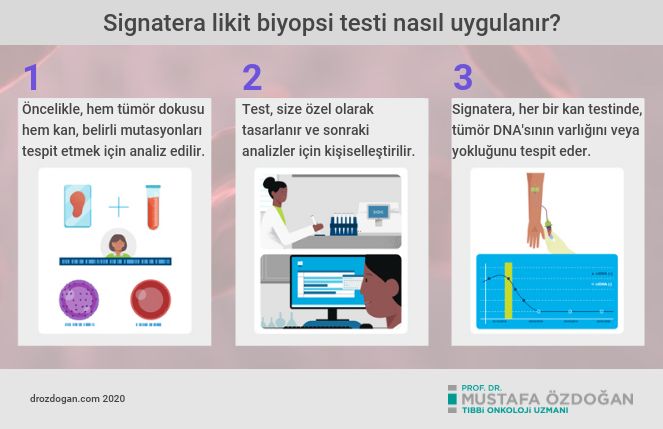
The Signatera Test: An Effective Method for Identifying Postoperative Molecular Residual Disease
GALAXY used Signatera to assess postoperative molecular residual disease (MRD) in colorectal cancer patients. ctDNA was analyzed in blood samples obtained 2-10 weeks after surgery, and the results were compared with long-term survival rates.
The findings showed significantly longer survival in Signatera-negative than in Signatera-positive patients.
Findings:
- 24-Month Overall Survival Rate (24M-OS): Reported as 98.5% (CI: 97.7–99.1%) in Signatera-negative patients and 83.65% (CI: 77.84–88.06%) in positive patients.
- 36-Month Overall Survival Rate (36M-OS): 96% (CI: 94.3–97.2%) in Signatera-negative patients and 71.8% (CI: 63.4–78.6%) in positive patients.
These results suggest that ctDNA negativity may favorably affect survival even after adjuvant chemotherapy and improve long-term outcomes.

The Effect of Adjuvant Chemotherapy on Survival: Significant Differences in High-Risk Patients
GALAXY evaluated receipt of adjuvant chemotherapy based on postoperative MRD positivity in patients with high-risk stage II and stage III-IV CRC.
Survival rates improved significantly among MRD-positive patients receiving adjuvant chemotherapy compared with those not receiving it. In particular, among patients with persistent MRD positivity, overall survival duration with adjuvant chemotherapy, compared with no chemotherapy, was 10 times higher.
Detailed Survival Data:
- Survival After Adjuvant Treatment in Signatera-Positive Patients: Survival duration improved significantly in MRD-positive patients receiving adjuvant treatment compared with untreated patients (HR = 9.68; CI: 6.33-14.82; P < 0.0001).
- Patients with Sustained ctDNA Negativity: Patients who cleared ctDNA after adjuvant chemotherapy and maintained negativity had much higher survival rates than those with transient clearance or no clearance.
Personalized Treatment Strategies and ctDNA Monitoring
ctDNA tests could revolutionize personalized treatment for diseases with a high recurrence risk, such as colorectal cancer. More precisely predicting treatment response in ctDNA-positive patients and adapting strategies accordingly could improve survival while avoiding unnecessary treatment and improving quality of life.
GALAXY data show that Signatera successfully identifies high-risk patients, that adjuvant chemotherapy offers a survival advantage particularly for these patients, and how ctDNA testing can support earlier, more accurate treatment decisions. The findings demonstrate that MRD analysis is not merely a biomarker but also a guide that could directly influence survival.
Was this article helpful?
Your feedback helps us improve our content.


Reader comments
Share your comment
Your name and comment are published only after administrator approval. Your email address is never shown to visitors.
Be the first to comment.