
What Is the Signatera Test? Measuring Cancer Recurrence Risk with Circulating Tumour DNA Testing

In this article
For a quick introduction, let us share some brief information about the Signatera liquid biopsy test from Natera, a biotechnology company that is a global leader in this field.
What is the Signatera test, and how is it performed?
The personalized, tumour-specific Signatera liquid biopsy test is an innovative cancer monitoring test that accurately detects freely circulating tumour DNA (ctDNA) in your blood.
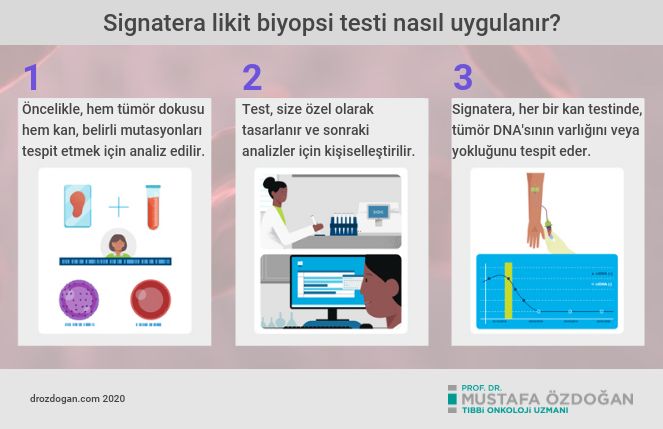
In which situations can the Signatera test be used:
- to detect the presence of any residual (remaining) disease after surgery
- to assess treatment response during treatment
- to monitor for early cancer recurrence after treatment
Are tumour cells remaining in circulation the reason cancer recurs after surgery?
Circulating tumour DNA fragments may, in colorectal (large bowel) cancers, indicate minimal residual (remaining) disease as a biomarker, as suggested by important scientific studies recently presented.
Can non-metastatic (without distant spread in the body) colon cancer recur after surgery?
Patients with stage-2 and stage-3 colon cancer have a 20-30% risk of recurrence (relapse). However, depending on the genetic and biological characteristics of the tumour, this risk may be 10% lower or 50% higher.
In patients with stage 1 colon cancer, the risk of recurrence is less than 10%.
How much does postoperative adjuvant treatment reduce the risk of recurrence in non-metastatic colon cancer?
Adjuvant treatment is given after the main treatment (for example, surgery) to reduce the risk of cancer recurrence. In colorectal cancer, using chemotherapy (5FU and oxalipatin) as adjuvant treatment may reduce the risk of recurrence by half.
Which patients benefit more from adjuvant treatment?
We generally recommend adjuvant treatment (chemotherapy after surgery) for patients with stage 3 colorectal cancer. We do not use it for stage 1 patients. Adjuvant treatment in stage 2 is somewhat more complicated. We do not know exactly who will benefit. Clinical features such as adverse histological findings, the presence of a T4 (large) tumour and lymph node involvement can be considered, but these are rather weak biological and clinical markers.
What is the effect of adjuvant treatment in people with minimal residual disease?
Although the benefit of adjuvant treatment for patients whose minimal residual disease after surgery is detected by tumour DNA in the bloodstream is still being determined in larger studies, the data obtained so far show that adjuvant treatment was beneficial in one out of every 3 patients during long-term follow-up.
What is the easiest way to diagnose minimal residual disease?
The best technique for diagnosis is to measure circulating tumour DNA using liquid biopsy. This measurement is a more sensitive diagnostic method than even imaging methods. These tests aim to find mutations in the patient's blood. They are sensitive enough to detect mutations present in just 1 out of 100,000 DNA fragments.
What is the difference between tumour-informed DNA testing and tumour-agnostic DNA testing?
We have 2 main methods for detecting the presence of cancer in the body: tumour-informed DNA testing and tumour-agnostic DNA testing.
- In the tumour-informed approach, we sequence the DNA of a surgically removed tumour and then look for certain mutations matching its profile. In other words, we know what we are looking for, and when we find it, the accuracy is very high.
- In the tumour-agnostic (tumour-independent) approach, we sequence genes commonly mutated in colorectal cancer. It does not contain patient-specific information. Its advantage is that it is less complex and can be performed quickly. However, false-positive results can also occur for reasons unrelated to minimal residual disease.
When should blood be taken after surgery to detect minimal residual disease?
Because there is also a healing process, we should wait 2-3 weeks before taking blood samples. After surgery, the body releases large amounts of normal DNA into the blood to heal damaged tissues. This makes abnormal DNA harder to detect in the blood. We therefore take samples 2-3 weeks after surgery, usually before starting adjuvant treatment.
A patient tests negative for minimal residual disease and does not receive adjuvant treatment. If the next test is positive, should adjuvant treatment be started?
We do not know the full answer, but studies are being designed to find out. Our expectation is that even if we do not give adjuvant treatment initially, we may use it later to cure the disease.
Can circulating tumour DNA turning from positive to negative be used to decide when to stop adjuvant treatment?
We hope this will be the case one day. According to current knowledge, circulating tumour DNA must be cleared before we can say recovery has occurred. However, this alone does not show that the disease will not recur. Demonstrating that tumour DNA is absent from circulation is a good way to show whether treatment is working, but to use it as an “endpoint” requires more research. We do not yet know its effect on survival after the disease has passed. It is currently used in small studies to see whether new treatments show promise.
Which studies consider clearing tumour DNA from circulation as a potential endpoint?
- There is a phase 1b/2 clinical trial involving 15 colorectal cancer patients with circulating tumour DNA but no disease visible on radiological imaging (study code NCT03436563). In this study, all patients receive a TGF-Beta inhibitor and an immunotherapy of the anti-PD-L1 class. Treatment response is also assessed on the basis of tumour DNA clearance from the blood.
- Another ongoing phase 2 study plans to develop an mRNA (messenger RNA)-based vaccine called RO7198457 for patients with stage 2 and stage 3 colorectal cancer who have tumour DNA in their blood (study code NCT04486378).
- In its phase 2/3 COBRA study, NRG Oncology is investigating how tumour DNA in the blood relates to the benefit of treatment in patients with stage 2A colorectal cancer (NCT04068103).
What other markers are available for detecting minimal residual disease?
- As mentioned earlier, most of this research concerns DNA mutations, but researchers also examine DNA methylation, because methylation may be specific to certain cancers and may increase the sensitivity of the test.
- Another approach is to look at the sizes of DNA fragments. The sizes of DNA fragments from cancer cells may differ from those of normal healthy cells.
What questions about circulating tumour DNA remain to be answered?
We need to validate these test results and learn how often testing should be performed. However, the questions we must answer first are;
- What should we do if tumour DNA is found in the circulation of patients who have already received adjuvant treatment?
- What new treatments can we use to cure them?
The answers to these questions are very important to us.
What is the approach to testing circulating tumour DNA and determining how often to test?
The biotechnology company that is a global leader in this field is Natera, and its tumour-informed test called Signatera can screen for circulating tumour DNA and detect minimal residual disease when performed every 3 months. This is currently the only commercially available test on the market, but we know there will be more. Many organizations have developed their own tests to date, and many more will do so in the future.
Recommendations for tests that detect circulating tumour DNA
In July 2020, the Colon and Rectal-Anal Task Forces of the US National Cancer Institute (The multidisciplinary Colon and Rectal-Anal Task Forces of the United States National Cancer Institute) published in Nature Reviews Clinical Oncology a study of the Signatera test used in colorectal cancer. Its purpose was to summarize what is known about the test's benefits, highlight the effectiveness of technologies to be developed for the test and provide guidance to improve clinical integration. Another important point is that the test must suit the situation in which it will be used. This means that different tests may need to be selected to stop or intensify treatment according to the result.
What other benefits might tests detecting circulating tumour DNA offer?
These tests will be an important driver of new drug development. I think monitoring circulating tumour DNA will change the rules of adjuvant treatment. Using liquid biopsies to establish treatment response or need will also show whether a particular cancer drug candidate could be evaluated in a study of 20 patients rather than a study of 1000 patients.
Sources
2. ClinicalTrials.gov. A phase II clinical trial comparing the efficacy of RO7198457 versus watchful waiting in patients with ctDNA-positive, resected stage II (high risk) and stage III colorectal cancer. https://clinicaltrials.gov/ct2/show/NCT04486378. Identifier: NCT04486378. Accessed October 27, 2020.
3. ClinicalTrials.gov. Circulating tumor DNA testing in predicting treatment for patients with stage IIA colon cancer after surgery. https://clinicaltrials.gov/ct2/show/NCT04068103. Identifier: NCT04068103. Accessed October 27, 2020.
4. ClinicalTrials.gov. M7824 in patients with metastatic colorectal cancer or with advanced solid tumors with microsatellite instability. https://clinicaltrials.gov/ct2/show/NCT03436563. Identifier: NCT03436563. Accessed October 27, 2020.
5. Dasari A, Grothey A, Kopetz S. Circulating tumor DNA- defined minimal residual disease in solid tumors: opportunities to accelerate the development of adjuvant therapies. J Clin Oncol. 2018;36:JCO2018789032.
6. Dasari A, Morris VK, Allegra CJ, et al. ctDNA applications and integration in colorectal cancer: an NCI Colon and Rectal-Anal Task Forces whitepaper [published online July 6, 2020]. Nat Rev Clin Oncol. doi:10.1038/s41571-020-0392-0.
7. Reinert T, Henriksen TV, Christensen E, et al. Analysis of plasma cell- free DNA by ultradeep sequencing in patients with stages I to III colorectal cancer. JAMA Oncol. 2019;5:1124-1131.
8. Tie J, Cohen JD, Wang Y, et al. Circulating tumor DNA analyses as markers of recurrence risk and benefit of adjuvant therapy for stage III colon cancer. JAMA Oncol. 2019;5:1710-1717.
9. Tie J, Wang Y, Tomasetti C, et al. Circulating tumor DNA analysis detects minimal residual disease and predicts recurrence in patients with stage II colon cancer. Sci Transl Med. 2016;8(346):346ra92.
Was this article helpful?
Your feedback helps us improve our content.




Reader comments
Share your comment
Your name and comment are published only after administrator approval. Your email address is never shown to visitors.
Be the first to comment.