
Could Permanent Colostomy Be Avoided in Rectal Cancer?

In this article
Concerns About a Permanent Colostomy Bag
New research suggests that a surgical procedure called “local excision” after chemotherapy may be a safe option for some rectal cancers .
Local excisionis a limited, organ-preserving surgical procedure in which the tumor is removed along with a small amount of surrounding healthy tissue.
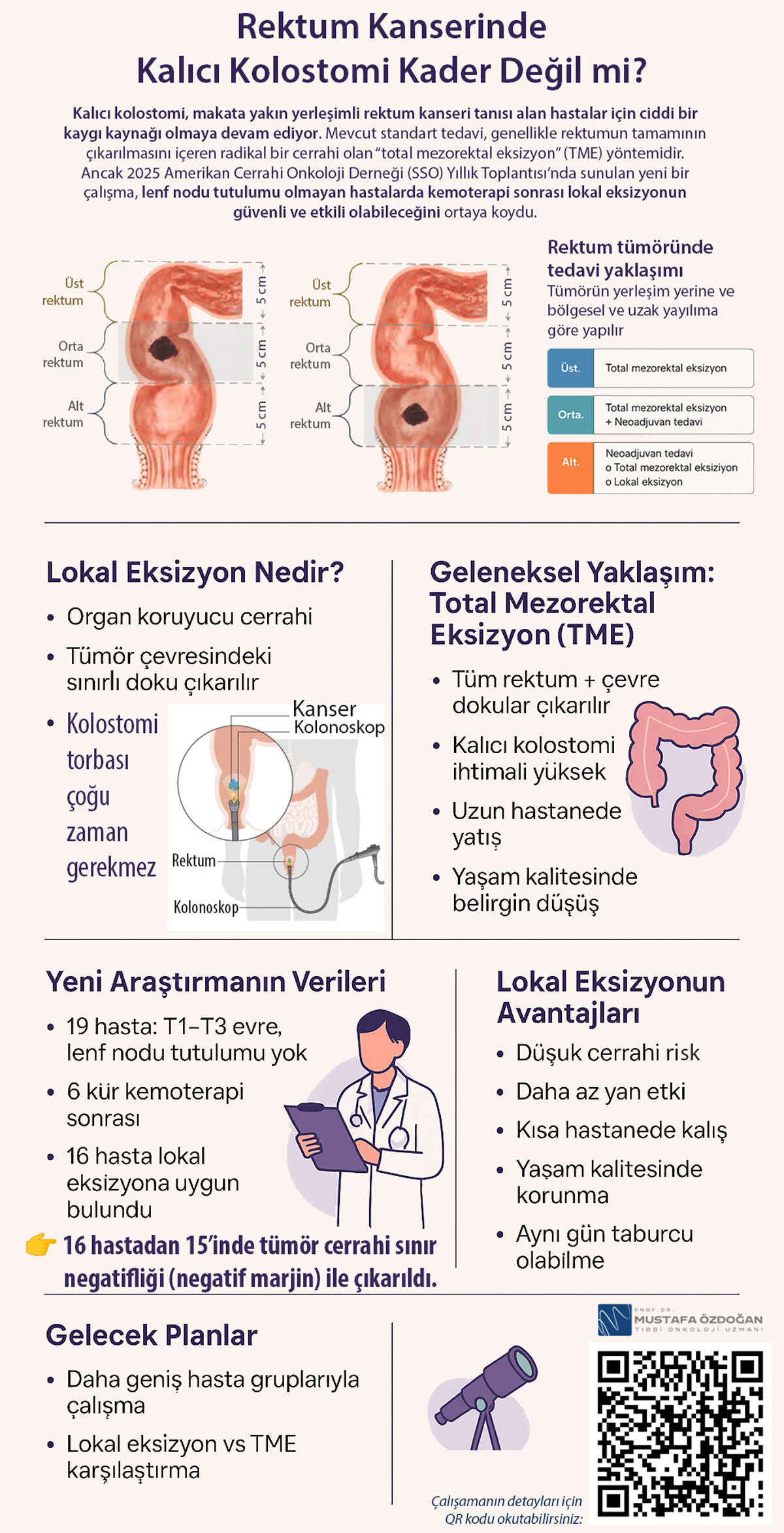
Permanent colostomyremains a major concern for patients diagnosed with rectal cancer close to the anus. The current standard treatment is total mesorectal excision (TME), a radical operation that usually involves removing the entire rectum. However, a new study presented at the 2025 Society of Surgical Oncology (SSO) Annual Meeting showed that local excision after chemotherapy may be safe and effective in patients without lymph node involvement .
The Current Approach: Radical Surgery and the Risk of Permanent Colostomy
Most patients diagnosed with low rectal adenocarcinoma close to the anus are treated with total mesorectal excision (TME) . This procedure removes not only the rectum but also the surrounding fatty tissue and lymph nodes. The disadvantages of TME include:
-
The need for a permanent colostomy
-
A prolonged hospital stay
-
A substantial decline in quality of life
Only patients with early-stage T1 tumors are currently considered suitable for the more limited procedure of local excision . However, the new research suggests that these eligibility criteria could be broadened.
“Patients Want to Avoid Permanent Colostomy”
Patients want to avoid a permanent colostomy whenever possible. When considering this type of surgery, they want to know whether other options exist.
In this context, the study aimed to determine whether local excision could be feasible for more patients.
Study Design: Limited Surgery After Chemotherapy
The study included patients with clinical stage T1-T3 disease without lymph node involvement : 19 patients received six cycles of chemotherapy. After treatment, 16 patients whose tumors had shrunk substantially or regressed completely were referred for local excision.

- T1: The tumor invades the submucosa
- T2: The tumor invades the muscularis propria
- T3: The tumor invades the subserosa or nonperitonealized pericolic or perirectal tissues
Results
-
Of the 16 patients, 15 had their tumors removed with negative surgical margins .
-
This was the study's primary measure of success.
How Is Local Excision Performed?
Local excisionis the removal of a tumor in the rectum along with a small amount of surrounding healthy tissue.
This procedure can generally be performed for early-stage rectal cancers (T1–T2) or T3 tumors that have responded using the following approaches:
1. Transanal Local Excision (TALE)
-
This is the most conventional method.
-
The tumor is accessed through the anus.
-
The tumor and approximately 1 cm of surrounding healthy tissue are removed.
-
The operation is brief and is usually performed under general anesthesia .
2. Transanal Endoscopic Microsurgery (TEM) / TAMIS
-
This is a more advanced technique, performed through the anus using a special system similar to laparoscopy.
-
TAMIS (Transanal Minimally Invasive Surgery): Minimally invasive excision is performed through a transanal approach using laparoscopic instruments.
-
It is more precise and causes less tissue damage.
-
It is generally performed by surgical oncologists or colorectal surgeons .
3. Endoscopic Submucosal Resection (ESD)
-
This procedure is more commonly performed by gastroenterologists for early-stage mucosal lesions.
-
However, if invasive cancer is suspected, it may be inadequate , and surgical excision is required.
In Summary
-
Local excision is a surgical procedure and was performed by a surgical team in this study.
-
It is generally performed through a transanal approach, with the tumor removed through the anus.
-
This technique is one of the most notable organ-preserving treatment options .
Advantages of Local Excision
The following advantages of local excision are highlighted:
-
Lower risk: A lower surgical complication rate than TME
-
Milder adverse effects
-
Shorter hospital stay: Some patients can be discharged the same day
-
Preserved quality of life: A reduced likelihood of permanent colostomy
These data show that, in appropriately selected patients, neoadjuvant chemotherapy followed by local excision is not only safe but also offers substantial benefits to patients.
Future Plans: Larger Comparative Studies
The researchers plan to test the results of this pilot study in larger patient groups. An additional arm comparing patients who undergo TME with those who undergo local excision is also being considered.
For now, the answer to whether neoadjuvant chemotherapy can help achieve negative surgical margins is “yes.” However, more patient data and comparative analyses are needed to establish a stronger evidence base for this approach.
Conclusion: Could Rectal Cancer Treatment Undergo a Paradigm Shift?
This study suggests that patients with early- or intermediate-stage low rectal cancer without lymph node involvement may have a promising alternative. Although these are early results, careful patient selection may make it possible to achieve a cure while preserving quality of life. Local excision may become applicable to a broader group of patients in the future.
Sources
Was this article helpful?
Your feedback helps us improve our content.




Reader comments
Share your comment
Your name and comment are published only after administrator approval. Your email address is never shown to visitors.
Be the first to comment.