
Dog, Poison, and Scalpel: Bernard Peyrilhe’s Wild Experiment and the Birth of Experimental Oncology

In this article
Day 62 (The History of Cancer in 365 Days Series)
The first physician to bring cancer into the laboratory: the startling story of the transition from philosophical debate to evidence-based medicine.
Throughout the history of cancer, physicians tried to understand what the “Crab” was by observing it from a distance or developing philosophical theories. Percivall Pott (Day 61) had identified external carcinogens, but the “internal” nature of cancer was still a black box. Bernard Peyrilhe was the first scientist in medical history to set speculation aside and dare to test cancer in an animal. The rational ancestor of the animal models, tumor transplants, and cellular experiments we use in oncology today is Peyrilhe’s noisy and tragic “dog experiment.” This analysis examines how the instinct to “generate evidence,” the most fundamental requirement of precision oncology, emerged.
A major question gnawed at the minds of 18th-century physicians: was the savage, putrefying nature of cancer an independent poison circulating in the body? Could it be transferred to another living being? The French surgeon Bernard Peyrilhe (1735-1804) decided to answer these questions with a scalpel rather than philosophy.
The Lyon Academy’s Great Question (1773)
In 1773, the Lyon Academy organized a competition: “What is cancer, and how is it treated?” In his famous prize-winning thesis, Peyrilhe claimed that cancer was a “living poison” (virus).
It was a remarkable manifesto arguing that the different forms of cancer (breast, skin, internal organs) were actually different faces of a single disease.
He defined cancer as an active, disease-causing poison existing in liquid form. This was the first claim suggesting that cancer behaved like a pathogen.
The First Oncology Experiment in Medical History
To prove his theory that cancer was a “poisonous fluid,” Peyrilhe designed the first planned in vivo animal experiment in medical history.
Injecting Cancer
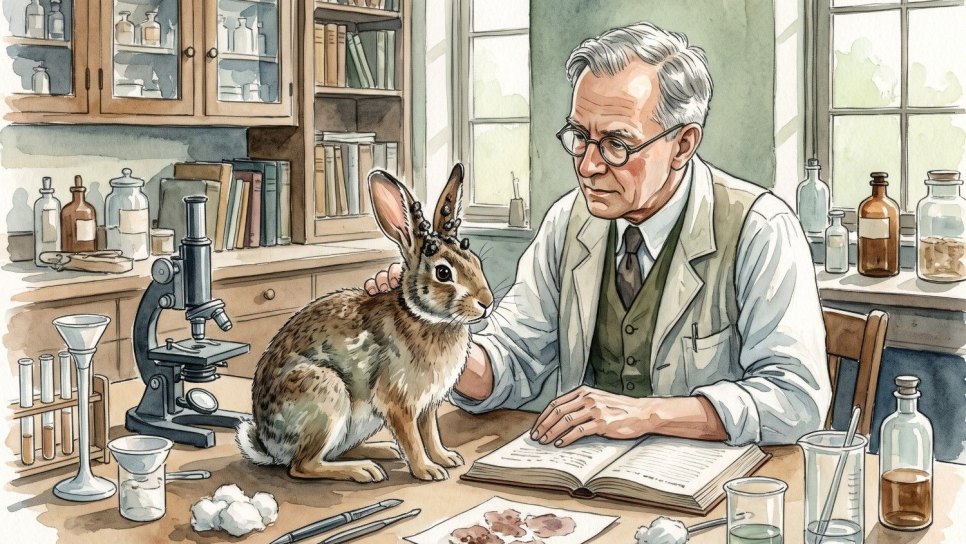
Peyrilhe drew the foul-smelling fluid (ichor) from the ulcerated tumor of a patient with breast cancer into a syringe and injected it under the skin of a healthy dog. His aim was to observe whether cancer would also develop in the dog. The outcome was a complete tragedy: bacteria from the human cancer caused a severe infection in the dog. Unable to bear the dog’s relentless howling, Peyrilhe’s servant drowned it without waiting for the experiment’s outcome.
The Remarkable Legacy of a Failed Experiment
The experiment failed to transfer human cancer to the dog because no one at the time knew about immunological rejection between species. However, Bernard Peyrilhe elevated research driven by speculation to the level of “Experimental Oncology,” charting a course for scientists: **“If you want to understand cancer, you must test it in living models.”**
Peyrilhe was also a great visionary in surgery. Because he recognized that cancer spread through the lymphatic system, he had formulated the philosophy of **Radical Mastectomy**, encompassing not only the tumor but also the pectoral muscle and axillary lymph nodes in breast cancer operations, 100 years before William Halsted.
Tomorrow (Day 63): We will turn to the tobacco (snuff) craze in the courts of England and to the lone genius John Hill, who proclaimed 200 years ago that tobacco caused nasal cancer!
Science Begins with Courage
Bernard Peyrilhe’s unsettling dog experiment shows us how scientific precision can sometimes derive great truths (experimental methodology) even from mistaken assumptions (the delusion that cancer is a virus). Precise guidance in oncology is not just the application of what is known; it is the courage to question the unknown systematically.
The philosophy of biological restoration requires the ability to model a tissue’s rebellion (cancer) in the laboratory to understand why it rebels. Peyrilhe’s first needle puncture in 1773 was the initial spark of the vast preclinical world in which we now test cancer vaccines and personalized treatments. Healing comes through deciphering nature’s language by experiment, rather than imitating nature.
Scientific References and Further Reading
- 1. Peyrilhe B. Dissertatio academica de cancro (Academic Dissertation on Cancer). 1775. (Original Latin and Antwerp Edition).
- 2. Hajdu SI. "Landmarks in History of Cancer, Part 2: Bernard Peyrilhe." Cancer, 2011;117(12):2811-2820.
- 3. Bland KI. "The history of breast cancer and the evolution of mastectomy." Am J Surg, 1981.
- 4. Faguet GB. A Brief History of Cancer: Age-Old Milestones. International Journal of Cancer, 2015.
Was this article helpful?
Your feedback helps us improve our content.


Reader comments
Share your comment
Your name and comment are published only after administrator approval. Your email address is never shown to visitors.
Be the first to comment.