
Durvalumab Improves Survival in Limited-Stage Small Cell Lung Cancer

In this article
Small cell lung cancer (SCLC) is a more aggressive, rapidly growing form of lung cancer. It is strongly associated with smoking, and most cases occur in people who smoke. SCLC tends to spread quickly even at an early stage and is often advanced by the time it is diagnosed.
SCLC accounts for approximately 15% of all lung cancers. It is divided into two main stages: limited stage and extensive stage.
- Limited Stage: Cancer is confined to one lung and nearby lymph nodes. At this stage, it remains within an area that can be treated with radiotherapy. Approximately one third of patients are diagnosed at this stage.
- Extensive Stage: Cancer has spread to the other lung, lymph nodes outside the chest or other organs.
FDA-Approved Immunotherapies and Targeted Drugs:
To date, newer-generation drugs have received approval only for extensive-stage small cell lung cancer from the FDA. These drugs include:
- Atezolizumab (Tecentriq): Approved in 2019 and used with chemotherapy as first-line treatment (FDA).
- Durvalumab (Imfinzi): Approved in 2020 and also used with chemotherapy as first-line treatment (FDA).
- Tarlatamab (Imdelltra): Approved in 2024 for patients whose disease progresses after platinum-based chemotherapy (FDA).
These drugs have brought important advances in extensive-stage SCLC and have helped extend patients' lives.
ADRIATIC Attracts Attention at ASCO 2024
Key Points:
- Median overall survival (OS) was 55.9 months with durvalumab and 33.4 months with placebo.
- Median progression-free survival (PFS) was 16.6 months with durvalumab and 9.2 months with placebo.
- Treatment was well tolerated, with a safety profile consistent with the known adverse effects of immunotherapy.
The long-awaited interim results of ADRIATIC showed statistically significant and clinically meaningful improvements with durvalumab consolidation compared with placebo in patients with limited-stage small cell lung cancer (LS-SCLC). Presented at the 2024 ASCO Annual Meeting (LBA5), the findings suggest that durvalumab could be the first new treatment in decades for this patient group, although the final study results have not yet been announced.
ADRIATIC: Design and Findings
In this multicenter study, patients without disease progression after chemoradiotherapy were randomized to three groups:
- Durvalumab plus placebo, followed by durvalumab;
- Durvalumab plus tremelimumab, followed by durvalumab; and
- Placebo plus placebo, followed by placebo.
Randomization took place after chemoradiotherapy and standard treatment had been completed.
Dr. David R. Spigel presented interim survival data comparing the durvalumab arm (264 patients) with the placebo control arm (266 patients). The durvalumab plus tremelimumab arm remains blinded, and its results will be released after the final analysis.
Durvalumab produced statistically significant and clinically meaningful improvements in overall survival (OS) and progression-free survival (PFS) compared with placebo.
- Median OS was 55.9 months with durvalumab and 33.4 months with placebo.
- Median PFS was 16.6 months with durvalumab and 9.2 months with placebo.
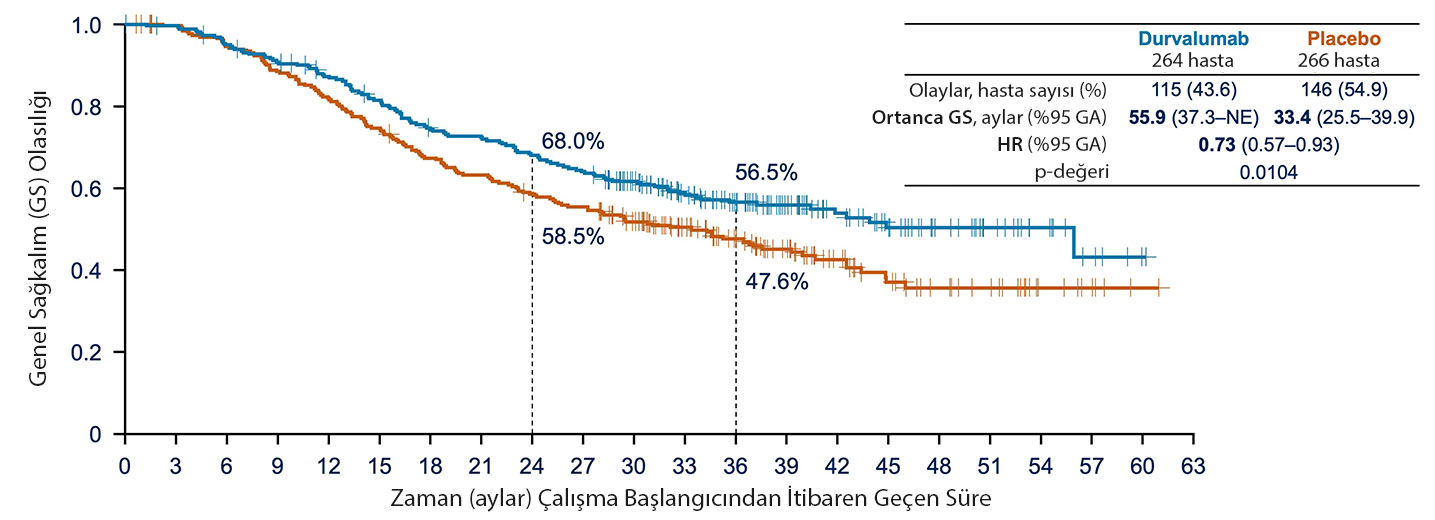
The survival graph above compares the probability of overall survival (OS) between the durvalumab and placebo groups in limited-stage small cell lung cancer (LS-SCLC).
Graph Data:
- Durvalumab Group (Blue): 264 patients
- Placebo Group (Orange): 266 patients
- Median Overall Survival (mOS):
- Durvalumab: 55.9 months (37.3 months to not determined)
- Placebo: 33.4 months (range 25.5-39.9 months)
- Probability Values:
- At 24 months, survival probability was 68% with durvalumab and 58.5% with placebo.
- At 36 months, survival probability was 56.5% with durvalumab and 47.6% with placebo.
- Hazard Ratio (HR): 0.73 (95% CI: 0.57-0.93), p=0.0104
The graph shows longer survival over time in patients receiving durvalumab than in those receiving placebo.
Adverse Events and Safety
Treatment was well tolerated, with a safety profile consistent with the known adverse effects of immunotherapy. Dr. Spigel said, "There were expected rates of pneumonia due to radiation and expected immune-related toxicities from durvalumab, but their distribution, frequency and severity were not unusual compared with other immunotherapy studies in non-small cell or small cell lung cancer,"
Future Directions
ADRIATIC is considered a long-awaited milestone in LS-SCLC treatment. SCLC is characterized by substantial progression and treatment resistance. Approximately one third of LS-SCLC cases constitute new SCLC cases, and these cases are difficult to manage.
Despite these challenges, ADRIATIC's interim results highlight the need to focus on personalized approaches and new drug targets in SCLC. Dr. Byers notes that SCLC has biologically and genetically distinct subtypes, underlining the importance of tailoring treatment selection to the patient.
In conclusion, ADRIATIC represents an important advance for patients with LS-SCLC. Adding durvalumab after chemoradiotherapy has the potential to improve treatment outcomes substantially. These findings may also guide future treatment development for LS-SCLC and other rare small cell cancers.
Sources
2. Bogart JA, Waqar SN, Mix MD. Radiation and systemic therapy for limited-stage small-cell lung cancer. J Clin Oncol. 2022;40(6):661-670.
3. Blackhall F, Girard N, Livartowski A, et al. Treatment patterns and outcomes among patients with small-cell lung cancer (SCLC) in Europe: a retrospective cohort study. BMJ Open. 2023;13(2)
4. Gay CM, Stewart CA, Park EM, et al. Patterns of transcription factor programs and immune pathway activation define four major subtypes of SCLC with distinct therapeutic vulnerabilities. Cancer Cell. 2021;39(3):346-360.e7.
5. Meara K. FDA Approves Tarlatamab-dlle for Extensive-Stage Small Cell Lung Cancer. Accessed May 21, 2024.
6. NRG Oncology. Chemotherapy with or without the immunotherapy drug atezolizumab in people with limited stage small cell lung cancer. Accessed May 21, 2024.
Was this article helpful?
Your feedback helps us improve our content.


Reader comments
Share your comment
Your name and comment are published only after administrator approval. Your email address is never shown to visitors.
Be the first to comment.