
Durvalumab Receives FDA Approval for Limited-Stage Small Cell Lung Cancer

In this article
On 4 December 2024, the US Food and Drug Administration (FDA) approved the immunotherapy durvalumab (Imfinzi, AstraZeneca) for adults with limited-stage small cell lung cancer (LS-SCLC) whose disease had not progressed after platinum-based chemotherapy and radiotherapy. This approval is considered an important milestone, offering a new treatment option for patients with LS-SCLC.
FDA Approval Based on the ADRIATIC Study
Durvalumab's efficacy and safety were evaluated in ADRIATIC, a randomized, double-blind, placebo-controlled study. It enrolled 730 patients with LS-SCLC whose disease had not progressed after concurrent platinum-based chemotherapy and radiotherapy. Patients were randomized 1:1:1 to durvalumab alone, durvalumab plus tremelimumab, or placebo.
Overall Survival (OS) and Disease-Free Survival (PFS) Results
The following results were obtained when comparing durvalumab alone with placebo:
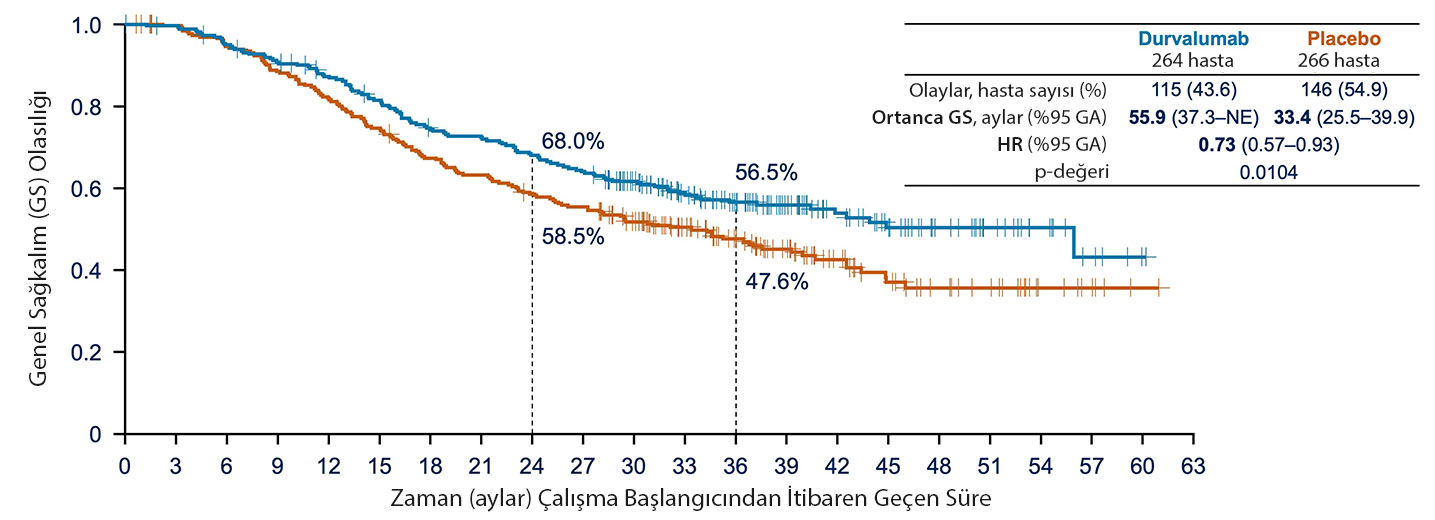
- Overall Survival (OS): Durvalumab produced a statistically significant improvement in overall survival compared with placebo (HR: 0.73; 95% CI: 0.57, 0.93; p=0.0104). Median OS was 55.9 months (95% CI: 37.3, not reached) in the durvalumab group and 33.4 months (95% CI: 25.5, 39.9) in the placebo group.
- Disease-Free Survival (PFS): Durvalumab produced a statistically significant improvement in PFS compared with placebo (HR: 0.76; 95% CI: 0.61, 0.95; p=0.0161). Median PFS was 16.6 months (95% CI: 10.2, 28.2) in the durvalumab group and 9.2 months (95% CI: 7.4, 12.9) in the placebo group.
Adverse Effects
The most common adverse effects during durvalumab treatment (in 20% or more) included pneumonitis or radiation pneumonitis and fatigue. This requires attention to the treatment's safety profile.
Recommended Treatment Regimen
- Patients weighing 30 kg or more: 1,500 mg by intravenous infusion every 4 weeks.
- Patients weighing less than 30 kg: 20 mg/kg by intravenous infusion every 4 weeks.
Treatment may continue until disease progression or unacceptable toxicity for a maximum of 24 months.
A Global Perspective: Project Orbis and International Collaboration
The review was conducted through Project Orbis, an initiative of the FDA Oncology Center of Excellence. Project Orbis enables concurrent submission and review of oncology drugs among international partners. During this review, the FDA collaborated with Australia's Therapeutic Goods Administration (TGA), Brazil's Health Regulatory Agency (ANVISA), Health Canada, and Switzerland's Swissmedic (SMC). The European Medicines Agency (EMA) was a formal observer. Reviews of applications at other regulatory agencies are ongoing.
Conclusion and Future Perspectives
Durvalumab's approval for LS-SCLC represents a step that expands treatment options for this aggressive cancer and substantially improves patients' survival. The clear increase in overall survival highlights its effect, while the adverse-effect profile identifies issues requiring attention during treatment. This approval raises hope for future targeted therapies and immunotherapies for patients with LS-SCLC.
Sources
Was this article helpful?
Your feedback helps us improve our content.




Reader comments
Share your comment
Your name and comment are published only after administrator approval. Your email address is never shown to visitors.
Be the first to comment.