
Enfortumab Vedotin and Pembrolizumab Receive FDA Approval for First-Line Urothelial Cancer Treatment

In this article
The combination of enfortumab vedotin-ejfv (Padcev) and pembrolizumab (Keytruda) received FDA (US Food and Drug Administration) approval on December 15, 2023, for patients with locally advanced or metastatic urothelial cancer.
Previously, for patients with locally advanced or metastatic urothelial cancer who were ineligible for cisplatin-containing chemotherapy, the FDA had granted this combination accelerated approval .
Urothelial cancer arises from the urothelial cells lining the urinary tract. This cancer is most commonly known as bladder cancer , but it can also affect the ureters in the upper part of the kidneys and other urinary tract structures.
According to the 2020 Turkey Cancer Statistics, bladder cancer is the 4th most common cancer in men, with 10,426 cases, and the 14th most common cancer in women, with 1,772 cases. Approximately 7% of all new cancers in men and 2% in women are bladder cancers. About 30% of patients with bladder cancer have regionally advanced or metastatic disease at diagnosis.
FDA Approval Based on the EV-302/KN-A39 Study
The phase-3 EV-302/KEYNOTE-A39 trial established enfortumab vedotin (Padcev) plus pembrolizumab (Keytruda) as a new standard for first-line treatment of advanced urothelial cancer.
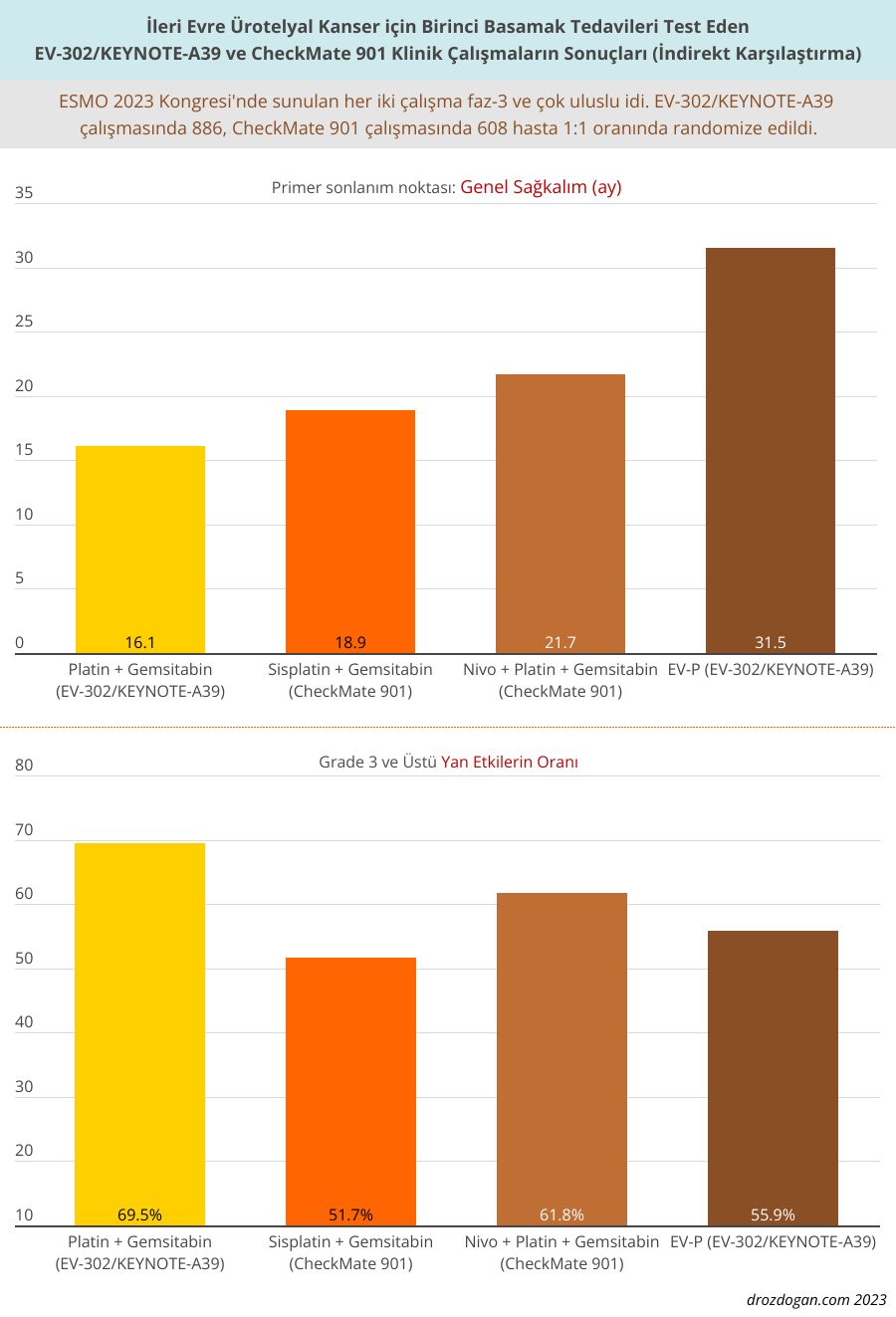
In 442 trial participants, this combination achieved a median overall survival of 31.5 months, markedly outperforming the existing standard of care, platinum-based chemotherapy. By comparison, the 444 participants who received gemcitabine with cisplatin or carboplatin had a median overall survival of 16.1 months, representing a 53% reduction in the risk of death (P < 0.00001).
Removing chemotherapy enabled the new combination to significantly reduce grade 3 or higher adverse effects.
This is the first instance in which overall survival with first-line treatment has been extended beyond that achieved with chemotherapy. The combination of enfortumab vedotin and pembrolizumab produced, in stage 4 solid cancers (those arising in tissues or organs), a 30% remission rate never seen before in this setting. Remission refers to a period when the signs of a disease disappear and disease progression stops.
The EV-302/KEYNOTE-A39 study was presented at the ESMO 2023 Congress and was its most notable trial. It overshadowed CheckMate 901, another trial presented immediately after EV-302/KEYNOTE-A39 that demonstrated improved overall survival compared with standard platinum-based chemotherapy.
In CheckMate 901, nivolumab was added rather than eliminating chemotherapy altogether. With 304 patients randomized to each arm, adding nivolumab improved median overall survival compared with the gemcitabine/cisplatin result of 18.9 months, with nivolumab producing a median overall survival of 21.7 months. This represents a reduction in the risk of death of 22% (P = 0.0171).
This demonstrated for the first time that adding immunotherapy to first-line chemotherapy improves survival in metastatic urothelial cancer.
After years of stagnation in first-line treatments for advanced bladder cancer, these trials represent valuable progress, as both surpassed chemotherapy in the initial treatment setting.
However, the much better survival achieved with enfortumab vedotin plus pembrolizumab means that this combination is now "the best first-line treatment regimen for advanced urothelial cancers."
Adverse Effects and Dosing Information
The most common adverse effects and laboratory abnormalities (in 20% or more) in patients receiving enfortumab vedotin with pembrolizumab included increased aspartate aminotransferase, increased creatinine, rash, increased glucose, peripheral neuropathy, increased lipase, decreased lymphocytes, increased alanine aminotransferase, decreased hemoglobin, fatigue, decreased sodium, decreased phosphate, decreased albumin, itching, diarrhea, alopecia, weight loss, decreased appetite, increased urate, decreased neutrophils, decreased potassium, dry eye, nausea, constipation, increased potassium, dysgeusia, urinary tract infection, and decreased platelets.
The recommended dose of enfortumab vedotin with pembrolizumab is 1.25 mg/kg (up to 125 mg for patients weighing ≥ 100 kg), administered by intravenous infusion over 30 minutes on days 1 and 8 of a 21-day cycle until disease progression or unacceptable toxicity. The recommended dose of pembrolizumab with enfortumab vedotin-ejfv is 200 mg by intravenous infusion every 3 weeks or 400 mg every 6 weeks, until disease progression, unacceptable toxicity, or 2 years of treatment.
Projects and Collaborations
This review was conducted under Project Orbis, an initiative of the FDA Oncology Center of Excellence that provides a framework for simultaneous submission and review of oncology drugs among international partners. For this review, the FDA collaborated with Australia's Therapeutic Goods Administration and Health Canada.
The review also used the Real-Time Oncology Review pilot program, which accelerates data submission before the complete clinical application is filed, and the applicant's voluntary Assessment Aid submission to facilitate the FDA's assessment. The FDA approved the application 5 months ahead of its target date. The application received Priority Review and Breakthrough Therapy designation.
Sources
Was this article helpful?
Your feedback helps us improve our content.




Reader comments
Share your comment
Your name and comment are published only after administrator approval. Your email address is never shown to visitors.
Be the first to comment.