
From the Genome to Early Diagnosis: Genetic Tests Bring Undetected Diseases to Light!

In this article
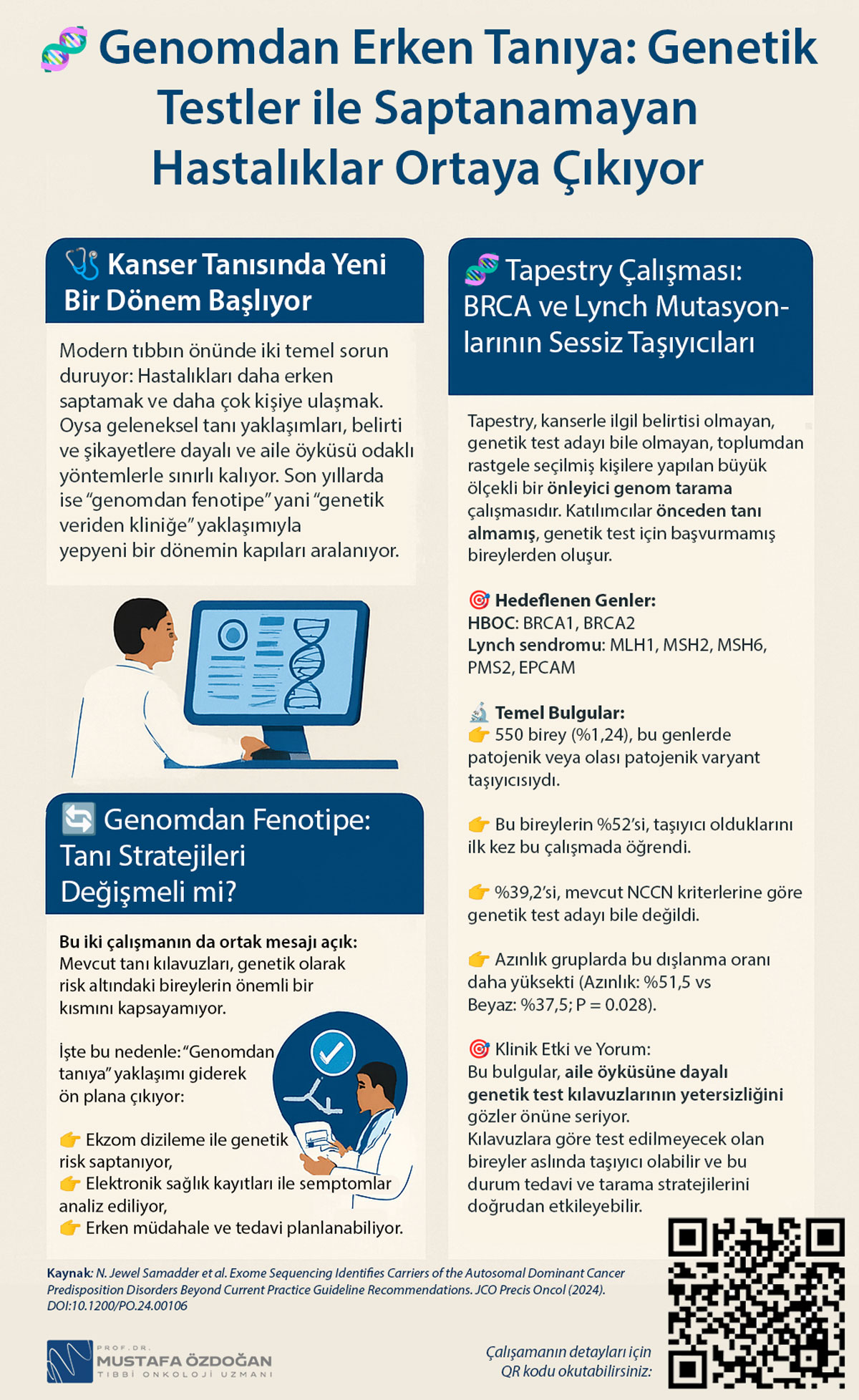
A New Era in Cancer Diagnosis Is Beginning
Modern medicine faces two fundamental challenges: detecting diseases earlier and reaching more people. Traditional diagnostic approaches, however, can remain limited to methods based on symptoms, complaints, and family history. In recent years, an entirely new era has begun to emerge through the “genome-to-phenotype” approach, or “from genetic data to clinical care.” This approach opens new possibilities for diagnosis.
In this article, we bring together two studies conducted in the United States and involving thousands of people to show how exome sequencing can identify people who have genetic risk but have not received a clinical diagnosis. These studies highlight a substantial “diagnostic gap” beyond existing screening guidelines in important areas such as cancer and cardiovascular disease.
The Tapestry Study: Silent Carriers of BRCA and Lynch Mutations
Published on July 16, 2024, in JCO Precision Oncology, the Tapestry study was led by Mayo Clinic.
Tapestryis a large-scale study of people randomly selected from the community who had no cancer-related symptoms and were not even candidates for genetic testing. It used preventive genomic screening. Participants were people who had not previously been diagnosedand had not sought genetic testing.
The aim was to identify people at risk of hereditary breast and ovarian cancer (HBOC) and Lynch syndrome (LS) early through population-based genomic screening. For this purpose, a racially diverse group living near three different US centers (Rochester, MN; Phoenix, AZ; Jacksonville, FL), totaling 44,306 people, underwent Exome+ sequencing through Helix Inc.
Target Genes:
-
HBOC: BRCA1, BRCA2
-
Lynch syndrome: MLH1, MSH2, MSH6, PMS2, EPCAM
Key Findings:
-
550 individuals (1.24%) carried pathogenic or likely pathogenic variants in these genes.
-
Of these individuals, 52%learned that they were carriers for the first time in this study.
-
39.2%were not even eligible for genetic testing under current NCCN criteria.
-
This exclusion rate was higher in minority groups (Minority groups: 51.5% vs White participants: 37.5%, P = 0.028).
Clinical Impact and Interpretation:
These findings reveal the limitations of genetic testing guidelines based on family history and age. People who would not be tested under the guidelines may in fact be carriers, and carrier status can directly affect treatment and screening strategies.
The study also quantifies the disadvantages minority groups face in accessing genetic services. This shows that health inequalities persist even at the genomic level.
The Cell Reports Medicine Study: Thousands of People with Genetic Risk but No Clinical Diagnosis
Published on May 21, 2024, in Cell Reports Medicine, this advanced study used the Mount Sinai Health System's BioMe Biobank database. Exome sequencing data from 29,039 people, integrated with electronic health records (EHRs), were analyzed. The aim was to identify people carrying variants associated with conditions such as hereditary breast cancer, colorectal cancer, familial hypercholesterolemia, and cardiomyopathy, among 9 genetic diseases, and assess how closely these findings matched their medical histories.
Findings:
-
In 614 people,a total of 644 pathogenic, likely pathogenic, or loss-of-function (P/LP/LoF) variants were found.
-
Among people with these variants, 76%had no recorded clinical diagnosis of the associated disease.
-
Moreover, among these undiagnosed people, 15%had clear evidence of symptomatic disease in their EHR data.
Notable Findings by Disease:
-
Among carriers of familial breast cancer variants (BRCA1/2), 22% had signs of symptomatic breast cancer.
-
Among familial hypercholesterolemia variant carriers (LDLR), 50% had cardiovascular symptoms and abnormal lipid profiles.
-
Among people carrying pathogenic variants in cardiomyopathy genes, 19% had symptoms of heart failure in their EHRs.
Clinical Impact:
-
None of these symptomatic but undiagnosed people had received appropriate care for the condition, such as statins, imaging, or prophylactic surgery.
-
The study emphasized that genetic variant carriers may have missed opportunities for early diagnosis and treatment.
What Makes It Innovative:
-
Instead of the conventional “clinical symptoms first, genetic testing second” approach, this study applied “genetic variants first, targeted phenotyping second” as a genome-first model.
-
The clinical penetrance of variants—the likelihood that they actually cause disease—was also analyzed by age group and gene type.
-
Signs of disease were shown to occur more frequently in genes classified as “clinically actionable” by the ACMG.
.
From Genome to Phenotype: Should Diagnostic Strategies Change?
Both studies share a clear message: Current diagnostic guidelines fail to cover a substantial proportion of people at genetic risk.
This is why the “genome-to-diagnosis” approach is gaining prominence:
-
Genetic variants are screened first,
-
Then EHRs (electronic health records) and symptom analysis are used to identify whether disease is present,
-
Treatment is started if necessary.
This method can identify cases that conventional screening algorithms miss.
Conclusion: Breaking the Genetic Silence
Population-based exome sequencing offers a screening strategy not only for very rare hereditary diseases but also for common conditions such as breast cancer, colorectal cancer, and heart disease—a revolutionary screening strategy for these conditions.
The question now is: Should medicine evolve from a symptom-focused model to one focused on genetic risk?
The era of “symptoms first, diagnosis second” in medicine may be coming to an end. The new paradigm is: Genetic information first, followed by targeted clinical assessment.
Was this article helpful?
Your feedback helps us improve our content.




Reader comments
Share your comment
Your name and comment are published only after administrator approval. Your email address is never shown to visitors.
Be the first to comment.