
HOW LONG the novel coronavirus (SARS-CoV-2) survives in the air and on surfaces has been established!

COVID-19 is caused by the novel coronavirus (SARS-CoV-2). Preliminary results from the first comprehensive study to establish how long this virus can remain on various surfaces and as an aerosol were discussed on March 17 in NEJM, the scientific journal.
Note: aerosol refers to solid or liquid particles that can remain suspended in the air. Their size can range from 0.003 micrometers to 100 micrometers in diameter.
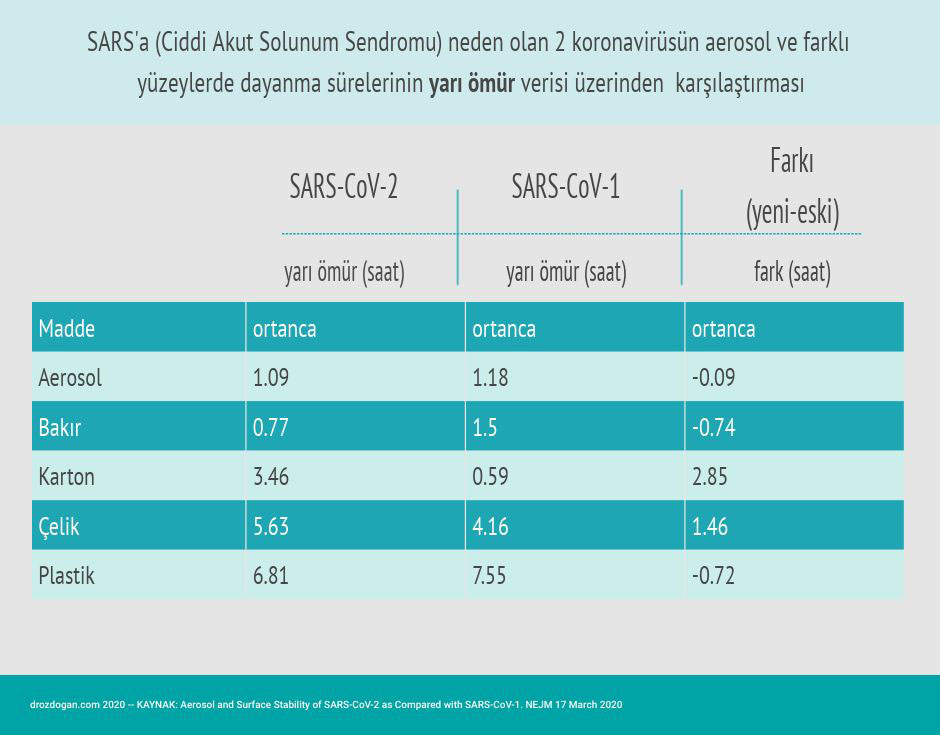
Until now, information on how long the novel coronavirus (SARS-CoV-2) remains on surfaces was based on other members of the coronavirus family that cause similar respiratory tract infections. This study separately examined how long SARS-CoV-2 and SARS-CoV-1, a member of the same family responsible for another outbreak, remained on steel, plastic, cardboard and copper, and in the air. The half-lives of both viruses in different environments are summarized in the table below.
What do half-lives mean, and how is the survival time of the novel coronavirus on different surfaces calculated?
Half-life is generally the time required for a decreasing substance to fall to half its initial amount.
Below is an illustration showing how long SARS-CoV-2 can survive on different surfaces, based on "median" half-life data:

Summary of the researchers' findings and interpretations
The 2 viruses were shown to persist longest on plastic and steel surfaces.
Apart from cardboard, very little difference was observed between the 2 viruses in how long they remained in the different environments. The researchers suggested that the experimental difference observed for the cardboard surface should be interpreted with certain experimental standard errors in mind.
The study's most important finding!
This study shows that the epidemiological differences (in their capacity to cause outbreaks) between the coronavirus responsible for the SARS outbreak in 2003 (SARS-CoV-1) and SARS-COV-2, which causes COVID-19, are due to other factors. Thus, while the SARS outbreak in 2003 did not become a pandemic, COVID-19 caused by this new virus, which has similar transmission and carriage characteristics, has become a pandemic and continues to grow in scale. It is becoming clear that this difference is related to other characteristics of SARS-CoV-2.
The prominent characteristics of SARS-CoV-2 in terms of its "virulence" (pathogenicity, or ability to cause disease) are:
- A high viral load in the upper airways (the virus uses receptors to attach to and enter normal cells more easily, and therefore multiplies more rapidly). The new virus has a 10-20 times greater binding affinity for receptors on human cells than the old virus that caused the outbreak in 2003.
- People infected with SARS-CoV-2 spread the virus before they begin to show symptoms (indeed, the early stages of the disease have been found to be the most infectious period).
The study's results also showed that SASR-CoV-2 can remain in different environments for hours (depending on the type of environment) and that its spread as an aerosol or via objects is quite possible. These findings are an important source of information for efforts to mitigate the pandemic.
OUR CORONAVIRUS DOSSIER
- What are the SYMPTOMS of novel coronavirus disease (COVID-19)? What happens on which day? How does it damage the lungs?
- Breaking coronavirus news – the situation worldwide and in Turkey
- Why and how should HEALTHCARE WORKERS be supported during the coronavirus (COVID-19) outbreak?
- 7 ways to protect against coronavirus when eating out
- Successful and unsuccessful countries in the coronavirus outbreak and what needs to be done
- What cancer patients need to know about Coronavirus
- What are an epidemic and a pandemic? How do they differ?
- Coronavirus News - when will the coronavirus vaccine be ready?
Sources
NEJM. March 17, 2020
Was this article helpful?
Your feedback helps us improve our content.


Reader comments
Share your comment
Your name and comment are published only after administrator approval. Your email address is never shown to visitors.
Be the first to comment.