
Localized Pain After Injection or Infusion: What Causes It, and When Should It Be Taken Seriously?

In this article
Why Does My Arm Hurt After an Infusion or Injection?
Injection-site pain can occur with certain intravenous (IV) chemotherapy treatments. It describes discomfort, tenderness, or pain where the needle enters the vein used to administer medication. It generally results from irritation of the vessel wall. More seriously, extravasation may occur: the drug leaks outside the vein into surrounding tissues, potentially causing severe tissue damage.
How Does Injection-Site Pain Present?
Injection-site pain may present differently according to severity. It is generally described as sharp or dull pain, burning, or throbbing confined to the IV site. There may also be:
- Redness,
- Swelling,
- Increased warmth
in the area.
Causes of Injection-Site Pain
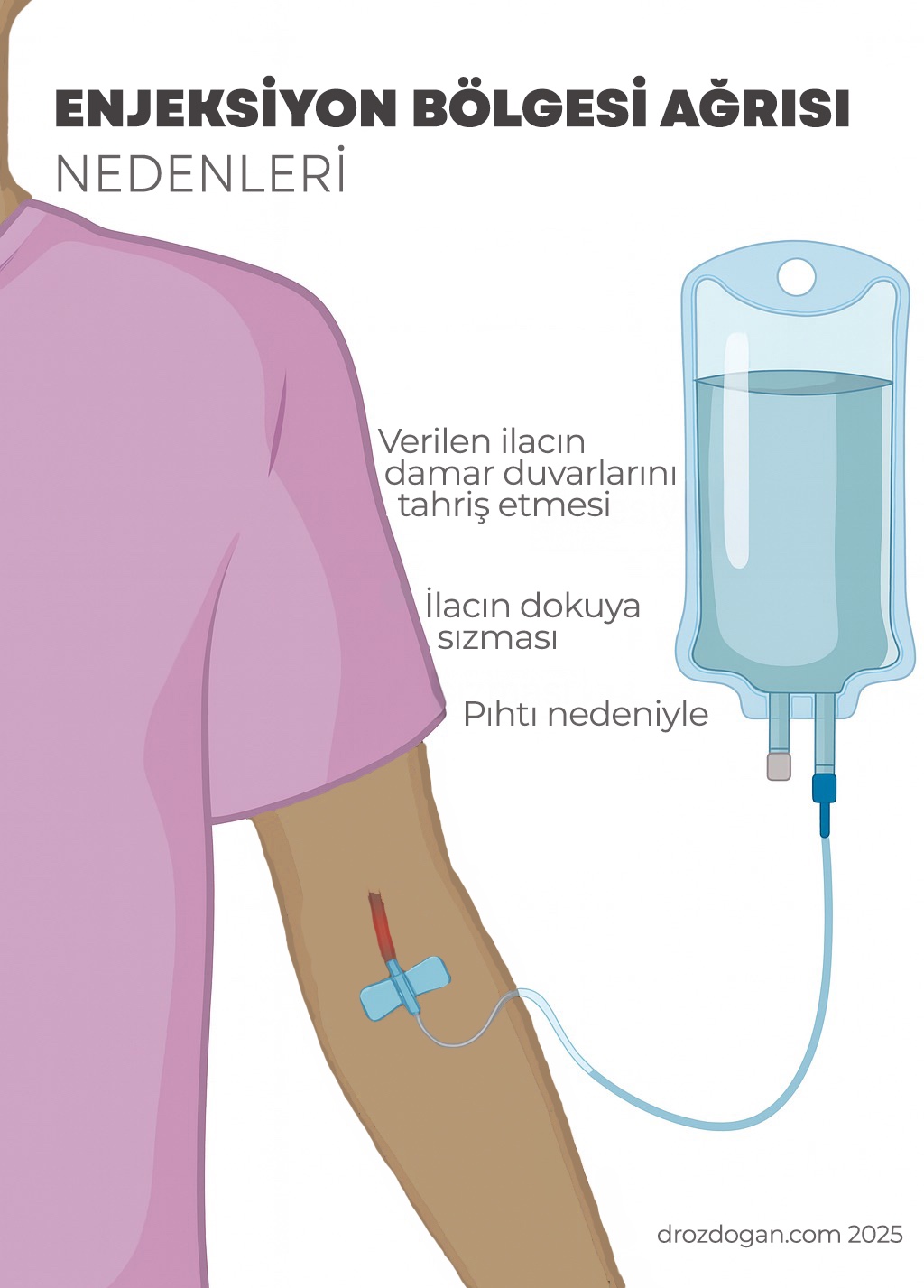
Drug Irritation of Vessel Walls
- Irritant drugs may inflame the vessel’s inner surface.
- This causes pain, redness, burning, and tenderness.
- Examples: Chemotherapy agents such as paclitaxel, carboplatin, and cyclophosphamide.
Extravasation (Leakage Outside the Vein)
- The drug leaves the vein and leaks into surrounding tissue.
- Vesicant drugs in particular may cause severe pain, swelling, redness, and necrosis when they leak into tissue.
- Requires emergency intervention.
Clot (Thrombus) Formation
- A small blood clot at the catheter site or within the vein may obstruct drug flow or press on the vessel wall.
- This can cause pain and edema.
Incorrect Needle Placement
- Choosing a very small or superficial vein may cause injection outside the vessel or vessel puncture.
- This causes mechanical pain independently of drug effects.
High Concentration or Rapid Infusion
- Giving undiluted medication or infusing it too quickly may irritate the vein.
Infection
- A local infection may develop at the catheter entry site.
- Pain may then accompany redness, warmth, and discharge.
Injection-site pain has drug-related causes (toxicity, irritation, extravasation) as well as mechanical and vascular causes. Assess severity when pain develops; if necessary, stop the infusion and begin appropriate treatment.
Who Experiences Injection/Infusion-Site Pain?
Injection/infusion-site pain is more common in patients receiving certain chemotherapy drugs intravenously (IV). Its occurrence depends on drug characteristics, the patient’s veins, and administration technique.
Patients receiving irritant or vesicant drugs
Irritants affect vessel walls and may cause pain and inflammation.
Examples of irritants:
- Alkylating agents: carboplatin, cisplatin, oxaliplatin, cyclophosphamide, bendamustine, carmustine, dacarbazine, busulfan, ifosfamide, melphalan
- Topoisomerase inhibitors: liposomal doxorubicin, mitoxantrone, etoposide, irinotecan, topotecan
- Taxanes: paclitaxel, docetaxel, ixabepilone
- Trastuzumab emtansine
Vesicants may cause severe tissue damage when leaking outside a vein.
- Anthracyclines: doxorubicin, daunorubicin, epirubicin, idarubicin
- Vinca alkaloids: vincristine, vinblastine, vinorelbine
- Trabectedin
- Oxaliplatin
- Mitomycin
- Dactinomycin
Patients treated with these drugs have a higher pain risk.
Patients receiving peripheral intravenous vesicants
- Small peripheral veins are more sensitive than large central veins.
- Risk is higher without a central venous catheter (port, PICC, Hickman, etc.).
Older individuals
- With age, vessels become more fragile and venous circulation weakens.
- This makes proper drug distribution within the vein more difficult.
Patients with poor veins
- Risk increases when veins are damaged by previous chemotherapy, radiotherapy, or chronic illness.
Rapid infusions
- Rapid drug administration may increase vascular irritation and pain.
Patients receiving inadequately diluted drugs
- Concentrated drugs given undiluted or in insufficient volume may damage vessel surfaces.
Patients on long-term infusion therapy
- Daily or frequent infusions increase sensitivity through repeated vein use.
How Is Infusion-Site Pain Treated?
Stop the Injection Immediately
- If pain, burning, swelling, or redness is noticed, stop the infusion immediately.
- Aspirate remaining medication and some blood through the catheter, particularly if extravasation is suspected.
Local Applications (Compresses)
- Warm or cold compresses may be used:
- For irritation: cold compresses are generally preferred.
- For extravasation of certain drugs (e.g., vincristine, vinorelbine): warm compresses are recommended.
- Apply compresses several times daily for 15–20 minutes.
Specific Medications for Extravasation
- Leakage of certain drugs may require local antidotes or dispersing agents.
Symptomatic Support
- Systemic analgesics (paracetamol, NSAIDs) may be used for pain.
- With local edema, arm elevation and rest are recommended.
Observation and Follow-Up
- With suspected extravasation or serious irritation, observe the patient for at least 24–48 hours.
- Tissue necrosis may require surgical consultation.
How Can Infusion-Site Pain Be Prevented?
Select an Appropriate Vein.
- Choose a large, robust vein with good blood flow.
- Small, weak, or previously used veins carry risk.
- Prefer veins above the elbow; avoid those on the back of the hand.
Prefer a Central Catheter for Vesicants.
Where possible, vesicants (drugs capable of tissue damage) should be given through a central venous catheter:
- PICC line
- Tunneled catheters (Hickman, Groshong)
- Implanted ports
Delivering medication into a large central vein rather than a small vein reduces extravasation and pain risks.
Use an Appropriate Catheter Gauge.
- Select a suitable needle/cannula diameter according to drug viscosity and infusion duration.
- Very fine IV needles may cause high pressure, vessel injury, and pain.
Dilution and Slow Infusion
- Drugs should be appropriately diluted and administered at a controlled rate.
- Rapid infusion increases vascular irritation and pain.
Vein Monitoring During Administration
Throughout infusion, the nurse should:
- Continuously inspect the site for swelling, redness, burning, or increased resistance.
- The patient should also be informed about pain, burning, or stinging during the procedure.
Check Vein Patency Before Infusion.
- Blood return on aspiration and saline flow should be satisfactory.
- Do not begin infusion if resistance is felt.
Education and Information
Nurses and healthcare staff should receive regular training in:
- Vesicant drug management
- Extravasation prevention protocols
and related topics.
Was this article helpful?
Your feedback helps us improve our content.


Reader comments
Share your comment
Your name and comment are published only after administrator approval. Your email address is never shown to visitors.
Be the first to comment.