
New PEACE-3 Findings: A Survival Difference with Enzalutamide Plus Radium-223

In this article
Metastatic prostate cancer, particularly with bone involvement, can seriously impair quality of life through pain and fractures. At this point, the disease becomes resistant to hormonal treatment and is termedmetastatic castration-resistant prostate cancer (mCRPC).
In recent years, enzalutamide and similar targeted hormonal drugs have substantially extended survival even at this stage. However, fractures and pain from bone metastases can make treatment difficult to continue. Bone-protecting agents such as zoledronic acid and denosumab have therefore become increasingly important.
An important trial in this field is PEACE-3 , an international Phase 3 study comparing enzalutamide alone with enzalutamide plus radium-223 , a radium-based treatment. Early safety concerns led to mandatory addition of bone-protecting agents in 2018.
Presented at the European Association of Urology (EAU) meeting in 2025, this subanalysis examined how adding bone protection affected patients' survival and radiographic progression-free survival . The findings suggest these agents may strengthen treatment benefits as well as protect bones.
Study Design and Main Findings: Summary 📊
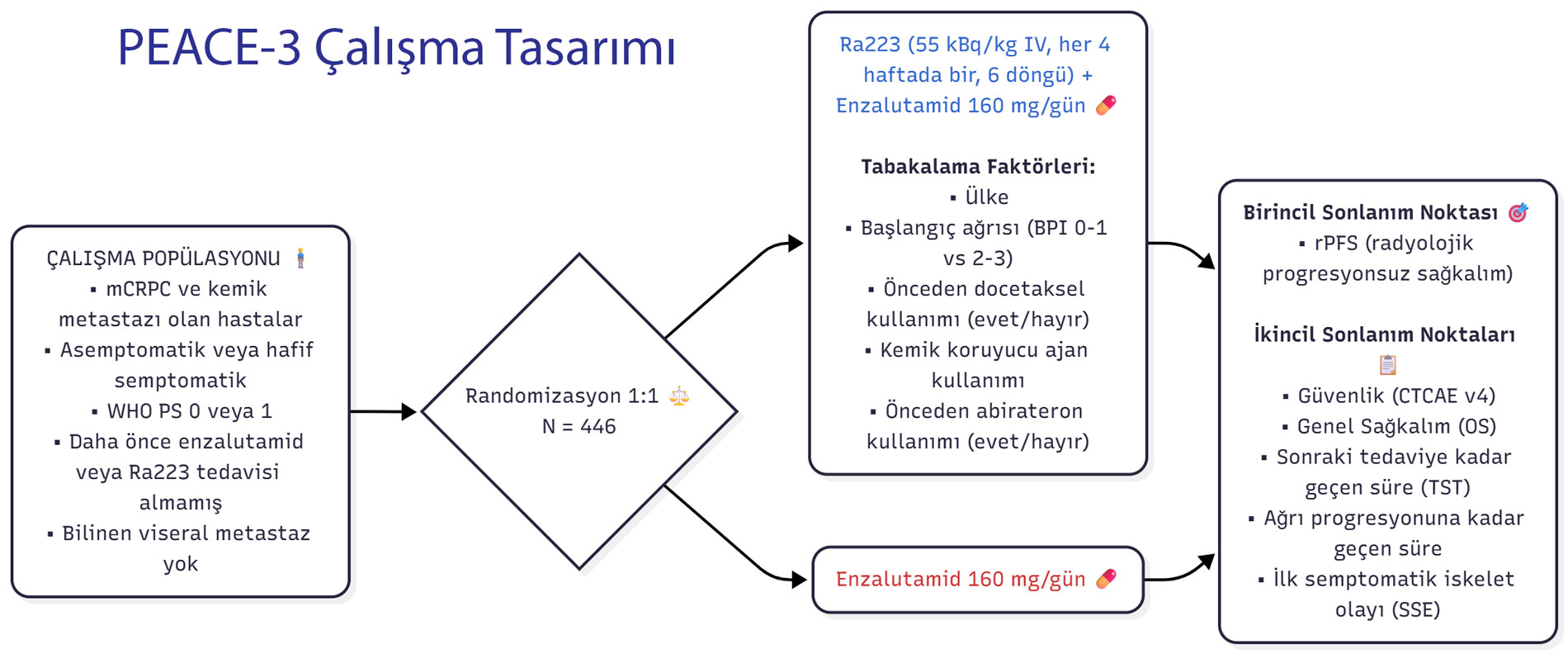
- PEACE-3: International trial, 446 mCRPC patients; 1:1 randomization: Enzalutamide vs Enzalutamide + Radium-223.
- Primary Endpoint (Overall Population): Radiographic progression-free survival (rPFS) HR 0.69 (95% CI 0.54–0.87; p=0.0009) — median rPFS: 16.4 months (ENZ) vs 19.4 months (ENZ+R223).
- Secondary (Interim, at 80% of Events): Overall survival (OS) HR 0.69 (95% CI 0.52–0.90; p=0.0031) — favoring ENZ+R223.
- Fracture Risk (after the safety letter): adding a bone-protecting agent (BPA) reduced risk from 36.5% to 12.5% .
Subanalysis: Patients With and Without Bone-Protecting Agents (BPAs) 🔎
Researchers separately evaluated patients enrolled before the safety warning, a total of 115 patients . Some used bone-protecting agents and others did not.
- No Bone-Protecting Agent, or Started Only After a Fracture: 59 patients (51%)
- Bone-Protecting Agent Use (before and/or during treatment): 56 patients (49%)
- The groups' baseline age, disease stage and general health were very similar.
Numerical Findings: rPFS and OS in the Subgroup
| Endpoint | No BPA | BPA | Effect |
|---|---|---|---|
| Median rPFS | 13.24 months | 26.91 months | +13.67 months; HR 0.60 (95% CI 0.39–0.93) |
| Median OS | 25.58 months | 42.87 months | +17.29 months; HR 0.56 (95% CI 0.37–0.86) |
| Subgroup | Median rPFS | Median OS |
|---|---|---|
| ENZ + R223 + BPA | 28.85 months | 71.59 months |
| ENZ, BPA absent | 12.9 months | 22.77 months |
Radiographic PFS (Months)
Safety and Fractures 🩺
- Fracture Rate: Without BPA, 49.2% (29/59) vs with BPA, 23.2% (13/56).
- CTCAE ≥3 hematological events: no BPA, 10.2% (6/59) vs BPA, 1.8% (1/56).
- CTCAE ≥3 renal/urinary events: no BPA, 8.5% (5/59) vs BPA, 1.8% (1/56).
- Enzalutamide Treatment Duration (Median): No BPA, 12 months (IQR 7–27) vs BPA, 26 months (IQR 13–44).
Clinical Interpretation and Practical Implications
- Efficacy: BPA use was associated with rPFS gains of +14 months (HR 0.60) and OS gains of +17 months (HR 0.56); the advantage appeared in both arms .
- Safety: BPAs reducedfractures and severe hematological/renal events, potentially supporting treatment continuity and dose intensity.
- Practice: Life-prolonging systemic treatment in mCRPC is strongly supported by early, regular addition of a BPA (zoledronic acid or denosumab).
- Dental Health and DVT/Hypocalcemia: Baseline dental assessment, calcium–vitamin D supplementation and proactive monitoring for jaw osteonecrosis and hypocalcemia are recommended.
Limitations and Cautions
- Exploratory Subanalysis: Timing and duration of BPA use varied, with potential substantial selection bias .
- Scale: The subgroup was small (115 patients); results are hypothesis-generating.
- Generalizability: Comorbidities and prior treatment may differ in clinical practice.
Summary: Take-Home Messages ✅
- PEACE-3 overall showed that ENZ + R223, compared with ENZ alone, significantly improved rPFS(HR 0.69; p=0.0009).
- Adding a BPAwas associated in the subanalysis with rPFS +14 months and OS +17 months (HR 0.60 and 0.56).
- With BPAs, fractures and severe hematological/renal toxicity were lower.
- With life-prolonging treatment in mCRPC, early BPA integration appears clinically reasonable and safe .
Brief Practical FAQ
- Which BPA? Zoledronic acid (IV) or denosumab (SC), with calcium–vitamin D supplementation.
- When? Plan at the start of treatment, ideally after dental assessment.
- For Whom? Asymptomatic/mildly symptomatic bone mCRPC patients receiving life-prolonging systemic therapy.
Sources
- EAU 2025 Annual Meeting, Prostate Cancer Session — PEACE-3 presentation (Prof. Fred Saad).
- PEACE-3 Phase 3 trial data (enzalutamide vs enzalutamide + radium-223): radiographic PFS and OS, fracture rates and updates after the safety letter.
- Clinical BPA use: zoledronic acid and denosumab product information and supporting literature.
Note: This subanalysis is exploratory and hypothesis-generating; decisions should account for patient characteristics and current guidelines.
Was this article helpful?
Your feedback helps us improve our content.




Reader comments
Share your comment
Your name and comment are published only after administrator approval. Your email address is never shown to visitors.
Be the first to comment.