
Retifanlimab Combination Receives FDA Approval for Anal Cancer

In this article
On May 15, 2025, the US Food and Drug Administration (FDA) approved retifanlimab-dlwr (Zynyz, Incyte Corporation) both with carboplatin and paclitaxel and as monotherapy for adults with locally advanced or metastatic squamous cell carcinoma of the anal canal. This development offers new hope for treating a rare but aggressive cancer.
What Is New About This Retifanlimab Approval?
- For the first time, an immunotherapycombined with first-line chemotherapy has received FDA approval for squamous cell anal cancer.
- In addition, retifanlimabhas become for platinum-refractory or platinum-intolerant squamous cell cancer, the first FDA-approved PD-1 inhibitor as monotherapy .

What Is Anal Cancer and Why Does It Matter?
Anal canal cancers develop in the anus, the final 3 cm of the digestive tract. They are rare but increasingly diagnosed. US studies show that, between 2001–2015, anal cancer incidence (new cases per year) increased by 2.7% annually, while mortality increased by 3.1% annually. These trends place anal cancer amongthe fastest-increasing cancer types.
More than 90% of anal cancers are associated with HPV infection, particularly HPV-16. The disease is generally more common in women and older people. Because it may advance without symptoms and be diagnosed at an advanced stage, early detection and effective systemic options are vital.
Scientific Basis for the New Approval: POD1UM-303 / InterAACT 2 and POD1UM-202
1. Combination Treatment (Retifanlimab + Carboplatin + Paclitaxel)
The FDA approval is based on the phase 3 POD1UM-303/InterAACT 2 trial involving 308 patients with inoperable locally advanced or metastatic squamous cell anal cancer who had not previously received systemic chemotherapy. Treatment was as follows:
-
Common to both groups: Carboplatin (AUC=5, day 1) and paclitaxel (80 mg/m², days 1, 8, and 15) for 6 cycles
-
Randomization: Retifanlimab-dlwr 500 mg IV (1 every 4 weeks) vs. placebo
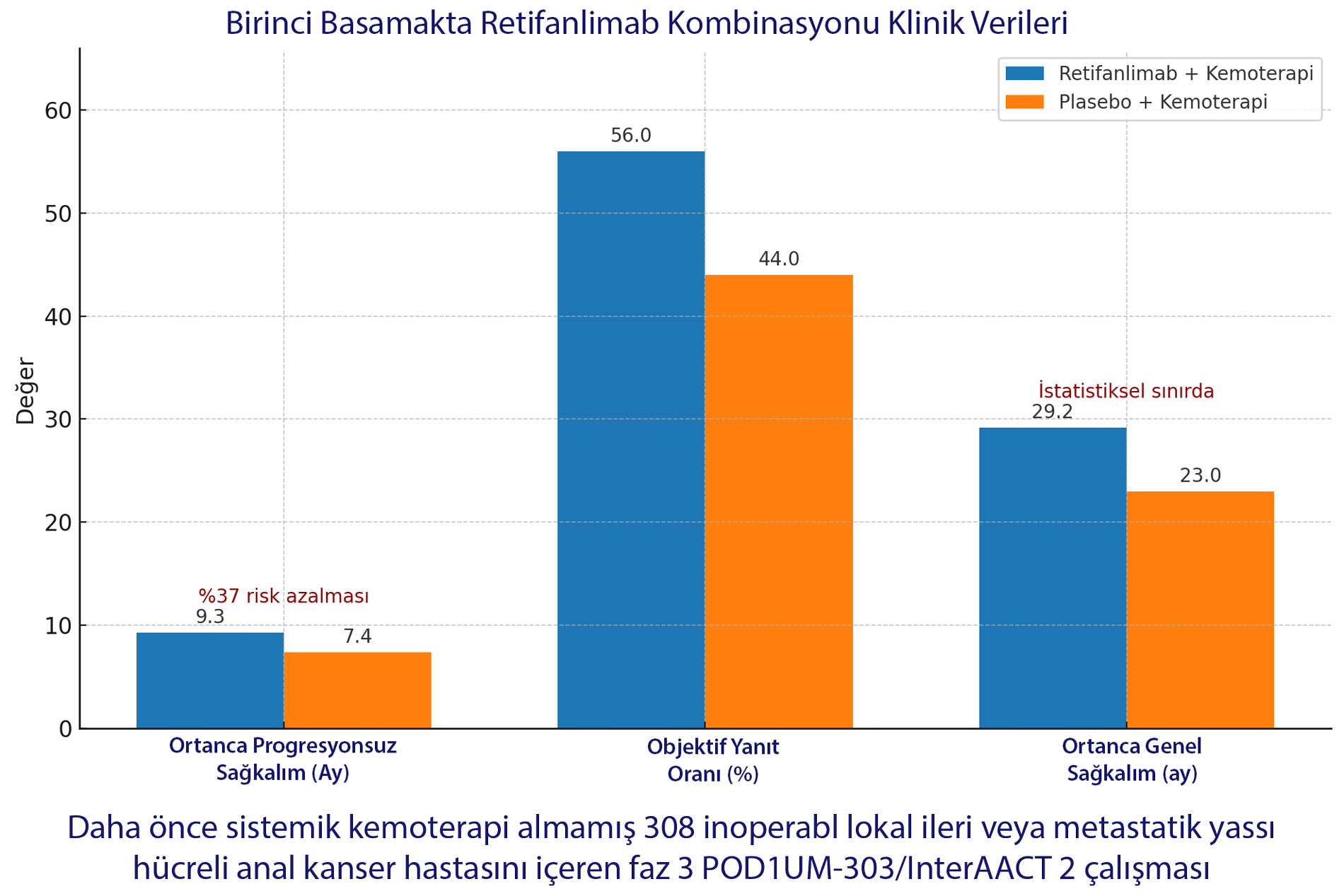
Key findings:
-
Median progression-free survival (PFS):
-
Chemotherapy + retifanlimab arm: 9.3 months
-
Chemotherapy + placebo arm: 7.4 months
-
HR: 0.63 (p=0.0006) → 37% risk reduction
-
-
Response rate (ORR):
-
Retifanlimab arm: 56%
-
Placebo arm: 44%
-
-
Median overall survival (OS):
-
Retifanlimab arm: 29.2 months
-
Placebo arm: 23 months
-
(HR: 0.70) → borderline statistical significance
-
Note: 45% of patients in the placebo arm received retifanlimab after progression.
2. Retifanlimab Monotherapy (POD1UM-202)
The FDA also approved retifanlimab as monotherapy for patients with platinum-refractory or platinum-intolerant squamous cell anal cancer . This approval is based on findings from the phase 2 POD1UM-202 study.
Study overview:
-
94 patients received retifanlimab 500 mg IV every 4 weeks.
-
Objective response rate: 14% (95% CI: 8–23)
-
Median duration of response (DoR): 9.5 months
About Retifanlimab (Zynyz): Previous FDA Approval and Clinical Use
Retifanlimab is a PD-1 (Programmed Death Receptor-1) inhibitor used as immunotherapy.
It received its first FDA approvalon March 22, 2023, for advanced Merkel cell carcinoma (MCC) . This approval was based on the phase 2 POD1UM-201 study, which reported a 52% response rate and a median response duration of 9.5 months.
MCCis a rare, aggressive skin cancer associated with sun exposure and immunosuppression.
Retifanlimab Administration and Safety
-
Combination dose: 500 mg IV every 4 weeks with carboplatin + paclitaxel, for a maximum of 12 months
-
Monotherapy dose: 500 mg IV every 4 weeks, for a maximum of 24 months
-
Warnings:
-
Immune-mediated adverse reactions that can be severe or fatal
-
Infusion reactions
-
Complications after allogeneic stem cell transplantation
-
Embryo-fetal toxicity
-
Conclusion and Significance
Approval of retifanlimab both in combination and as monotherapy is an important development that strengthens the role of first-line immunotherapy in anal canal cancer. The significant PFS improvement in particular could change the treatment paradigm for this rare but serious tumor. Together with its earlier MCC approval, retifanlimab stands out as a promising agent for rare cancers.
Sources
Was this article helpful?
Your feedback helps us improve our content.




Reader comments
Share your comment
Your name and comment are published only after administrator approval. Your email address is never shown to visitors.
Be the first to comment.