
Vitamin D Insufficiency and Chemotherapy-Induced Peripheral Neuropathy Risk (Numb Hands and Feet)

In this article
Vitamin D deficiency and supplementation remain topics of sustained medical interest, particularly their relationship with cancer, which has attracted many scientific studies. Vitamin D supplements are among the top 10 most frequently prescribed products, and vitamin D deficiency is among the top 5 most common diagnoses. Research into vitamin D's role in cancer particularly examines its biochemical effects and how it may influence cancer-cell growth and spread. Identifying deficiency and supplementing when needed have therefore become important in general health management as well as cancer treatment. Maintaining adequate vitamin D levels may improve treatment effectiveness and reduce side effects, supporting quality of life and adherence. Correcting deficiency and using supplements are consequently receiving increasing attention in oncology.
A Treatment Side Effect and Its Link to Vitamin D Insufficiency
A study found that patients with insufficient vitamin D had approximately 1.6 times the risk of peripheral neuropathy (CIPN), a form of nerve damage that can develop after chemotherapy, compared with those with adequate levels.
Chemotherapy-induced peripheral neuropathy (CIPN) results from nerve damage caused by chemotherapy drugs. It can produce sensory problems such as numbness, tingling, and pain, particularly uncomfortable changes in sensation in the hands and feet. Paclitaxel is the chemotherapy drug most closely associated with this side effect.
In November 2023, the National Comprehensive Cancer Network journal in the United States published this study, which identified an important finding particularly in patients receiving breast cancer treatment.
Patients receiving paclitaxel who had insufficient vitamin D were more likely to develop severe (grade 3 or higher), painful, function-limiting CIPN. This suggests vitamin D levels may be protective against this chemotherapy side effect. Identifying and, if necessary, correcting insufficiency before chemotherapy may therefore be an important step in reducing CIPN risk.
In this study, vitamin D insufficiency was defined as a serum vitamin D level below 20 nanograms per milliliter (< 20 ng/mL).
Researchers obtained these findings by analyzing data from an early-stage breast cancer trial comparing six doses of adjuvant chemotherapy regimens containing doxorubicin, cyclophosphamide, and paclitaxel. The phase 3 SWOG S0221 trial aimed to evaluate the effectiveness and safety of these drug combinations.
The study involved 1191 breast cancer patients with an average age of 51.1. All were women, 83.7% were White, and 52.5% received paclitaxel every two weeks. At baseline, 33.3% had insufficient vitamin D. Severe sensory CIPN developed in 16.4%, and severe sensory or motor CIPN in 17.1%. These rates provide important information about CIPN prevalence and the potential effect of vitamin D deficiency.
Key Findings
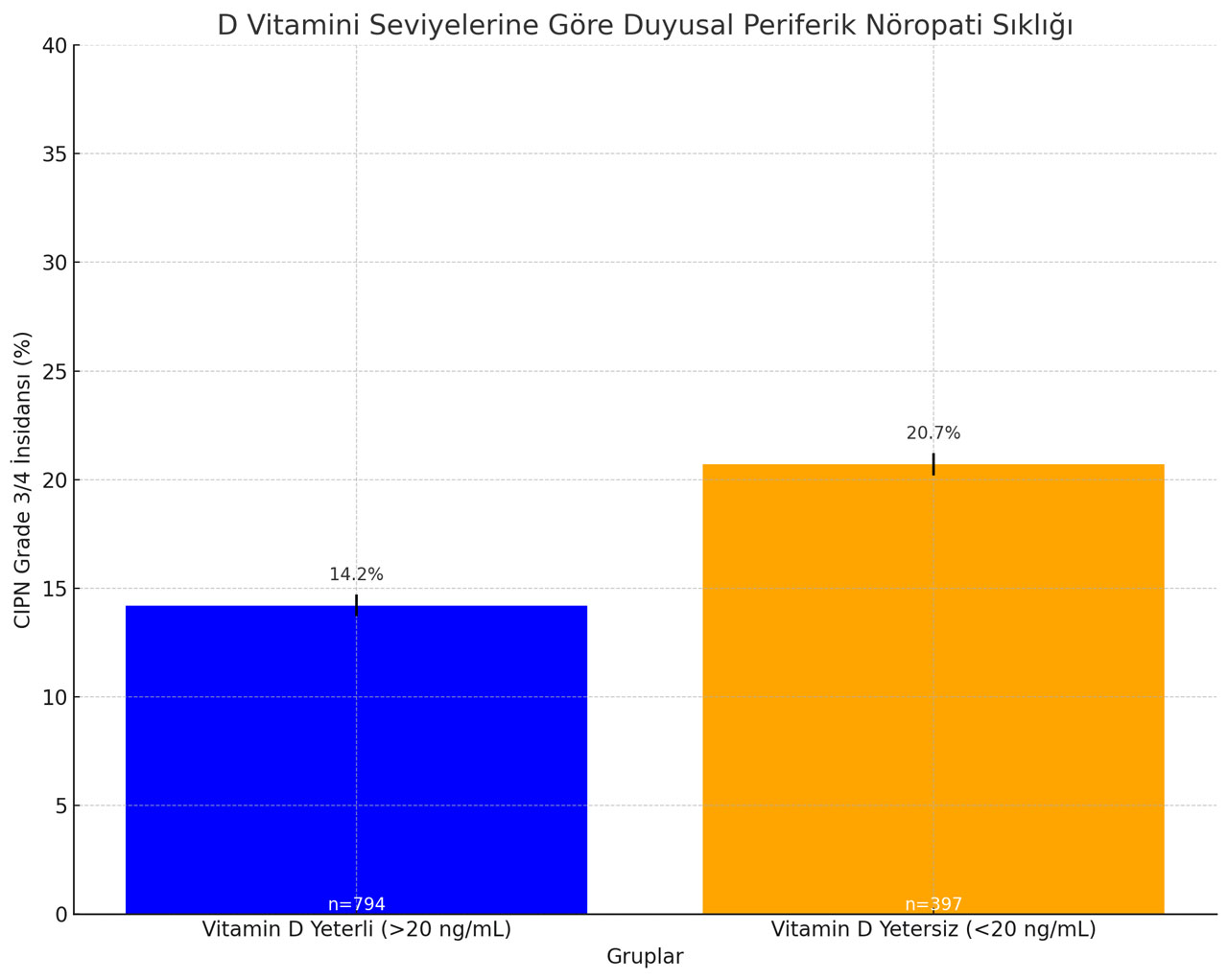
Chart Explanation: This bar chart compares grade 3 or 4 CIPN incidence in patients with adequate (>20 ng/mL) or insufficient (<20 ng/mL) pretreatment vitamin D. Among 397 patients with insufficient vitamin D, CIPN incidence was 20.7%, compared with 14.2% among 794 with adequate levels. The odds ratio (OR) was 1.57, a statistically significant difference (P=0.005).
The increases in CIPN risk associated with individual risk factors were:
- Vitamin D insufficiency: 1.57-fold higher CIPN risk
- Older age: 1.02-fold higher CIPN risk
- Black race: 2.48-fold higher CIPN risk
- Other races, neither Black nor White: 1.84-fold higher CIPN risk
- Paclitaxel every two weeks: 2.37-fold higher CIPN risk.
Of these factors, only vitamin D insufficiency is modifiable.
Conclusion
Identifying and, if necessary, correcting vitamin D insufficiency may reduce CIPN risk and improve long-term quality of life. It may enable patients to continue effective paclitaxel treatment longer and thereby extend survival. Vitamin D levels may therefore be an important biomarker for individualized treatment planning.
*
Image Description: The article's image was created by ChatGPT 4.0 using the prompt: “A blog image showing that vitamin D is important for health.”
Sources
Was this article helpful?
Your feedback helps us improve our content.


Reader comments
Share your comment
Your name and comment are published only after administrator approval. Your email address is never shown to visitors.
Be the first to comment.