
What Does Stomach Cancer Look Like on Endoscopy?

In this article
Detecting stomach cancer at an early stage is crucial to successful treatment. Endoscopy is one of the most effective methods used to diagnose stomach cancer. This procedure allows abnormalities in the stomach's internal structure / wall to be visualized and a definitive diagnosis to be made through biopsy. So what does stomach cancer look like on endoscopy, and when is this procedure performed?
The Appearance of Stomach Cancer on Endoscopy
During endoscopy, various changes in the gastric mucosa (the stomach's inner lining) that may indicate cancer can be identified. These appearances may include:
- Lesions and ulcers: Abnormal tissue or open sores may be seen.
- Mucosal changes: As cancer progresses, thickening of the stomach wall and surface irregularities may develop.
- Deep tumors: If cancer lies in the deeper layers of the stomach wall, standard endoscopy alone may not be sufficient. In this case, detailed imaging with endoscopic ultrasound may be necessary.
Example 1: The images below show different tissue changes during endoscopic assessment. At the bottom right, a well-defined white lesion stands out within the stained area. Such structures are frequently seen with staining techniques used to examine malignant (cancerous) tumors.

Example 2: Below are images of stomach cancer and ulcers. In particular, at the bottom right, an ulcerovegetative mass can be seen. An ulcerovegetative mass refers to a structure that is both ulcerated (with tissue loss) and raised above the surface or growing outward (vegetative). The red area in the image is generally associated with increased vascularity or tissue damage, while the white area may represent fibrin deposits, necrotic tissue, or cellular debris. These structures are common in malignant tumors and may be encountered in conditions such as stomach cancer. However, benign ulcerovegetative lesions can also occur. 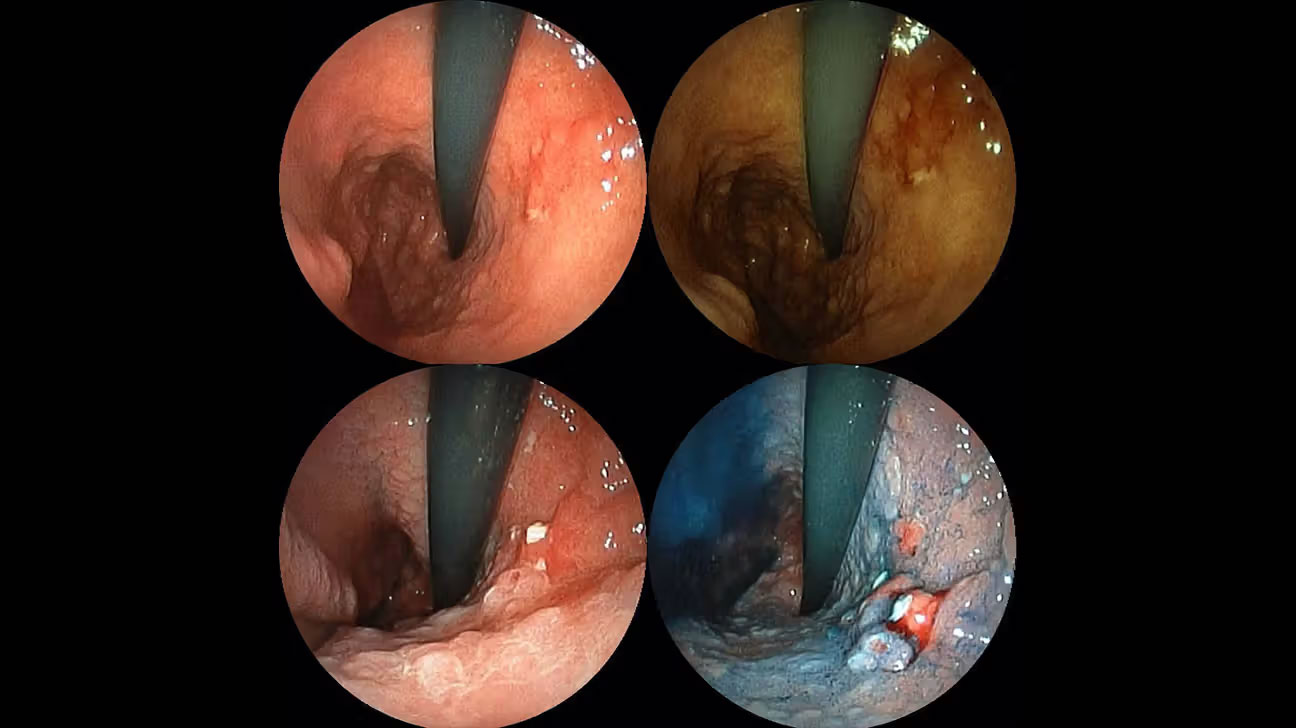
Pathological examination (biopsy) is important for a definitive diagnosis. Biopsies taken during endoscopy clarify whether this structure is inflammatory or cancerous.
When Do Doctors Recommend Endoscopy?
Endoscopy may be recommended for people with the following symptoms:
- Persistent abdominal pain
- Unexplained weight loss
- Nausea and indigestion
- Difficulty swallowing (dysphagia)
- Feeling full early
- Vomiting blood (hematemesis)
Doctors may also recommend endoscopy for the following reasons:
- Family history: A family history of stomach cancer
- Chronic stomach conditions: Conditions such as pernicious anemia or chronic gastric atrophy
- Genetic factors: Familial adenomatous polyposis or familial intestinal gastric cancer syndromes
- History of stomach surgery: Previous stomach surgery (partial gastrectomy)
- Geographical factors: Living in regions where stomach cancer is common (East Asia, Eastern Europe, South and Central America)
How Is Endoscopy Performed?

Endoscopy is performed by passing a flexible tube through the esophagus into the stomach. During the procedure:
- Anesthesia: The patient receives sedation to prevent discomfort.
- Tissue sample: Biopsies are taken from suspicious areas for laboratory examination.
- Procedure duration: It takes approximately 15-30 minutes. After resting briefly following the procedure, the patient is discharged.
Before the procedure, patients may need to avoid eating for approximately 6 hours and avoid drinking fluids for 2 hours.
Is Endoscopy a Reliable Method?
Endoscopy is a highly reliable method for diagnosing stomach cancer. Multiple biopsies are generally taken today.
- Single biopsy: 70% of stomach cancer cases can be detected with a single biopsy.
- Multiple biopsies: When 7 biopsy samples are taken, the detection rate rises to as high as 98%.
However, the experience of the doctor performing the endoscopy can be decisive, particularly in detecting early-stage cancers.
Diagnostic Methods Other Than Endoscopy
In some cases, additional tests may be needed to confirm a stomach cancer diagnosis or assess its spread:
- Barium X-ray: X-ray imaging of the stomach
- CT and MRI: Advanced imaging methods used to obtain detailed images
- PET-CT: Imaging that shows the extent of cancer spread
- Laparoscopy: A surgical procedure performed to examine the organs inside the abdomen
Conclusion
Endoscopy is considered the gold standard for diagnosing stomach cancer. When suspicious symptoms or risk factors are present, doctors use this method to take biopsies for a definitive diagnosis and perform further tests when necessary.
If you have symptoms of stomach cancer or belong to a high-risk group, it is important to consult a specialist promptly for early diagnosis.
Was this article helpful?
Your feedback helps us improve our content.




Reader comments
Share your comment
Your name and comment are published only after administrator approval. Your email address is never shown to visitors.
Be the first to comment.