
What Is a Gene Signature? Can It Predict Response to Cancer Treatment?

In this article
What Is a Gene Signature?
A gene signature combines the expression levels of several genes to predict a disease's presence, course or response to treatment. In cancer biology, it describes a tumor's molecular features and helps predict prognosis or treatment response. By reflecting tumor genetics and cancer-cell behavior, signatures help us understand the disease and develop personalized strategies. They can also be viewed as a step beyond cancer genetic testing, or as genetic data analyzed with artificial intelligence algorithms.
- Prognostic: Prognostic refers to predicting a disease's future course, particularly progression, recurrence risk or overall survival. Using a gene signature to estimate long-term survival in cancer, for example, is a prognostic application.
- Predictive: Predictive refers to anticipating response to a particular treatment or medicine, identifying whether a patient is likely to respond well or poorly. A gene signature indicating how a patient may respond to immunotherapy, for example, is a predictive approach.
Measuring and Testing Gene Signatures
Gene signatures are generally measured with advanced genetic engineering and bioinformatics technologies, including RNA sequencing (RNA-Seq), microarray analysis and quantitative real-time polymerase chain reaction (qRT-PCR). These identify signatures by measuring gene expression levels. RNA-Seq, for example, sequences and analyzes RNA from tumor samples to create expression profiles. Statistical analyses and algorithms evaluate these profiles to develop a signature model. Testing the models in clinical samples provides information on prognosis or treatment response.
Cancers in Which Gene Signatures Have Shown Prognostic and Predictive Value
Recent years have demonstrated prognostic and predictive value in several cancers. For example:
- Breast Cancer: Gene signatures have been used to predict recurrence risk and response to hormonal treatment.
- Colon Cancer: Gene signatures are used to determine disease stage and predict chemotherapy response.
- Lung Cancer: Gene signatures are used to predict prognosis and response to targeted treatments.
- Stomach Cancer: Gene signatures are being investigated to predict immunotherapy and chemotherapy response.
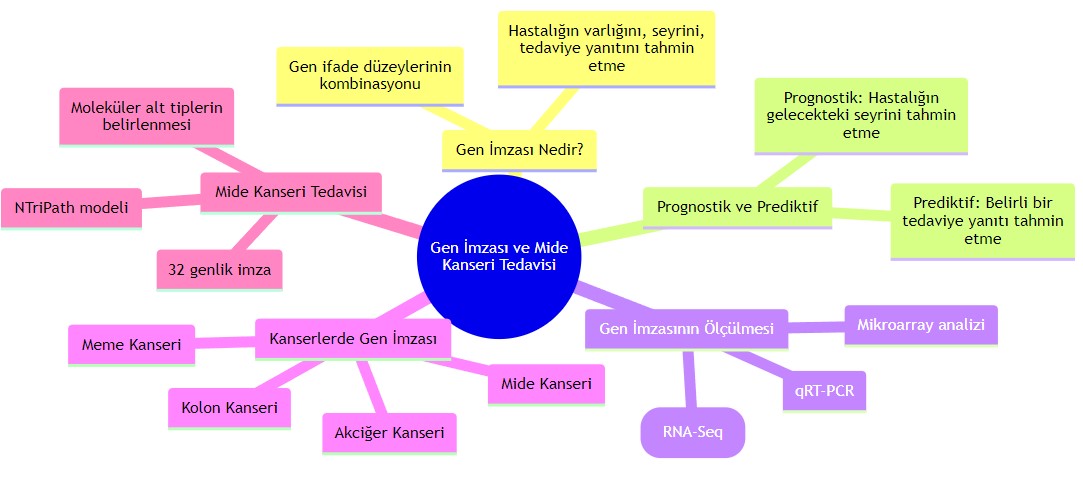
A mind map illustrating gene signatures and stomach cancer treatment is shown below:
A Gene Signature May Predict Stomach Cancer Treatment Response
A machine learning-derived gene signature predicted whether patients with stomach cancer would benefit from chemotherapy, targeted medicines or immunotherapy in a study reported in February 2022 in Nature Communications .
Lead author Tae Hyun Hwang, from Artificial Intelligence and Informatics at Mayo Clinic Cancer Center, says, "We were pleased to see that our 32-gene signature not only provides prognostic information but also predicts whether patients will benefit from chemotherapy and immunotherapy."
Hwang adds, "We were particularly surprised that the 32-gene signature could predict a patient's immunotherapy response, given how challenging it has been to identify reliable biomarkers for immunotherapy response in stomach cancer."
Stomach cancer is among the leading causes of cancer-related death worldwide.
Most patients receive chemotherapy, targeted medicines and sometimes immunotherapy as part of treatment, but not all benefit. For example, the standard adjuvant fluoropyrimidine–platinum combination improves long-term survival by only about 9%.
The researchers used genomic sequencing to develop a model predicting whether a patient would benefit from available treatments.
The study workflow is shown below:
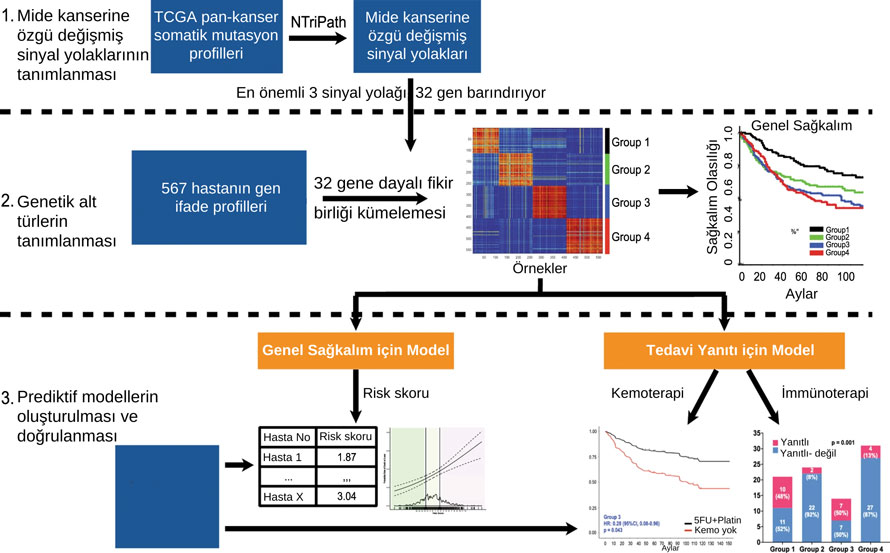
Figure description: Somatic mutation profiles from 6681 TCGA (The Cancer Genome Atlas) patients across 19 cancers were entered into NTriPath to identify intracellular signaling pathways specifically altered in stomach cancer. Microarray-based mRNA expression profiles from 567 stomach cancer patients were generated and entered into NTriPath. Unsupervised clustering based on expression of 32 genes in the top 3 pathways identified molecular subtypes. Their prognostic and predictive capacity was tested in multiple independent cohorts.
NTriPath was developed by Hwang and colleagues using a machine learning algorithm integrating genetic data from several thousand patients.
As the authors explain, they used TCGA (The Cancer Genome Atlas) data from 6681 patients across 19 cancer types. Their somatic mutation profiles were entered into NTriPath to identify pathways specifically altered in stomach cancer.
Samples from 567 stomach cancer patients were used to generate microarray-based mRNA expression profiles, which were processed and analyzed with NTriPath.
The analysis used expression levels of 32 genes in the three most important stomach cancer-specific pathways. These 'top three pathways' are three main biological mechanisms critical to cancer development and progression:
- The DNA damage response,
- TGF-ß signaling,
- Cell proliferation.
The 32 genes in these pathways, reflecting stomach cancer characteristics, include TP53, BRCA1, MSH6, PARP1 and ACTA2.
Expression levels of these 32 genes identified different molecular subtypes of stomach cancer. These were tested in multiple independent patient cohorts for prognostic and predictive features, including disease course and treatment response.
The group had previously identified five transcriptome-based molecular subtypes predicting survival. In that report, the inflammatory subtype had the best prognosis, the mesenchymal subtype the worst, and the other three showed intermediate, overlapping outcomes. Comparing the two classification schemes, the team found that each 32-gene group was generally represented across all 5 molecular subtypes.
Hwang says the 32-gene molecular signature still needs prospective validation but believes it may eventually identify patients who will respond to chemotherapy and immunotherapy. "Similarly, we will be able to identify those who will not benefit, sparing them the possible side effects of chemotherapy and immunotherapy."
The researchers are also developing AI algorithms using diagnostic histopathology images to help identify patients likely to benefit from immunotherapy. They are examining molecular mechanisms of immunotherapy resistance identified through the machine learning and AI approaches.
*
Image description: The article's image was generated by ChatGPT 4.0 using the following prompt: "What Is a Gene Signature? Can It Predict Response to Cancer Treatment?"
Sources
Was this article helpful?
Your feedback helps us improve our content.




Reader comments
Share your comment
Your name and comment are published only after administrator approval. Your email address is never shown to visitors.
Be the first to comment.