
What is mitosis? An essential requirement for cancer!

In this article
Cells are our body's basic building blocks. Cells form tissues, and tissues form organs and systems. Cells must multiply for vital processes to occur.
Cells multiply for the following purposes;
- creating new cells to replace aging, dying ones,
- renewing damaged tissues,
- growth and development
However, cells have limited capacity to grow and divide. Some divide frequently, whereas muscle and nerve cells cannot multiply. Cells with “unlimited” proliferative capacity are stem cells. Adults have small numbers of these cells.
What is mitosis?
Cell division producing two daughter cells with the same number and types of chromosomes is called "mitosis" in terminology. During mitosis, a cell divides in two, producing two "genetically" identical cells.
Our body contains approximately 30 trillion cells, and about one in 300 divides daily. Thus, 100 billion cells undergo mitosis every day.
The stages of mitosis are shown below

Mitosis involves 3 basic events:
- Before dividing, a cell must copy its genetic information. To distribute equal amounts to daughter cells, DNA replication (copying) occurs.
- Copied chromosomes must be divided equally between cells. Spindle fibers pull chromosomes toward each cell.
- After chromosomes are distributed, the cell visibly splits into two. This is called cytokinesis (cytoplasmic division).
A single cell takes approximately 24 hours to undergo mitosis. Most of this time is preparation for division.
What is mitosis's role in cancer?
Cancer cannot arise without mitosis, so the two are closely related. As DNA damage, meaning mutations , accumulates, the cell begins multiplying uncontrollably.
In 1 day, 100 billion cells undergo mitosis. Imagine a very busy factory producing 100 billion new products daily. Errors inevitably occur on the production line; we call these mutations. Even with a one-in-a-million probability, that means 100 thousand new mutations daily. Our factory actually works so perfectly that throughout life, DNA repair genes repair 100 thousand mutations daily. However, mutations increase because of carcinogens such as years of smoking, or chronic inflammationcaused by obesity, and by accumulatingexceed cells' repair capacity and trigger uncontrolled proliferation, meaning cancer development….
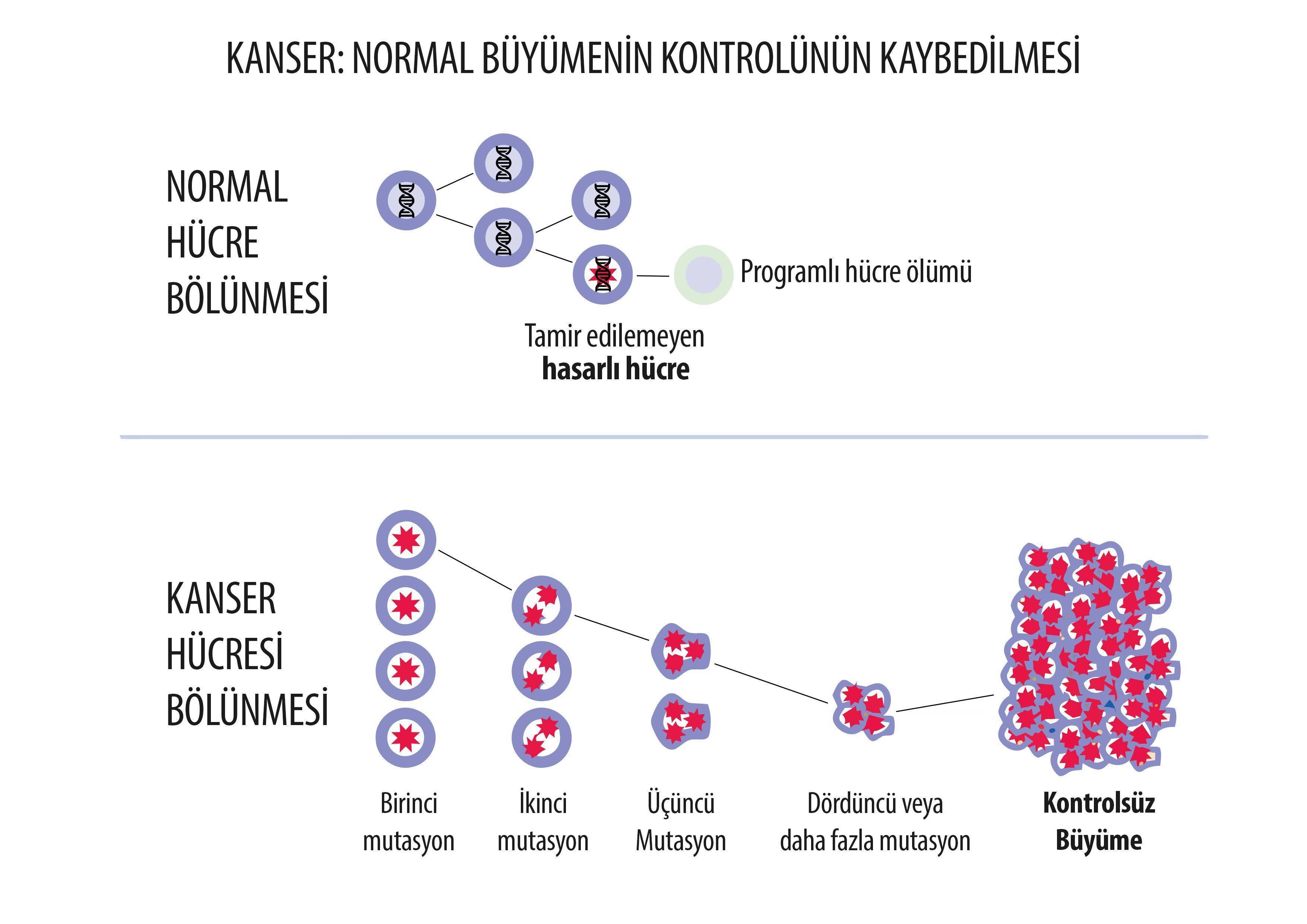
Examining mutations in cancer cells, we see that most occur in genes involved in "mitosis" as their function.
Many current cancer drugs are designed to target mitosis. Different cancers have different mitotic rates, expressed in pathology reports as "frequent mitoses" or "rare mitoses". Highly mitotic cancers tend to spread rapidly, but drugs affecting mitosis work better in them. Our next related article discusses “cancer drugs targeting mitosis”.
You may be interested in: WHAT IS CANCER? Why and how does it develop? The whole process summarized!
Sources
Was this article helpful?
Your feedback helps us improve our content.




Reader comments
Share your comment
Your name and comment are published only after administrator approval. Your email address is never shown to visitors.
Be the first to comment.