
What Is Pertuzumab (Perjeta)? FDA Approval, Licensing and Reimbursement in Turkey

In this article
The Power of Dual Blockade in HER2-Positive Breast Cancer: Pertuzumab
One of the agents revolutionizing breast cancer treatment, Pertuzumab (Perjeta®)has substantially extended survival through “dual blockade” with trastuzumab (Herceptin) in HER2-positive tumors. It is integral to standard care in early and metastatic disease.
Drug Profile
- Brand Name: Perjeta®
- Active Ingredient: Pertuzumab
- Class: Monoclonal Antibody (HER2 Dimerization Inhibitor)
- Administration: Intravenous (IV) Infusion
- Manufacturer: Roche
- License: Licensed in Turkey. License date: 18.02.2016
- Payment: Included in SGK's reimbursement list (SUT).
- Reimbursement Conditions: May be used until progression with trastuzumab and docetaxel as first-line metastatic breast cancer treatment in patients without prior systemic chemotherapy or trastuzumab for metastatic disease, ECOG performance status 0-1, HER-2 immunohistochemistry +3 or FISH/CISH/SISH (+), and visceral metastases.
Not used after relapse in patients previously receiving adjuvant or neoadjuvant trastuzumab for early breast cancer. If progression occurs on pertuzumab, it cannot continue alone or as part of a combination. If docetaxel stops because of toxicity, trastuzumab + pertuzumab may continue. - June 2026 Price: For a 420 mg vial, 82,921.72 TL .
- The initial loading-dose cycle costs 164,086,4 TL; subsequent per-cycle cost is 82,921.72 TL.
Approved Indications
- Metastatic Breast Cancer (1st Line): Combined with trastuzumab and docetaxel in previously untreated metastatic disease.
- Neoadjuvant Treatment (Before Surgery): Locally advanced, inflammatory or early-stage tumors (>2 cm or node-positive).
- Adjuvant Treatment (After Surgery): High recurrence risk (node-positive or hormone receptor-negative).
FDA Approval History
Pertuzumab's approval rests on three major studies that changed standard care:
The FDA, CLEOPATRA based on striking trial findings, approved it for metastatic (stage 4) disease. Adding pertuzumab extended survival by an average of 15.7 months , setting a record.
The FDA, NeoSphere based on trial findings, approved presurgical use in early-stage patients. *Note: Pertuzumab was the first breast cancer drug ever FDA-approved for neoadjuvant treatment.
APHINITY results supported approval as postsurgical preventive treatment in patients at high recurrence risk.
What Is Pertuzumab? Molecular Mechanism of Action
Pertuzumab is a laboratory-developed, HER2-specific recombinant humanized monoclonal antibody. Its distinguishing feature is the different “address” where it binds.
🔬 Molecular Operating Principle
HER2 is a cell-surface antenna signaling “grow.” To function, it generally pairs with another antenna, particularly HER3, joining side by side. This is called “heterodimerization” .
- 1. Domain II Blockade (Physical Barrier):
Trastuzumab (Herceptin) binds near the receptor's base (Domain IV); pertuzumab binds the central joining arm, the extracellular dimerization region (Domain II) . Binding here makes physical contact between HER2 and HER3 impossible. - 2. Interrupting the Strongest Signaling Pathway:
The HER2-HER3 pair is a “super-couple” generating the strongest cancer growth signals, activating intracellular PI3K/Akt signaling. By disrupting pairing, pertuzumab blocks survival and proliferation signaling (the PI3K pathway) at its source. - 3. Synergy with Trastuzumab (Comprehensive Blockade):
Because they bind different regions of the same receptor, trastuzumab and pertuzumab do not obstruct one another. They surround it at two sites to provide “Comprehensive Dual Blockade” . Trastuzumab primarily blocks ligand-independent signals; pertuzumab blocks ligand-dependent signals. Together, they kill tumors more effectively than either alone. - 4. Recruiting the Immune System (ADCC):
Like trastuzumab, bound pertuzumab marks the cell for natural killer (NK) cells. This is called Antibody-Dependent Cellular Cytotoxicity (ADCC) , enabling immune cells to engulf and destroy the cancer cell.
Administration and Dosage
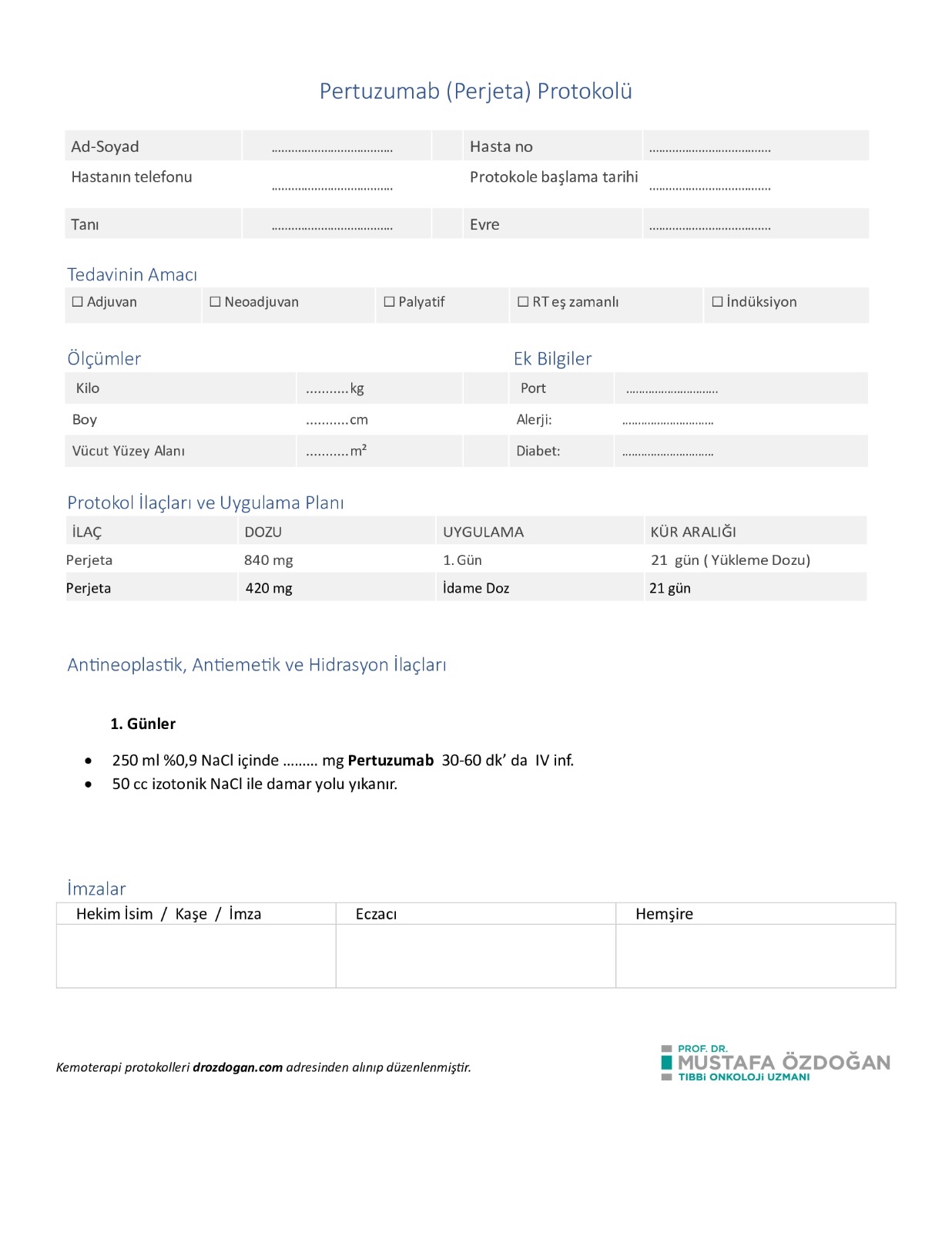
Pertuzumab is given intravenously every 3 weeks (21-day cycles).
- Loading Dose (Cycle 1): 840 mg pertuzumab (60 min infusion).
- Maintenance Dose (Cycle 2+): 420 mg pertuzumab (30-60 min infusion).
- Administration Sequence: If given the same day: Pertuzumab first, trastuzumab next, then chemotherapy (taxane).
Dose Modifications and Management
Pertuzumab is not dose-reduced like conventional chemotherapy (e.g., halving the dose). Give the full dose or withhold/discontinue.
| Situation | Action |
|---|---|
| Missed Dose (< 6 Weeks) | If less than 6 weeks since the last dose: 420 mg continue. |
| Missed Dose (≥ 6 Weeks) | If 6 weeks or more since the last dose: Repeat 840 mg (Loading Dose) , then continue 420 mg. |
| Chemotherapy Toxicity | If adverse effects (e.g., neutropenia) are attributable only to chemotherapy (docetaxel, etc.), reduce or stop chemotherapy; pertuzumab may continue. |
Dose Management According to Cardiac Function (LVEF)
Pertuzumab + trastuzumab may affect cardiac pumping strength (LVEF). Echocardiography is mandatory before treatment and every 3 months. Manage doses when:
- LVEF falls below 40% ,
- OR LVEF falls to 40-45% , with a decline of more than 10% from baseline (percentage-point loss):
👉 ACTION: HOLD pertuzumab and trastuzumab for at least 3 weeks. Reassess after 3 weeks. Discontinue permanently if it does not recover.
Adverse Effects and Management
Pertuzumab is generally well tolerated, but combination chemotherapy produces cumulative adverse effects. Common effects requiring management include:
- Diarrhea: The most characteristic effect (60-70%). Generally mild, but occasionally severe. Manage with substantial fluids and antidiarrheals (loperamide, etc.) if needed.
- Alopecia (Hair Loss): Occurs in approximately 60% because of accompanying docetaxel/paclitaxel. Hair regrows after treatment.
- Neutropenia: Reduced white blood cells (50%+), increasing infection risk. Fever (febrile neutropenia) requires urgent intervention.
- Weakness and Fatigue: Low energy is common.
- Cardiac Toxicity: Heart failure symptoms (dyspnea, foot swelling) are rare but require regular monitoring.
Special Situations and Warnings
- Pregnancy and Breastfeeding (Boxed Warning): In the fetus, pertuzumab may cause oligohydramnios (reduced amniotic fluid) and renal failure, leading to death.
Rule: During treatment and after the last dose for 7 months , effective contraception is mandatory. Breastfeeding is not recommended. - Infusion Reactions: Fever, chills or rash may occur in 13% during the initial infusion and 5% subsequently. Restart more slowly after symptoms resolve.
- Anthracyclines: Drugs such as doxorubicin/epirubicin are not used concurrently because heart failure risk increases. Pertuzumab generally starts after anthracycline treatment ends.
Pharmacokinetics and Interactions
- Half-Life: Approximately 18 days (hence dosing every 3 weeks).
- Metabolism: Does not interact with hepatic CYP enzymes. Broken down like other body proteins.
- Interactions: No clinically significant interaction with standard chemotherapy (docetaxel, paclitaxel, carboplatin). It and trastuzumab do not alter each other's blood levels.
References
- FDA Prescribing Information for Perjeta (pertuzumab), Genentech, Inc.
- Swain SM, et al. Pertuzumab, trastuzumab, and docetaxel in HER2-positive metastatic breast cancer (CLEOPATRA): end-of-study analysis. Lancet Oncol. 2020.
- von Minckwitz G, et al. Adjuvant Pertuzumab and Trastuzumab in Early HER2-Positive Breast Cancer (APHINITY). N Engl J Med. 2017.
- Gianni L, et al. Efficacy and safety of neoadjuvant pertuzumab and trastuzumab (NeoSphere). Lancet Oncol. 2012.
- T.C. Sağlık Bakanlığı, Perjeta Kısa Ürün Bilgisi (KÜB).
Was this article helpful?
Your feedback helps us improve our content.


Reader comments
Share your comment
Your name and comment are published only after administrator approval. Your email address is never shown to visitors.
Be the first to comment.