
A Blood Test for BRCA Mutation Carriers Can Predict Breast Cancer 2 Years in Advance

In this article
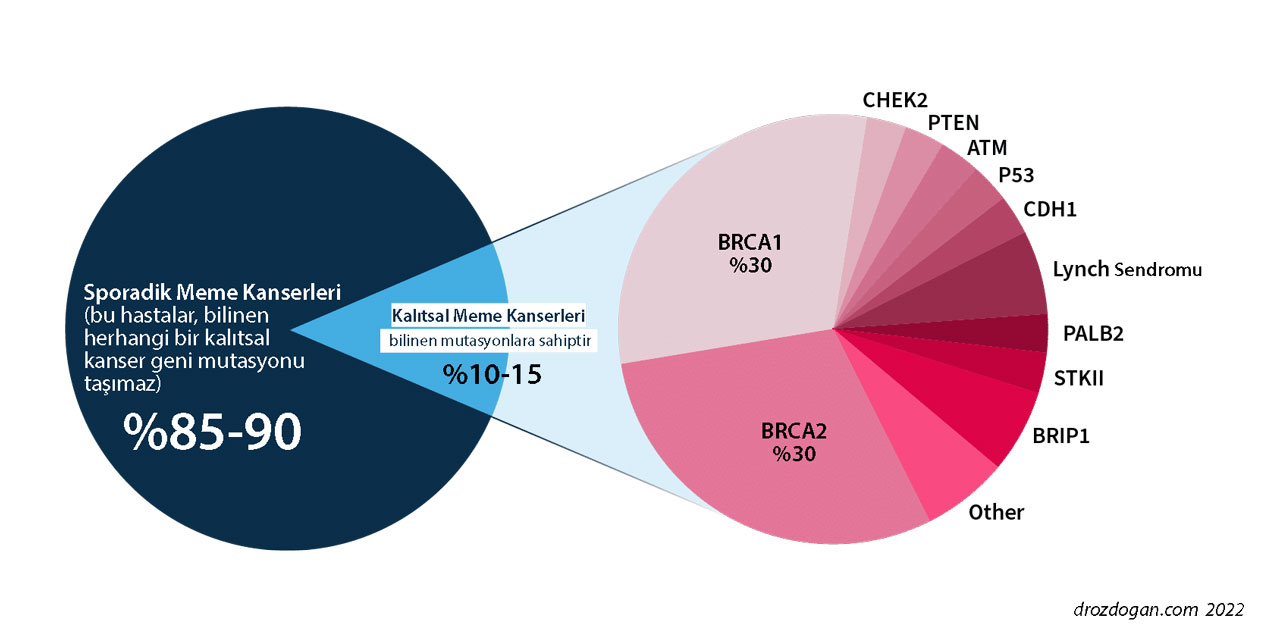
Breast cancers are hereditary in around 15% of cases: their main underlying cause is inherited cancer genes carrying a mutation passed down from a mother or father. The best-known inherited cancer genes associated with breast cancer are BRCA1 and BRCA2, which are involved in DNA repair.
The chart below shows genes associated with hereditary breast cancer and their contribution.
A Dutch Study
A new blood test developed by Dutch researchers can identify changes in serum proteins indicating the onset of breast cancer up to 2 years before diagnosis in women at high risk because they carry BRCA mutations.
The findings come from blood samples collected from participants in TESTBREAST, a study involving 1174 women carrying BRCA gene mutations. They are followed at nine centres in the Netherlands and, because of their higher risk, undergo regular breast screening from a younger age and more frequently than the general population. Blood samples are also collected regularly; more than 3000 serum samples have been gathered over 10 years.
The results now reported come from an in-depth analysis of 30 samples from three women who developed breast cancer and three women without the disease (controls). These are early results from just these 6 women; analysis of more samples from more women continues.
Analysis of these first few women showed that levels of six proteins differed significantly between those who developed breast cancer and those who did not, and that the differences were detectable up to 2 years before diagnosis.
These proteins could form the basis of a blood test for early breast cancer detection in women at increased risk.
The research was presented on 16 November 2022 at the 13th European Breast Cancer Conference and was recently published in International Journal of Molecular Sciences.
Young women with BRCA mutations have a markedly increased risk of breast cancer, and that risk can reach 72%.
Starting screening earlier and repeating it more frequently is therefore an important decision, since tumours may develop during the screening period in up to 17% of these women.
The new blood test is intended to be used at 6-month intervals in high-risk women. Women identified as being at greater risk could then be followed more closely using an individualised plan, allowing cancer to be detected at its earliest stage.
Another question is how follow-up should be intensified if levels of these 6 proteins begin to rise. If protein levels increase, women could undergo magnetic resonance imaging (MRI) in addition to mammography and ultrasound screening.
Deciding on Preventive Removal of Both Breasts
If the test enters hospital use, it could make another important contribution. Women at increased breast cancer risk because they carry BRCA mutations may be advised to have both breasts surgically removed as a preventive measure. This operation, in which breast tissue is removed, is called bilateral prophylactic mastectomy. It is major surgery, and losing one’s breasts in this way has many psychosocial consequences. Such a blood test could help determine more accurately which women carrying BRCA mutations should undergo prophylactic mastectomy.
Study Details
To examine protein changes before diagnosis, the team analysed blood samples using targeted mass spectrometry as the analytical method. Serum samples from three women carrying BRCA mutations who developed breast cancer and three who did not were analysed.
5 serum samples were taken from each of the three cancer cases and three controls, giving a total of 30 samples for analysis. The initial analysis showed that each patient had a unique, identifiable protein clustering pattern.
Small changes in blood proteins over time were noted, but differences between patients were greater than differences within the same patient.
Cluster analysis of cases and controls identified, among 764 candidate proteins, a panel of six different proteins significantly associated with early-stage breast cancer.
Using both individualised and population-based data, the team found these protein differences were present 1 to 2 years before clinical diagnosis of breast cancer.
The researchers next want to validate these findings across the full TESTBREAST cohort. They are also collaborating with international researchers to simplify the technique.
Sources
2. 13th European Breast Cancer Conference (EBCC-13): Abstract 1. Presented November 16, 2022.
Was this article helpful?
Your feedback helps us improve our content.




Reader comments
Share your comment
Your name and comment are published only after administrator approval. Your email address is never shown to visitors.
Be the first to comment.