
A Carriage Wheel and a Bottle of Carbolic Acid — The Day Modern Surgery Was Born

In this article
Joseph Lister, James Greenlees, and the Birth of the Second Pillar of Modern Surgery
Anesthesia (Ether Day, October 16, 1846, day 78) and obstetric chloroform (Simpson, November 4, 1847, day 79) constituted the first great leap in the history of modern surgery — but they were not enough on their own. Because the surgical wards in the middle of the 19th century still resembled a slaughterhouse after the operation. The patient survived the procedure; but in the days that followed — according to sources, in 30-50% of cases — entered a nightmarish sequence beginning with foul-smelling discharge from the wound's edges, fever, shivering, and a racing pulse. Surgeons called this "pyaemia", "erysipelas", "hospital gangrene" or, under an all-encompassing name, "hospitalism" — hospital disease, as they called it. The wards themselves were killing people. In the early 1860s at Glasgow Royal Infirmary, a diagnosis of compound fracture almost certainly meant either amputation or death from sepsis . On the afternoon of Saturday, August 12, 1865, an 11-year-old boy from the city's poorer neighborhoods — James Greenlees — was brought into the corridors of Glasgow Royal Infirmary. A carriage wheel had run over his left leg, breaking the shinbone (tibia), which pierced the skin and protruded: a typical compound fracture. The standard approach at the time was clear: first amputation, then a 50% chance of death from sepsis. But that day the University of Glasgow's Regius Professor of Surgery, Joseph Lister (1827-1912), decided to try something different. He told his assistant to bring a chemical that he had heard "eliminated foul odors" at a sewage treatment plant in Carlisle: carbolic acid (phenol, C₆H₅OH). He washed the wound with it, reduced the fracture, placed dressings soaked in carbolic acid over it, and bandaged it tightly. And waited. When he removed the dressing four days later, the pus, fever, foul odor, and redness he had expected were absent. The wound was clean, the tissue pink, and healing normal. Six weeks later, the bone had fully united. James Greenlees was discharged with his leg intact and returned to the streets of Glasgow. This was the moment modern antiseptic surgery was born. Today — on day 80 of the series, we examine the second of the two pillars of modern oncologic surgery alongside anesthesia (days 78-79): antisepsis. Anesthesia removed pain; antisepsis removed death. Without these two, William Halsted's radical mastectomy of 1894 (day 110) would have been inconceivable. Without these two, no modern oncologic operation performed today would be possible.
The terrifying statistics of surgery in the middle of the 19th century
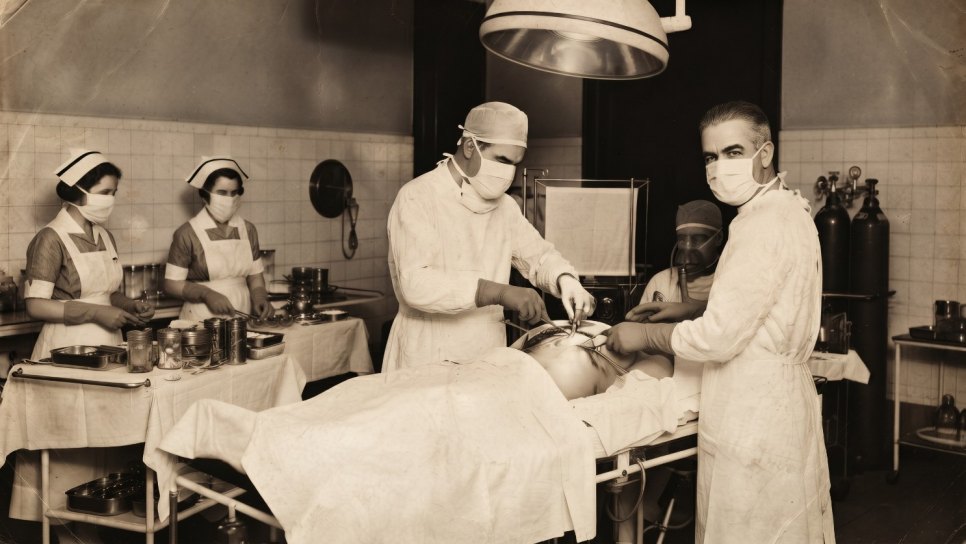
To understand what Lister was fighting against in 1865, we need to visualize the practical reality of surgical wards at the time. Anesthesia had been discovered (1846-1847), but no one knew what hygiene was, whether microbes existed, or why some wounds healed while others led to death. Surgeons entered the operating room in street clothes and almost never changed their gowns — old blood and pus stains were regarded as a "medal of experience" — and passed instruments from one patient to the next after merely wiping them with a cloth. Wound dressings were often pieces of oilcloth clogged with discharge (sediment, dried blood). Mortality rates:
☠ "HOSPITALISM" — PATIENTS KILLED BY THE WARD
To the surgeons of the time, rather than the operation itself , it was the subsequent stay in the ward that inspired greater fear. For a patient with a compound fracture, treatment at home was safer than hospital admission, as was clearly known. Large urban hospitals such as Glasgow Royal Infirmary, Edinburgh Royal Infirmary, and London's St. Bartholomew's had the most "diseased" wards — the paradox was that the larger and more crowded the hospital, the higher patient mortality.
Surgeons spoke of four main deadly postoperative syndromes: (1) Pyaemia — pus entering the bloodstream (septic shock in modern terminology); (2) Erysipelas — a skin infection spreading like wildfire (modern Streptococcus pyogenes); (3) Hospital gangrene — a necrotizing infection destroying the wound (modern necrotizing fasciitis); (4) Puerperal fever — postpartum sepsis in obstetric wards. The cause of none of these was known; explanations such as "bad air" (miasma), "imbalance in nature", "the patient's weak constitution" were offered.
What Lister did in 1865 — bringing Pasteur's fermentation–germ theory into surgical practice — was to name this invisible enemy and choose a weapon against it.
Vienna 1847: washed hands, ignored data
The most tragic precursor to Lister's transformation in 1865 was the Hungarian obstetrician Ignaz Semmelweis (1818-1865). Semmelweis had died in August 1865, the year in which Lister treated James Greenlees — the enemy he had debated for years at Vienna's Allgemeine Krankenhaus, in his own eyes, was brought to an end when the guards of an asylum ward beat him to death. His life is a historical tragedy.
In 1847 — 18 years before Lister's success — Semmelweis examined Vienna's two obstetric wards. In one, medical students and physicians managed deliveries; puerperal fever mortality there was 18%. In the other, only midwives worked; mortality there was 2%. The only practical difference between them was that medical students came to the ward after performing autopsies in the morning, while midwives did not. Semmelweis formulated the hypothesis: hands coming from autopsies carry "deadly particles". He implemented a handwashing protocol with a chlorinated lime solution. Mortality fell to 1% within three months.
But Semmelweis's data were rejected by the European medical establishment. The idea that physicians' "hands might be dirty" was seen as damaging to the professional honor of the time. The outcome was dramatic: years of academic exclusion, mental deterioration, admission to an asylum in 1865, and death soon afterward. Lister probably had not read Semmelweis — sources are not clear on this point; but he had reached the same conclusion by finding Pasteur's germ theory through a different route. In medical history, Semmelweis is remembered as the tragic precursor to Lister's success.
Historical irony: Semmelweis's death and Lister's success with James Greenlees both occurred in 1865. One was being forgotten as an Austrian physician in an asylum; the other was saving a boy's leg in Glasgow. The same scientific truth (cleanliness to prevent wound infection) was entering human history through two different channels with two different endings. Semmelweis's tragedy is the saddest example of "belatedly recognized discoveries" in medical history; Lister's success became an example that barely escaped the same delayed recognition — because Lister's ideas were also strongly criticized at first.
Joseph Lister's years from 1827-1861
Joseph Lister was born on April 5, 1827, in Upton, Essex. His father, Joseph Jackson Lister (1786-1869), was a wealthy Quaker wine merchant; but he also has an important place in medical history: in 1830, as an amateur optician who developed the modern achromatic microscope , he became a Fellow of the Royal Society. Thus young Joseph grew up with a microscope at home. The microscope's tiny worlds were familiar to him.
Being a Quaker placed certain barriers in the way of academic life in Victorian Britain — Oxford and Cambridge were officially affiliated with the Anglican Church and excluded Quakers. Lister therefore went to the newly established, religiously nondiscriminatory University College London. He received a bachelor's degree from the arts faculty in 1847 and a BMBSCh (Bachelor of Medicine and Surgery) from the medical faculty in 1852; that same year, he became a member of the Royal College of Surgeons. At age 26, he set off for Edinburgh — where Britain's most respected surgeon, James Syme, was the man he would work alongside.
JAMES SYME (1799-1870) — LISTER'S TEACHER AND FATHER-IN-LAW
The chief surgeon of Edinburgh Royal Infirmary, nicknamed the "Napoleon of Surgery", James Syme was one of the fastest and most technically skilled surgeons of his time. He was a contemporary of Robert Liston (day 77); but Syme's speed was not just about saving time, it was also about anatomical precision . The "Syme amputation" he developed (at ankle level, preserving the heel pad) is still used today.
Lister became Syme's assistant in 1854, at age 27; two years later, in April 1856, Syme's eldest daughter, Agnes Syme , became his wife. Agnes is one of the overlooked figures in modern medical history: she worked actively in all of Lister's laboratory experiments, kept the experimental notebooks, read drafts of his papers, and should even have been credited as a coauthor on some of them. The couple had no children; Agnes's sudden death in 1893 (pneumonia during a trip to Tyrol, Italy) was a devastating loss for Lister.
Lister's Edinburgh years from 1854-1860 — alongside Syme — shaped his surgical technique and discipline of clinical observation. When he was appointed Regius Professor of Surgery at the University of Glasgow in 1861, he was 33, married, and one of Britain's most promising young surgeons.
Understanding that "pus did not come from the atmosphere"
When Lister began work in Glasgow, he saw the mortality in the wards of Glasgow Royal Infirmary at close quarters. In particular, the two large surgical wards under his own care — for compound fractures brought in after accidents and for elective surgical patients — were among Glasgow's most "diseased" wards. By early 1865, of the amputation patients under his care, he had lost 46% to sepsis. This was a despair experienced by every surgeon of his generation.
Lister began systematically investigating the question "why do some wounds form pus and others do not". He used the microscope (his father's legacy was proving useful here); took samples of wound discharge; and prepared histological sections. The prevailing theory of the time — "miasma", meaning disease caused by bad air — did not satisfy him, because of two patients breathing the same air, one recovered and the other died.
Around 1864-1865, a colleague at the University of Glasgow — chemistry professor Thomas Anderson — showed Lister the French chemist Louis Pasteur's studies, published between 1857-1860, on fermentation and "germ theory". Pasteur had proved that wine fermentation and the souring of milk were caused by microscopic living beings in the air (microbes). In other words, spoilage, rather than "bad air", had living microorganisms as its source.
Lister arrived at carbolic acid through an interesting channel. In 1864, Carlisle city engineers had begun using carbolic acid (phenol, an aromatic compound obtained from coal tar) at the sewage treatment plant to remove foul odors and reduce parasitic infections in animals. Glasgow chemist Thomas Anderson told Lister about this practice; the idea that the substance that cleaned sewage might also clean a wound became Lister's reasoning. In the middle of 1865, he began small trials.
A boy's leg at Glasgow Royal Infirmary
Glasgow Royal Infirmary, male surgical ward · The moment modern antiseptic surgery was born
Patient: James Greenlees, an 11-year-old boy. A child from a poor family in Glasgow's poorer neighborhoods. While playing in the street, he had fallen in front of a carriage; its heavy wheel had run over his left leg. The shinbone (tibia) had broken in two places, and the broken bone fragments had pierced the skin and protruded. A classic compound fracture.
The standard approach at the time: first amputation (removal of the leg), then a 50% chance of death from sepsis. If the surgeon refused amputation, sepsis was even more certain. Cutting off an 11-year-old child's leg — an emotionally devastating decision. The child was crying on the table; his family was waiting in the corridor.
Lister came to the ward. He examined the child. Instead of amputation, he decided to try something no surgeon had yet tried. He called to his assistants and asked them to bring carbolic acid.
First, the child was given chloroform anesthesia (an extension of days 78-79 — without anesthesia, this process would have been unbearable). Lister first dipped his ungloved hands and his instruments into a carbolic acid solution. Then he washed the wound with copious carbolic acid, put the broken bone fragments back in place, and sutured the skin. A linen dressing soaked in carbolic acid was placed over the wound; he wrapped thin tin foil around the dressing (to prevent the carbolic acid from evaporating); and bandaged everything tightly.
And waited.
Lister followed the subsequent days hour by hour. James Greenlees's temperature did not rise. No foul odor came from the wound edges. The child was eating and drinking normally. Four days later, on Wednesday, August 16, Lister removed the dressing.
Removing the dressing · "There was no pus. There was no foul odor. The tissue was pink."
Lister carefully removed the dressing. What he expected — what the other surgeons in the ward had already imagined subconsciously — was pus, dead tissue, foul odor, redness, and fever. There was no trace of any of them. The wound was clean; the tissue was pink; healing was proceeding normally. The nurses and young assistants around him looked on, unable to believe what they saw. Some paused silently. Others wondered "how is this possible" and whispered it.
Lister renewed the dressing — fresh linen soaked in carbolic acid, fresh tin foil. The child remained in the ward for weeks; the dressings were changed every 3-4 days.
Six weeks later, James Greenlees's shinbone had fully united and his wound had closed. His leg was intact. He could walk. Lister discharged the child; he returned to the streets of Glasgow.
This was the moment modern antiseptic surgery was born.
Before publication: 11 cases, systematic verification
Lister was determined not to repeat Crawford Long's mistake (day 78 — Long's seven years of silence had caused him to lose his priority). But he did not want to publish hastily either — applying Pasteur's germ theory to surgical practice was a major claim, and solid data were needed to withstand criticism. Over the 15 months between autumn 1865 and the end of 1866, Lister systematically treated cases of compound fracture and abscess at Glasgow Royal Infirmary with the carbolic acid method. He kept detailed clinical notes on the cases, made anatomical drawings rather than photographs, and recorded the outcomes.
In his first series of 11 cases — all compound fractures — there were only two deaths . This was extraordinary by the standards of the time; mortality in the same ward a year earlier had been 45%. Lister concluded that his data were sufficiently strong.
"On a New Method of Treating Compound Fracture, Abscess, etc."
On Saturday, March 16, 1867 , in the weekly issue of Britain's most prestigious medical journal, The Lancet, Lister's first paper appeared: "On a New Method of Treating Compound Fracture, Abscess, etc., with Observations on the Conditions of Suppuration". The paper opened by presenting the cases of James Greenlees and three other patients.
Over the next four weeks, three more consecutive papers followed (March 23, March 30, April 6); then, on July 27, 1867, the fifth and final paper appeared, focusing on abscess treatment. The series of six papers in total systematically detailed 11 compound fracture cases and several abscess cases. The results were dramatic: many of the classic ward deaths were preventable , as was clearly demonstrated.
LISTER'S ANTISEPTIC PROTOCOL — THE 1867 VERSION
- Handwashing: Before and after surgery, the surgeon and assistants should use a 5% carbolic acid solution to wash their hands.
- Instrument sterilization: All surgical instruments should be immersed in carbolic acid solution before use; hard metals should be preferred to porous materials (wood) for instrument handles.
- Wound washing: After the wound is opened, it should be washed with copious carbolic acid; all visible foreign material should be removed.
- Dressing technique: Linen/cotton soaked in carbolic acid should be placed over the wound; thin tin foil over that (to prevent evaporation); a tight bandage on top.
- Dressing changes: Every 3-4 days, following the same protocol; during dressing changes, the wound should be washed again with carbolic acid.
- Catgut sutures: Instead of silk sutures, carbolic acid–impregnated catgut (an absorbable suture made from sheep intestine) was later recommended by Lister; it would dissolve naturally in the body and would not form a focus of infection.
- 1871-1887 addition: In the operating room, a carbolic acid spray was added by Lister — constantly enveloping the air in an antiseptic cloud to prevent aerosol contamination. (It would later be abandoned — limited effect, toxic to physicians and patients.)
A revolution in the wards of Glasgow Royal Infirmary
By systematically applying his protocol from autumn 1865 to summer 1867, Lister dramatically reduced mortality in his own wards at Glasgow Royal Infirmary. The summary he presented at the British Medical Association meeting in Dublin in August 1867:
1867-1879: the medical world's gradual persuasion
Lister's publications in 1867 were not immediately accepted. Britain's conservative surgical community — especially the respected physicians in London — strongly resisted the protocol. Criticism centered on several areas:
⚔ EARLY RESISTANCE TO LISTER'S PROTOCOL — 1867-1875
- Theoretical skepticism: "Germ theory" was not yet fully accepted in Britain; some leading surgeons found Pasteur's fermentation studies "exaggerated". James Y. Simpsonhimself (the figure from day 79!) — Lister's respected contemporary in Edinburgh — initially approached Lister's ideas skeptically; in 1869 he publicly expressed some reservations. Simpson and Lister remained personal friends, but differed conceptually.
- Statistical debate: In 1868, a young surgeon from Wakefield, R. Lawson Tait (1845-1899), presented alternative statistics to Lister's mortality data. Tait's claim: in other Glasgow wards that did not use Lister's protocol, mortality was also falling during the same period; the improvement might have come not from antisepsis but from indirect improvements in general hygiene practices. This statistical debate — whether Lister's success came from antisepsis or the "cleanliness and cold water school" — continued into the 1880-1890s.
- Practical difficulty: Carbolic acid irritated the skin; surgeons' and nurses' hands peeled in flakes, dermatitis developed, and some experienced symptoms of systemic intoxication (headache, nausea). During Lister's spray era (1871-1887), all operating-room staff worked constantly in carbolic acid vapor — a toxic exposure over the long term.
- Professional honor: As in Semmelweis's tragedy, the suggestion that "surgeons' hands were dirty" was seen as damaging to the honor of the Victorian British medical community. Some senior surgeons would not accept "a young Glasgow professor" lecturing them.
But the data accumulated. In Germany, Theodor Billroth and Richard von Volkmannadopted Lister's protocol in the early 1870s; they confirmed the results in their own wards. In France, Pasteur and Lister corresponded directly; Pasteur supported Lister. 1877saw Lister invited to King's College London as a professor — he came to the center of London. In the 1880s, antisepsis became standard in British surgery. In the 1890s, in Germany, Ernst von Bergmann and Curt Schimmelbusch shifted from "antisepsis" to "asepsis" — steam sterilization and the use of sterile gowns, gloves, and masks — which would become the foundation of surgical practice in the 20th century.
1877-1912: London, a baronetcy, and ultimate honor
Lister's 35 years between 1877-1912 read as a chain of successes:
1877-1912: LISTER AT HIS HEIGHT
- 1877: Appointed Professor of Surgery at King's College London; at the heart of Britain's academic center.
- 1883: By Queen Victoria, the baronet title was bestowed upon him — "Sir Joseph Lister, 1st Baronet, of Park Crescent, in the Parish of St. Marylebone, in the County of Middlesex".
- 1893: His wife Agnes Syme died suddenly (pneumonia during a trip to Italy). A devastating loss for Lister; they had no children; he lived with his elder sister and his nieces and nephews.
- 1895-1900: Presidency of the Royal Society — Britain's highest scientific honor; a traditional position dating back to Newton. Lister was the first physician to hold this post.
- 1897: Baron Lister of Lyme Regis was the title he received — from a baronetcy to a barony , he was the first British physician to be elevated. This was a historic step in the recognition of medicine's scientific status within the monarchical honors system.
- 1902: Order of Merit — Britain's highest civilian honor — one of the first 12 recipients in its founding year.
- February 10, 1912: A peaceful death in his own home in Walmer, Kent. He was 84 years old — an age reached by none of the Long-Wells-Morton-Jackson quartet from day 78.
Lister's funeral was held at Westminster Abbey; his family buried him beside Agnes in Hampstead Cemetery (London). A burial place at Westminster Abbey was offered, but the family declined — they preferred a place beside his wife.
Lasting legacy: "Listerine" mouthwash (produced by the Lambert Pharmacal Company in 1879, made available for public purchase in 1914) and the "Listeria monocytogenes" bacterial genus (named by the Joseph Lister Institute in the 1940s) both bear Lister's name — two rare extensions of scientific achievement into popular culture. Ironically, while Listerine is still sold as an antiseptic product today, the bacterium called Listeria is a dangerous pathogen — two faces of the world Lister fought against.
Day 80's ultimate link to the history of cancer
Lister's success in 1865-1867, among the historical foundations of modern oncologic surgery, established the second pillar of the historical foundations of modern oncologic surgery. The first pillar was anesthesia (days 78-79): keeping the patient free of pain. The second pillar was antisepsis: protecting the patient from sepsis. When these two came together — and only when they came together — cancer surgery became practically possible:
ANTISEPSIS × ONCOLOGIC SURGERY — THREE LINKS
1. The safety of prolonged operations. Anesthesia alone could keep a patient unconscious for hours; but the longer anesthesia lasted, the greater the likelihood of wound infection. Without antisepsis, William Halsted's hours-long radical mastectomy procedure in 1894 (day 110) would have been impractical because of its mortality rate. Lister's carbolic acid made "prolonged surgery" possible.
2. Safe dissection inside the body. Cancer operations often require deep dissection into body cavities (the chest, abdomen, retroperitoneum, and pelvis). Before antisepsis, opening a body cavity meant almost certain sepsis — so these procedures were rarely attempted. After Lister, abdominal surgery, thoracic surgery, and then modern radical oncologic dissection became possible.
3. Confidence as an "extension" of the surgeon's hand. Lister, regarding the surgeon's hand itself , showed it to be an infection vector. This concept is the principle behind all of today's operating technology, gloves, masks, sterile gowns, air filtration, and operator practices that do not wash away the rules. Modern oncologic operating rooms function through the continuity of these practices.
From Tıphane-i Âmire to Cemil Topuzlu Pasha: antisepsis enters Ottoman medicine
News of Lister's Lancet papers of 1867 spread rapidly through the European medical world; in Istanbul, within approximately one year , it arrived. Tıphane-i Âmire (day 75 — Mustafa Behçet Efendi, 1827) and its developed successor, Mekteb-i Tıbbiye-i Şahane, regularly followed European medical journals. Around 1869-1870, senior Austrian teachers (particularly Karl Ambros Bernard and, in the subsequent period, Sigmund Spitzer) introduced Lister's method to Istanbul's surgical wards.
But full adoption came with the founder of modern Turkish surgery, Cemil Topuzlu Pasha (1866-1958). Cemil Topuzlu — who will be the subject of day 92 — trained in Paris in the 1880s; in precisely those years, Louis Pasteur's laboratory in Paris was the focus of the scientific world's attention, and Lister's antiseptic method had become the undisputed standard of European surgical practice. Topuzlu moved from Paris to Berlin and Vienna; Theodor Billroth's clinic in Vienna was where he completed a rotation — Billroth had pioneered Listerian antisepsis in the German-speaking world. When Cemil Topuzlu returned to Istanbul in the 1890s, ether + chloroform + carbolic acid antisepsis + Listerian instrument sterilization — all four together — were what he brought to Mekteb-i Tıbbiye-i Şahane. The birth certificate of modern Turkish oncologic surgical practice dates to Istanbul in the 1890s; but behind it lies the crushed leg of a boy in Glasgow on August 12, 1865.
ANESTHESIA + ANTISEPSIS = MODERN ONCOLOGIC SURGERY
🔍 INFORMATION VERIFIED IN THIS ARTICLE
- Joseph Lister: Born April 5, 1827, in Upton, Essex — died February 10, 1912, in Walmer, Kent. Son of a Quaker wine merchant. His father was Joseph Jackson Lister (the amateur optician who developed the achromatic microscope, a Fellow of the Royal Society in 1830).
- Education: University College London, bachelor's degree in arts in 1847, BMBSCh medical degree in 1852, membership of the Royal College of Surgeons that same year.
- James Syme: As Lister's mentor in 1854; chief surgeon of Edinburgh Royal Infirmary, the "Napoleon of Surgery".
- Marriage to Agnes Syme: April 1856 (some sources give 1857; Past Medical History says "April 1856"). Childless; Agnes died of pneumonia in Italy in 1893.
- Regius Professor of Surgery at the University of Glasgow: 1861, at age 33.
- Pasteur's influence: Glasgow chemistry professor Thomas Anderson showed Lister Pasteur's fermentation–germ studies from 1857-1860 in 1864-1865.
- Source of carbolic acid: Its use in the city of Carlisle's sewage treatment plant to remove foul odors and prevent parasitic infections in animals.
- The James Greenlees case: An 11-year-old, admitted to Glasgow Royal Infirmary on Saturday, August 12, 1865. Compound fracture of the left tibia caused by a carriage wheel running over it. Lister's carbolic acid dressing; no infection after 4 days; bone union after 6 weeks; successful discharge.
- The Lancet papers: March–July 1867, a series of 6 papers. The first paper was on March 16, 1867 (some sources list a total of 5 papers; the James Lind Library gives 6). The fifth/final one was on July 27, 1867.
- First-series data: 11 compound fracture cases, only 2 deaths.
- Decrease in mortality: Amputation mortality of 46% in 1864-1865 → 15% after 1867.
- The BMA meeting in Dublin: August 1867, the public announcement of antiseptic treatment. A presentation stating that there had been no pyaemia/erysipelas/gangrene cases in Lister's wards for 9 months.
- The carbolic acid spray era: 1871-1887, an operating-room spray at a 1:100 dilution; subsequently abandoned.
- Resistance: R. Lawson Tait's (1845-1899) statistical objections in 1868; James Y. Simpson's partial doubts in 1869.
- Acceptance in Germany: Theodor Billroth (Vienna) and Richard von Volkmann (Halle) in the early 1870s.
- Lister's late-career honors: Professor at King's College London in 1877; baronet in 1883; President of the Royal Society in 1895-1900 (the first physician appointed to this position in Britain); the title of baron in 1897; the Order of Merit in 1902 (among the first 12 recipients in its founding year).
- Death: February 10, 1912, in his own home in Walmer, Kent, at age 84.
- Funeral: Funeral service at Westminster Abbey; burial beside Agnes Syme in Hampstead Cemetery (London).
- The Semmelweis connection: Ignaz Semmelweis (1818-1865), Vienna, the study of puerperal fever in 1847. Death in an asylum in August 1865 — the same month as Lister's Greenlees case.
Wilhelm Conrad Röntgen and the Discovery of X-Rays: Würzburg, November 8, 1895, His Wife Anna's Hand, and the Moment Medical Imaging Was Born
Anesthesia (days 78-79) and antisepsis (day 80) established the two pillars of modern surgery; but the surgeon still, without seeing inside the body , performed operations. All diagnosis was based on palpation, percussion, auscultation, and clinical observation. On Friday evening, November 8, 1895, in a dark laboratory at the University of Würzburg, Professor Wilhelm Conrad Röntgen noticed a barium platinocyanide screen at the other end of the room glowing spontaneously while he was conducting cathode-ray experiments. An unknown type of ray, through thick cardboard, wood, and his bones, was passing. The following weeks became one of history's most intense periods of scientific observation. On December 22, 1895, he placed his wife Anna Bertha's left hand on a photographic plate; after a 15-minute exposure, the resulting image was the first human X-ray film in modern medical history. When Anna saw it, "I have seen my own death" was what she said. Tomorrow we will examine this story — Röntgen's discovery, its rapid entry into medical practice in 1896, and the branches reaching into oncology of the chain Marie Curie began with radium in 1898.
Author's note: The Lister quotation in this article is a conceptual adaptation compiled from The Lancet in 1867 and the presentation at the Dublin BMA meeting in August 1867; the original English text can be found in The Lancet and British Medical Journal issues from 1867. The details of the James Greenlees case (age, date, mechanism of injury, and outcome) have been verified from Glasgow Royal Infirmary patient records and Lister's Lancet paper of 1867. Semmelweis's tragic biography is remembered as a fundamental reference in modern medical history; a separate non-cancer medical history day may be devoted to Semmelweis later in the series. R. Lawson Tait's statistical objections in 1868 are among the important early examples of modern medicine's "evidence-based medicine" debates; the question of whether Lister's success came from antisepsis or from indirect improvements in general hygiene practices remains an interesting historical example discussed from the perspective of modern epidemiological methodology. Day 92 will cover Cemil Topuzlu Pasha, day 110 William Halsted's radical mastectomy, and day 81 Röntgen's X-rays in detail.
Sources and Further Reading
- Lister J. On a New Method of Treating Compound Fracture, Abscess, etc., with Observations on the Conditions of Suppuration. The Lancet, March 16 - July 27, 1867 (a series of 6 papers). (The founding text of modern antiseptic surgery.)
- Lister J. An Address on the Antiseptic System of Treatment in Surgery, Delivered before the Medico-Chirurgical Society of Glasgow. British Medical Journal, 1867. (Publication following the presentation at the Dublin BMA meeting.)
- Worboys M. Joseph Lister and the performance of antiseptic surgery. Notes and Records of the Royal Society 2013;67(3):199-209. doi:10.1098/rsnr.2013.0028 (A social-historical analysis of Lister's discovery.)
- Goldman B. Joseph Lister: The Surgical Pioneer Who Transformed Medicine. (A modern biographical review.)
- Schlich T. Statistics and the British controversy about the effects of Joseph Lister's system of antisepsis for surgery, 1867-1890. James Lind Library, 2015. (The debate over statistical verification of Lister's success.)
- Pitt D, Aubin JM. Joseph Lister: father of modern surgery. Canadian Journal of Surgery 2012;55(5):E8-9. (An assessment marking the 100th anniversary of his death.)
- Toledo-Pereyra LH. Joseph Lister (1827-1912): A Pioneer of Antiseptic Surgery. PMC 2023. (An academic biographical review.)
- Cheyne WW. Lister and His Achievement. London: Longmans, Green and Co., 1925. (A classic biography written by Lister's student.)
- Fitzharris L. The Butchering Art: Joseph Lister's Quest to Transform the Grisly World of Victorian Medicine. New York: Scientific American/Farrar, Straus and Giroux, 2017. (A modern popular medical history monograph.)
- Carter KC, Carter BR. Childbed Fever: A Scientific Biography of Ignaz Semmelweis. Westport, CT: Greenwood Press, 1994. (A biography of Semmelweis, the historical parallel between Lister and Semmelweis.)
- Pasteur L. Études sur le Vin et sur la Bière. Paris, 1866-1876. (The original publication of Pasteur's fermentation–germ studies.)
- The Lancet Editorial Board. Joseph Lister Centenary Issue. The Lancet, February 2012. (An editorial assessment marking the 100th anniversary of his death.)
- Royal College of Surgeons of Edinburgh. Joseph Lister Papers archive. RCSed Library, Edinburgh. (Lister's personal archive, letters, and clinical notes.)
- Turkish Surgical Society. The history of surgery in Turkey — from Tıphane-i Âmire to the Republican era. Istanbul: TCD compilation.
This article is day 80 of the History of Cancer in 365 Days Series. Joseph Lister's James Greenlees case at Glasgow Royal Infirmary on August 12, 1865 remains in medical history as the written birth certificate of modern antiseptic surgery. When anesthesia (Morton 1846, Simpson 1847 — days 78-79) and antisepsis (Lister 1865-1867) came together, William Halsted's radical mastectomy of 1894 (day 110) and the oncologic surgical paradigm of the 20th century became possible. All the practices of surgical sterilization, gloves, sterile gowns, and air filtration used today at modern tertiary oncology centers such as Memorial Göztepe are the long continuation of that day in Glasgow, August 12, 1865. The statistical data in this article — particularly Lister's mortality figures before/after antisepsis — in terms of modern evidence-based medicine methodology, contain certain methodological problems (sample selection, absence of a concurrent control group, retrospective analysis); however, historically, academic consensus on the practical effect of Lister's antiseptic system is solid. The objections of R. Lawson Tait and others in 1868-1890 remain valuable cases in medical history teaching as early examples of modern epidemiological methodology. Semmelweis's tragedy is also one of the saddest examples in medical history of social-psychological resistance to the spread of scientific knowledge. This article has been prepared from a historical-popular perspective; it contains no medical treatment guidance. All dates, biographical details, and location information in the article have been verified from Lister's original The Lancet publications of 1867, Worboys's Royal Society Notes and Records analysis of 2013, Schlich's James Lind Library statistical examination of 2015, Fitzharris's popular monograph of 2017, Pitt & Aubin's Canadian Journal of Surgery paper of 2012, and modern archival sources.
Was this article helpful?
Your feedback helps us improve our content.



Reader comments
Share your comment
Your name and comment are published only after administrator approval. Your email address is never shown to visitors.
Be the first to comment.