
A First in Head and Neck Cancer: Pembrolizumab Receives FDA Approval Before and After Surgery

In this article
On June 12, 2025, the US Food and Drug Administration (FDA) approved treatment for patients whose tumors show PD-L1 expression [Combined Positive Score (CPS) ≥1] and who are adults with resectable, locally advanced head and neck squamous cell carcinoma (HNSCC), using pembrolizumab (Keytruda, Merck) . This approval covers its use as a single agent before surgery in the neoadjuvant setting, then after surgery in combination with radiotherapy (RT), with or without cisplatin, in the adjuvant setting, followed by continued single-agent maintenance treatment.
A Long-Awaited Advance in Head and Neck Cancer
Head and neck squamous cell carcinoma (HNSCC) carries a high risk of recurrence and progression for patients diagnosed with locally advanced disease, despite combinations of surgery, radiotherapy, and chemotherapy. Integrating immunotherapies that target the immune system into treatment for this challenging patient population has long been under investigation.
Following the striking results presented at the AACR Congress in April 2025 from KEYNOTE-689 , the anticipated FDA approval has finally arrived. With this development, pembrolizumabhas received approval for both neoadjuvant (before surgery) and adjuvant (after surgery) use in locally advanced, resectable head and neck cancer.
Details of the FDA Approval
📌 Approval Date: June 12, 2025
📌 Approving Authority: US Food and Drug Administration (FDA)
📌 Indication:
In adults with resectable, locally advanced head and neck squamous cell carcinoma (HNSCC) expressing PD-L1 (CPS ≥1):
- In the neoadjuvant setting, single-agent pembrolizumab
- In the adjuvant setting, combination with postoperative radiotherapy ± cisplatin
- Subsequently, single-agent maintenance pembrolizumab
This is the first FDA approval in head and neck cancer in 6 years . It is also the first treatment regimen approved in the perioperative setting.
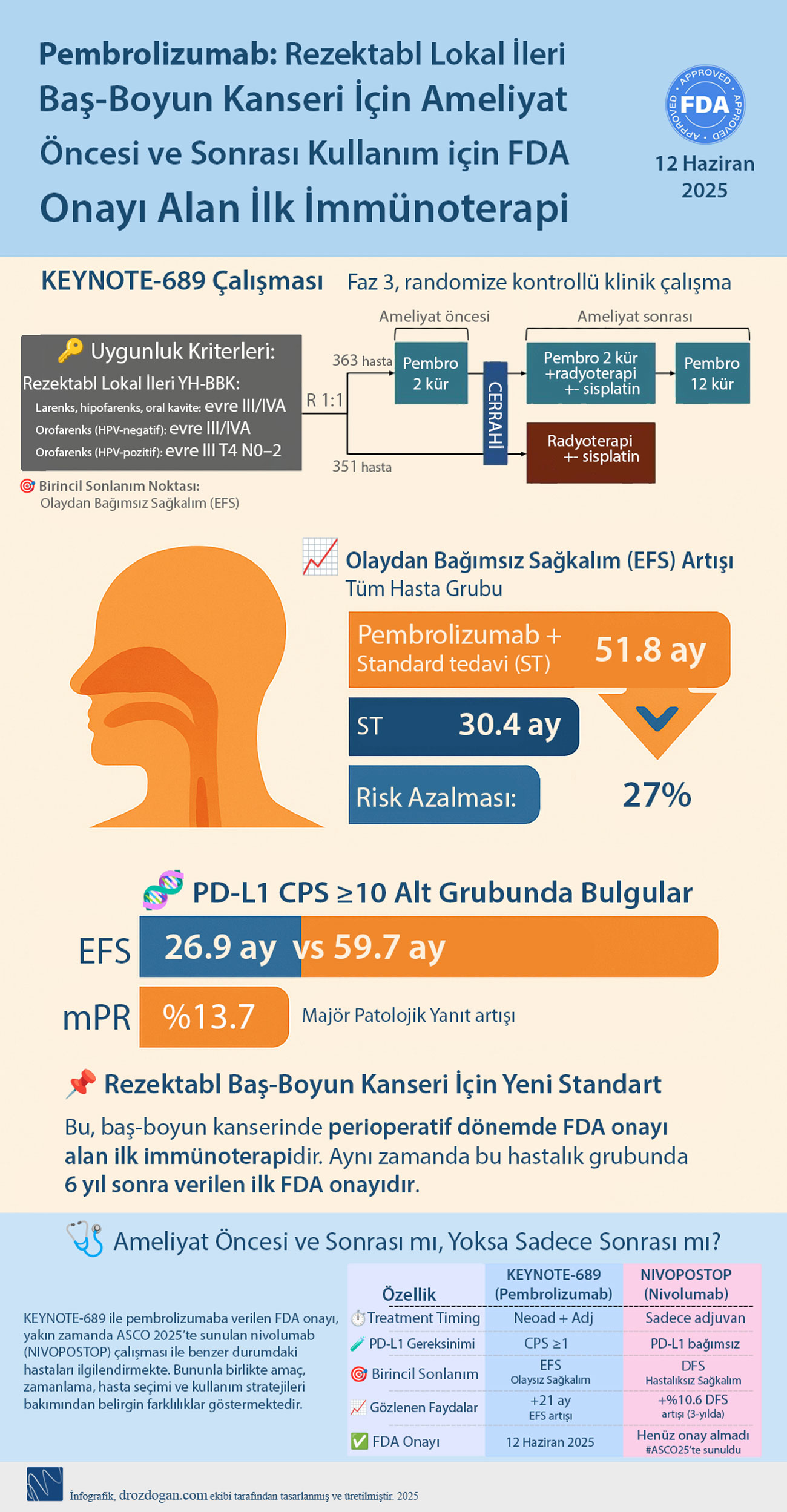

Study Design and Findings: KEYNOTE-689
📋 Participants: 714 patients
📋 Stage: Locally advanced, resectable (Stage III–IVA, AJCC 8th edition)
📋 Number of patients with PD-L1 CPS ≥1: 682
Treatment Arms:
- Experimental Arm:
- Neoadjuvant: Pembrolizumab 200 mg every 3 weeks for 2 cycles
- After surgery:
- Adjuvant: Pembrolizumab + RT ± cisplatin (3 cycles)
- Then: Single-agent pembrolizumab (12 cycles)
- Control Arm:
- No neoadjuvant treatment
- After surgery: RT ± cisplatin
Primary Endpoint:
📈 Event-Free Survival (EFS):
- Pembrolizumab Arm: Median EFS = 59.7 months (CI: 37.9 – Not Reached)
- Control Arm: Median EFS = 29.6 months (CI: 19.5 – 41.9)
➡️ Risk reduction: 30%
➡️ HR: 0.70 (95% CI: 0.55–0.89)
➡️ p-value: 0.0014
These results show that pembrolizumab offers a clear advantage in delaying disease recurrence or progression.
Safety and Tolerability
💉 Adverse events preventing surgery: Occurred in 1.4% of patients in both arms.
⚠️ Warnings:
- Immune-mediated adverse reactions (hypothyroidism, pneumonitis, etc.)
- Infusion-related reactions
- Fetal toxicity during pregnancy
🧪 Dosing:
- 200 mg every 3 weeks or 400 mg every 6 weeks
- Note: If given with chemotherapy on the same day, pembrolizumab should be administered first.
Clinical and Scientific Commentary
KEYNOTE-689 demonstrated the potential for perioperative immunotherapy to become a new standard in the management of head and neck cancer. The nearly twofold improvementin EFS highlights the strength of this approach, particularly in patients with PD-L1 CPS ≥1.
⏳ Although overall survival (OS) data are not yet mature, no unfavorable trend has been identified.
Conclusion: A New Era in Oncology Begins
With this approval of pembrolizumab, a promising new treatment paradigm for patients with head and neck cancer has entered clinical practice. The goal now is to integrate this strategy into care for the most suitable patients, with appropriate timing and multidisciplinary teams.
📍 In multidisciplinary tumor boards, consideration of this new approval before surgical planning is recommended.
Before and After Surgery, or Only After Surgery?
The FDA approval of pembrolizumab through KEYNOTE-689 concerns patients in circumstances similar to those in the nivolumab (NIVOPOSTOP) study recently presented at ASCO 2025. However, there are clear differences in goals, timing, patient selection, and treatment strategies between them.
The following comparison table and explanations summarize the key differences between the two studies and their approval statuses:
📊 Comparative Summary Table
| 🧪 Feature | 📌 KEYNOTE-689 | 📌 NIVOPOSTOP |
|---|---|---|
| 💉 Immunotherapy Drug | Pembrolizumab (anti–PD-1) | Nivolumab (anti–PD-1) |
| 🗓️ FDA Approval | ✅ June 12, 2025 Perioperative use (neoadjuvant + adjuvant) |
❌ Not yet approved (Presented at ASCO 2025) |
| 🕒 Treatment Timing | Neoadjuvant + Adjuvant | Adjuvant Only |
| 👥 Patient Profile | PD-L1 CPS ≥1 Locally advanced, resectable |
Regardless of PD-L1 High-risk, resected |
| 🔄 Use of RT + Cisplatin | According to risk status in the adjuvant setting |
For all patients in the adjuvant setting |
| 🎯 Primary Endpoint | Event-Free Survival (EFS) | Disease-Free Survival (DFS) |
| 📈 Survival Data | EFS: 59.7 months vs 29.6 months HR: 0.70 (p=0.0014) |
3-year DFS: 63.1% vs 52.5% HR: 0.76 (p=0.034) |
| 🧬 Dependence on PD-L1 | Only patients with CPS ≥1 | All patients included |
| ⚖️ Clinical Impact | A new standard (in the perioperative setting) |
An addition to existing adjuvant treatment |
| ⚠️ Safety Profile | 44.6% serious adverse events (control: 42.9%) |
13.1% serious adverse events (control: 5.6%) |
✅ Conclusion: Two Treatments, Two Different Turning Points
| 📌 | KEYNOTE-689 and perioperative pembrolizumab represent a comprehensive paradigm that could transform head and neck cancer treatment from start to finish. |
|---|---|
| 📌 | NIVOPOSTOP , meanwhile, adds significantly to existing postoperative treatment, offering a strong alternative to prolong disease-free survival in high-risk patients. |
Both studies signal a new era in head and neck cancer treatment. Future guidelines appear likely to be reshaped by these data.
Sources
Was this article helpful?
Your feedback helps us improve our content.




Reader comments
Share your comment
Your name and comment are published only after administrator approval. Your email address is never shown to visitors.
Be the first to comment.