
A Major Step Toward Personalized Treatment Selection With Tumor Organoids

In this article
Tumor organoids, or tumoroids, have become a promising approach in personalized cancer care. By supporting treatment selection according to a patient's tumor genotype and phenotype, they are taking an active role in clinical decisions. This integration of preclinical research into clinical practice is driving important advances in oncology.
What Is a Tumor Organoid?
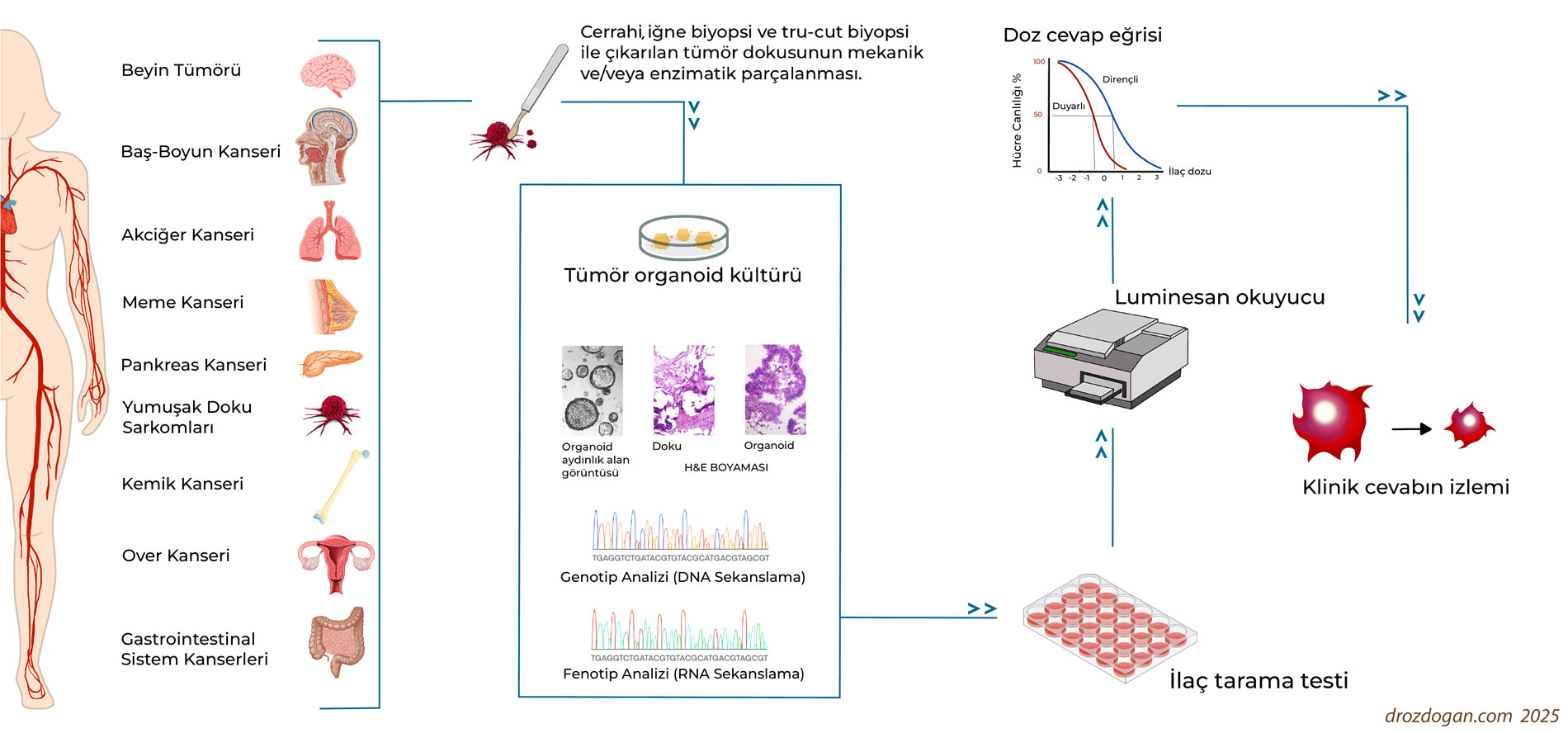
Tumor organoids are miniature tumor models made by reconstructing primary or metastatic patient tumor tissue in 3-dimensional cultures with specific biomolecules and matrices (Figure 1).
These structures can be considered “in vitro tumor avatars”, offering realistic models that mimic both tumor cells and their microenvironment . They can also be generated from circulating tumor cells in body fluids, although success rates and formation times are lower in this setting.
Organoid Establishment and Validation
Successful establishment requires adequate biopsy tissue and close similarity to the original tumor in genetic (DNA), transcriptomic (RNA), proteomic (protein) and morphological features. Completion may take between 2 and 8 weeks, depending on sample type.
Drug Sensitivity Testing (DST)
After organoid establishment, a drug panel is selected using the patient's clinical and molecular history. It may include chemotherapy, targeted agents and immunotherapies. Selected drugs are tested repeatedly at different doses to determine sensitivity, followed by a detailed report to inform treatment planning.
Clinical Successes and Applications
Research into organoid technology accelerated after 2020, and 2023 marked a milestone with thousands of publications. Their inclusion in clinical decision support has begun to produce success stories. At the 2024 ESMO (European Society for Medical Oncology) Congress, a French study involving 155 patient tumoroids in pancreatic and colorectal cancer attracted interest as a tool for predicting which treatments might work best. Another notable study came from UCLA's Dr. Alice Soragni and colleagues, involving 126 patients and 24 sarcoma subtypes. Sarcoma organoids were established within 1 week and tested with many drugs; approximately 80% showed at least one substantial drug response. In patients with uncommon alterations, including ALK fusions, ROS1, HER2, MET exon 14 skipping and BRAF, organoid testing correctly predicted clinical responses. These successes suggest organoids can guide real clinical decisions as well as laboratory research.
Important studies demonstrating clinical success with organoid drug sensitivity testing are summarized in Table 1.
TABLE 1: Clinical Concordance of Organoid-Based Drug Sensitivity Testing: Published Studies
|
Study Team |
Study and Publication Years |
Number of Patients / Samples |
Cancer Type |
Organoid Establishment Success |
Treatment Protocol Tested |
Clinical Concordance |
Clinical Details |
|---|---|---|---|---|---|---|---|
|
Millen et al.
|
Conducted in 2019-2022. Published in 2023. |
97 patients-110 tumoroid models established. |
Head and neck cancers |
No single percentage given; 35-88% depending on epithelial density. |
Radiotherapy, chemoradiotherapy, targeted drugs |
Organoid results fully matched clinical radiotherapy responses in 27 patients (primary=6, postoperative=21). |
GR50-based sensitivity correlated significantly with recurrence (p=0.01); cetuximab was radioprotective in most models; a PRMT5 inhibitor was effective with CDKN2A loss |
|
Vlachogiannis et al. |
Conducted in 2014-2017. Published in 2018. |
110 biopsy samples from 71 patients. |
Metastatic gastrointestinal cancers |
70% |
55 drugs used in phase I-III trials or clinical practice |
Clinical concordance could be followed in 15% of patients. Depending on the drugs and genetic profiles, organoid–patient concordance was approximately 80%. |
Organoid DST predicted clinical response with 100% sensitivity, 93% specificity, 88% positive predictive value and 100% negative predictive value. |
|
Yao et al. |
Conducted in 2017-2019. Published in 2020. |
112 biopsy samples collected; effectiveness could be followed in 80 patients. |
Locally advanced rectal cancer |
71% |
Radiotherapy, irinotecan and 5-fluorouracil |
Concordance with clinical response after single-agent and combination treatment was approximately 88%. |
|
|
Chen et al. |
Published in 2021. |
132 biopsy samples collected from 125 patients. |
Advanced breast cancer |
- |
49 drugs, including 30 not approved for breast cancer |
Based on organoid IC50 values and definitions of complete response, partial response, stable disease, PFS and DFS, concordant effects were observed in 61%. |
Everolimus, gemcitabine, cisplatin, vinorelbine, epirubicin and docetaxel were effective in organoids and correlated with partial responses, PFS and DFS in patients. |
|
Hogenson et al. |
Conducted in 2017–2021. Published in 2022. |
163 patients; 28 PDOs used in the analysis |
Gastrointestinal cancers |
51.5% |
5-FU, gemcitabine, oxaliplatin, docetaxel, SN-38, JQ1, SAHA, BGJ398, regorafenib |
82% (9/11 cases concordant) |
In cholangiocarcinoma, concordant for erlotinib and gemcitabine but not TAS-102. FOLFOX was concordant in pancreatic ductal adenocarcinoma. Vemurafenib, eFT508, bozitinib and regorafenib were concordant in colorectal carcinoma. |
|
Wang et al. |
Conducted in 2019-2021. Published in 2023. |
158 lung organoids generated from 107 patients; clinical follow-up available for 54. |
Lung cancers |
75.7% |
14 chemotherapy drugs, 45 tyrosine kinase inhibitors |
When classified as osimertinib, chemotherapy, dual-targeted therapy and other targeted therapy, concordance with clinical response was, respectively, 86.7% (13/15), 83.3% (10/12), 100% (10/10) and 70.6% (12/17). |
Osimertinib showed notable organoid–clinical concordance, with a partial response in one patient and progression in another. ALK fusion-targeted organoid results matched clinical responses in 100%. Patients with ROS1 (P-25), HER2 (P-75), MET exon 14 skipping (P-86 and P-105) and BRAF (P-95) alterations were included in drug sensitivity analyses, which correctly predicted clinical responses. |
The results demonstrate that organoid-based tests are a powerful predictive tool for identifying effective drugs in line with clinical outcomes and ruling out ineffective treatment options.
Sources
2. Hogenson, T. L., Xie, H., Phillips, W. J., Toruner, M. D., Li, J. J., Horn, I. P., Kennedy, D. J., Almada, L. L., Marks, D. L., Carr, R. M., Toruner, M., Sigafoos, A. N., Koenig-Kappes, A. N., Olson, R. L., Tolosa, E. J., Zhang, C., Li, H., Doles, J. D., Bleeker, J., ... Fernandez-Zapico, M. E. (2022). Culture media composition influences patient-derived organoid ability to predict therapeutic responses in gastrointestinal cancers. JCI Insight, 7(22), e158060. https://doi.org/10.1172/jci.insight.158060
3. Millen, R., de Kort, W. W. B., Koomen, M., van Son, G. J. F., Gobits, R., Penning de Vries, B., Begthel, H., Zandvliet, M., Doornaert, P., Raaijmakers, C. P. J., Geurts, M. H., Elias, S. G., van Es, R. J. J., de Bree, R., Devriese, L. A., Willems, S. M., Kranenburg, O., Driehuis, E., & Clevers, H. (2023). Patient-derived head and neck cancer organoids allow treatment stratification and serve as a tool for biomarker validation and identification. Med, 4(5), 290–310. https://doi.org/10.1016/j.medj.2023.03.001
4. Vlachogiannis, G., Hedayat, S., Vatsiou, A., Jamin, Y., Fernández-Mateos, J., Khan, K., Lampis, A., Eason, K., Huntingford, I., Burke, R., Rata, M., Koh, M., Tunariu, N., Collins, D., Hulkki-Wilson, S., Ragulan, C., Spiteri, I., Moorcraft, S. Y., Chau, I., ... Valeri, N. (2018). Patient-derived organoids model treatment response of metastatic gastrointestinal cancers. Science. https://doi.org/10.1126/science.aao2774
5. Yao, Y., Xu, X., Yang, L., Zhu, J., Wan, J., Shen, L., Xia, F., Fu, G., Deng, Y., Pan, M., Guo, Q., Gao, X., Li, Y., Rao, X., Zhou, Y., Liang, L., Wang, Y., Zhang, J., Zhang, H., ... Hua, G. (2020). Patient-derived organoids predict chemoradiation responses of locally advanced rectal cancer. Cell Stem Cell, 26(1), 17–26.e6. https://doi.org/10.1016/j.stem.2019.10.010
6. Wang, H.-M., Zhang, C.-Y., Peng, K.-C., Chen, Z.-X., Su, J.-W., Li, Y.-F., Li, W.-F., Li, Q.-Y., Gao, Q.-Y., Zhang, S.-L., Chen, Y.-Q., Zhou, Q., Xu, C., Xu, C.-R., Wang, Z., Su, J., Yan, H.-H., Zhang, X.-C., Chen, H.-J., ... Yang, J.-J. (2023). Using patient-derived organoids to predict locally advanced or metastatic lung cancer tumor response: A real-world study. Cell Reports Medicine, 4(2), 100911. https://doi.org/10.1016/j.xcrm.2022.100911
Was this article helpful?
Your feedback helps us improve our content.




Reader comments
Share your comment
Your name and comment are published only after administrator approval. Your email address is never shown to visitors.
Be the first to comment.