
An Important Discovery about How Cancer Cells Evade the Immune System

A Discovery to Inspire New Approaches to Cancer Treatment
The discovery of how cancer cells evade the immune system is inspiring new treatment approaches. Cancer cells are known for spreading genetic chaos. As they divide, pieces of DNA and even entire chromosomes may be copied, mutated or lost altogether. This is called chromosomal instability, and scientists from Memorial Sloan Kettering (MSK) have discovered that it is associated with cancer aggressiveness. The more unstable the chromosomes, the more likely DNA fragments from them are to end up where they do not belong: floating in the cytoplasm outside the cell's central nucleus.
Cells interpret these DNA fragments as evidence of viral invaders, triggering intracellular alarm bells and inflammation. Immune cells move toward the tumor and produce defensive chemicals. The mystery here is why the immune reaction triggered by cancer cells cannot bring these cells down.
The Study Illuminating Cancer's Escape Trick
"The elephant in the room is that we do not understand how cancer cells can survive and actually thrive in this inflammatory environment ", says Samuel Bakhoum, a physician-scientist at MSK and a member of the Human Oncology and Pathogenesis Program.
On 28 December, Cancer Discovery published a new study from Dr. Bakhoum's laboratory suggesting that the reason is partly related to a molecule called ENPP1 on the surface of cancer cells destroying the stimulatory signals each time before they reach neighboring immune cells. The findings help explain why some tumors do not respond to immunotherapy and point to equally important cellular pathways: ways to make them sensitive to immunotherapy.
Detecting Dangerous DNA Fragments
The warning system studied by Dr. Bakhoum is called cGAS – STING. When DNA from a virus (or an unstable cancer chromosome) is located in a cell's cytoplasm, cGAS binds to it. The combined molecule produced is called cGAMP, which serves as a warning signal. Inside the cell, this warning signal activates an immune response called STING that addresses the urgent problem of a potential viral invader.
In addition, much of the cGAMP also goes outside the cells, serving as a warning signal to neighboring immune cells. It activates their STING pathways and unleashes an immune attack against the virally infected cell.
Earlier work in the Bakhoum laboratory showed that cGAS-STING signaling inside cancer cells led them to adopt properties of immune cells that help their ability to metastasize — particularly the capacity to move stealthily and spread. This partly answered the question of how cancer cells survive in an inflammatory environment and help metastasis in the process.
Blocking Warning Signals
The new study shows how cancer cells handle the warning signals that activate the release of cGAS-STING into their surroundings. A scissor-like protein cuts the signals, providing a second way for the cells to avoid threats of immune destruction.
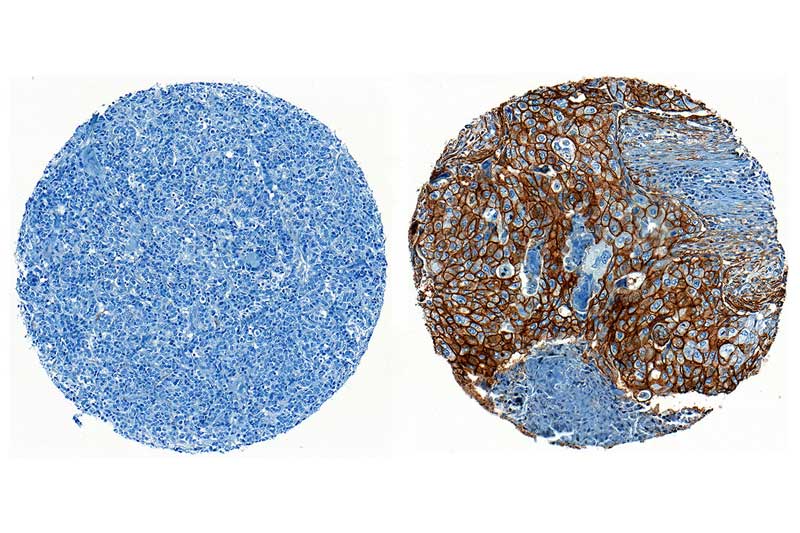
Above, triple-negative breast cancer tissue samples staining negative (left) and positive (right) for ENPP1 expression.
The scissor-like protein coating cancer cells is called ENPP1. When cGAMP finds its way outside the cell, ENPP1 cuts it and blocks the signal arriving from immune cells. At the same time, this cutting releases an immune-suppressing molecule called adenosine, which also suppresses inflammation.
Through experiments in mouse models of breast, lung and colorectal cancers, Dr. Bakhoum and colleagues showed that ENPP1 acts like a "control knob" for immune suppression and metastasis. Turning it on suppresses immune responses and increases metastasis, while turning it off enables immune responses and reduces metastasis.
The scientists also examined ENPP1 in samples of human cancers. ENPP1 expression was associated with both increased metastasis and resistance to immunotherapy in those samples.
Strengthening Immunotherapy
From a treatment perspective, the study's most striking finding may be that, after switching off ENPP1, immunotherapy drugs called checkpoint inhibitors can be met with greater sensitivity by several different cancer types. The researchers showed that this approach was effective in mouse models of cancer.
Several companies, including one founded by Dr. Bakhoum and colleagues, are currently developing drugs to inhibit (block) ENPP1 on cancer cells. Dr. Bakhoum says it is fortunate that ENPP1 is on the surface of cancer cells, because this makes it an easier target for a drug designed to block ENPP1. It is also relatively specific. Because most other tissues in a healthy individual are not inflamed, drugs targeting ENPP1 primarily affect cancer.
In Conclusion, targeting ENPP1 cuts cancer off in two ways: “You simultaneously increase the level of cGAMP outside cancer cells, which activates STING in neighboring immune cells while also blocking the production of immune-suppressing adenosine. So you kill two birds with one stone.” says Dr. Bakhoum.
He says that the pace of the research has been incredibly fast. “One of the things I am really proud of is that, considering we started this work in 2018, it may soon result in helping patients,” adds Dr. Bakhoum. He believes that ENPP1 inhibitors will enter a phase-I clinical trial within a year.
Sources
Was this article helpful?
Your feedback helps us improve our content.




Reader comments
Share your comment
Your name and comment are published only after administrator approval. Your email address is never shown to visitors.
Be the first to comment.