
Chemotherapy-Free Treatment for Mesothelioma (Cancer of the Lung Lining) Is on the Horizon

In this article
The strongest evidence that chemotherapy could be avoided in newly diagnosed mesothelioma patients was presented at the 2020 World Conference on Lung Cancer Virtual Congress. In the CheckMate 743 study, presented on August 8, researchers reported new survival data with a combination of two immunotherapies, nivolumab (Opdivo) and ipilimumab (Yervoy), in patients with newly diagnosed mesothelioma (cancer of the lung lining).
On October 2, 2020, the US Food and Drug Administration (FDA) approved the nivolumab (Opdivo) plus ipilimumab (Yervoy) dual immunotherapy combination for adults with unresectable malignant pleural (lung-lining) mesothelioma as a first-line treatment.
What is mesothelioma?
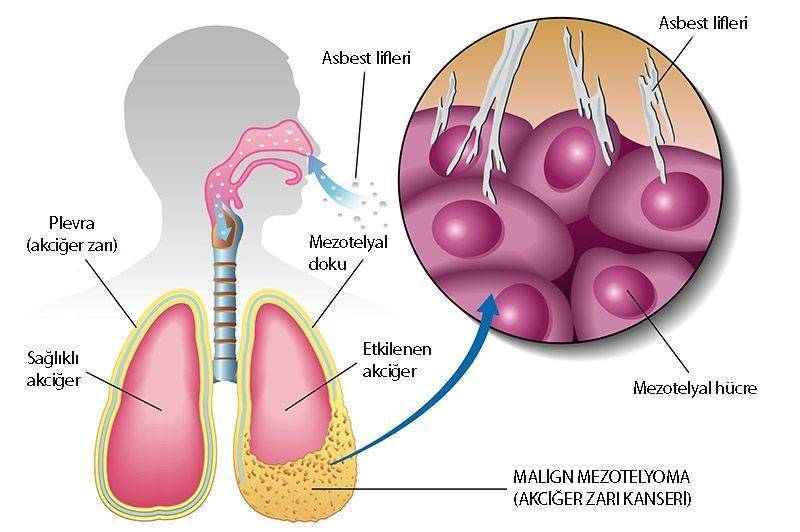
Our lungs are covered by a two-layered membrane called the pleura. A small amount of fluid lies between the pleural layers, and this fluid is produced by mesothelial cells. Tissues similar to the pleural membrane of the lungs are found elsewhere in the body. These are called the peritoneum around the abdomen and the pericardium around the heart. Malignant mesothelioma is the name of the cancer arising from these membranes. Malignant Mesothelioma arising from the pleural membrane accounts for 80% of patients with this disease.
What causes it? The most important cause of malignant mesothelioma is exposure to asbestos. More rarely, genetic causes and a virus called Simian 40 cause it.
Mesothelioma is a rare cancer. In countries with occupational asbestos exposure, it is more common in men, whereas with environmental asbestos exposure, as in Turkey, its incidence is equal in women and men. Worldwide, its frequency is 1-2 per 1 million people, while around 500 people receive a new mesothelioma diagnosis each year in Turkey.
The CheckMate 743 study
The phase-3 CheckMate 743 study evaluated outcomes in 605 previously untreated patients with pleural mesothelioma.
The dual nivo + ipi immunotherapy combination was associated with a 26% improvement in overall survival. At 2 years, 41% of patients in the immunotherapy arm were still alive, compared with 27% in the chemotherapy group.
This is the first positive randomized (random patient enrollment) study of dual immunotherapy in first-line treatment for patients with mesothelioma. This approach could soon become the standard treatment for mesothelioma.
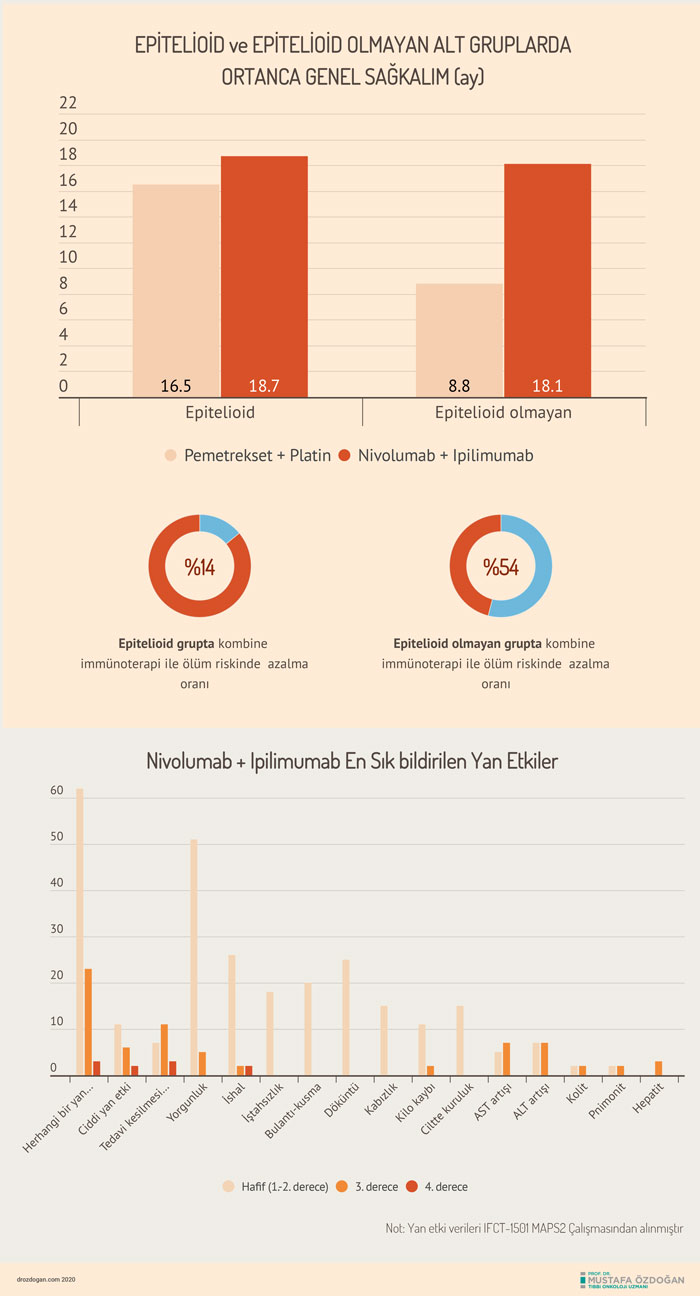
The study also had other interesting results, for example concerning mesothelioma's histological subtypes. Standard chemotherapy is normally known to perform better in patients with the epithelioid subtype than in those with non-epithelioid subtypes. In this study, however, nivo + ipi performance in patients with epithelioid and non-epithelioid tumors, with median overall survival of 18.7 months and 18.1 months respectively, was emphasized to be "almost the same". In other words, the immunotherapy combination was similarly effective in both subtypes.
There are three different types of mesothelioma:
- Epithelioid mesothelioma is the most common type. It grows more slowly than the others and may therefore respond better to treatment.
- Sarcomatoid mesothelioma is less common. It tends to progress faster, and poorer outcomes are expected with chemotherapy, the standard treatment. It is considered primarily resistant to chemotherapy.
- Biphasic mesothelioma is also rare. It is more aggressive than epithelioid mesothelioma but grows more slowly than sarcomatoid mesothelioma.
Note: Non-epithelioid mesothelioma is also called the sarcomatoid type.

By contrast, overall survival in the chemotherapy arm was 16.5 months in patients with epithelioid tumors and 8.8 months in those with non-epithelioid tumors. In other words, chemotherapy struggles to achieve the same effectiveness in non-epithelioid tumors and remains quite weak.
These data provide clear evidence that the nivo + ipi combination will become standard treatment, at least for non-epithelioid mesothelioma.
In the future, chemotherapy and immunotherapy combinations including all histologies, or selective targeting of non-epithelioid mesothelioma, could further increase patient benefit.
Research to improve survival in mesothelioma...
Unlike many other cancers, mesothelioma had not had a new drug approved for decades. The most recent US Food and Drug Administration (FDA) approval for this cancer had come in May 2019: for first-line treatment of unresectable, locally advanced or metastatic pleural mesothelioma, in combination with pemetrexed plus platinum-based chemotherapy, an electrical-current therapy (tumor treating fields, TTF), the NovoTTF-100L System (Novocure).
Platinum-based chemotherapy plus pemetrexed is currently the standard treatment for mesothelioma, but the 5-year survival rate is "still below 10%."
Previous large studies of single-agent immunotherapy in the "second-line" treatment of mesothelioma had shown no significant benefit.
However, nivolumab and ipilimumab have a "complementary mechanism of action," and data from two previous studies had suggested that they were effective as second-line treatment in mesothelioma. The CheckMate 743 study was planned on this basis.
Previously Untreated Pleural Mesothelioma: 605 Patients, Combined Immunotherapy (Nivolumab-Ipilimumab) Results of the Phase-III CheckMate-743 Study
- In the study, patients were randomized 1:1 to receive either nivo + ipi for up to 2 years, until cancer progression or unacceptable side effects occurred, or six cycles of pemetrexed plus cisplatin or carboplatin.
- Patients were allowed to receive other treatment afterward if their cancer progressed. Further treatment was received by 44% of patients in the experimental (immunotherapy) arm and 44.1% in the chemotherapy arm.
- The minimum follow-up for overall survival was 22.1 months; median follow-up was 29.7 months.
- Nivo + ipi reduced the risk of death by 26% compared with standard chemotherapy [with a hazard ratio of 0.74 (P = 0.0020)].
- Median overall survival was 18.1 months in the immunotherapy arm and 14.1 months in the chemotherapy arm.
- For progression-free survival (PFS), there was no difference between the two treatment arms. Chemotherapy performed better in the first 6 months of treatment, after which the nivo + ipi arm had lower rates of adverse events.
- Nivo + ipi, with an average of 11.0 months versus 6.7 months for standard-care chemotherapy, was also associated with a longer duration of response. At month 24, 32% of nivo + ipi patients were still experiencing a response, compared with only 8% in the chemotherapy arm.

Results by PD-L1 positivity
- It was found that a negative result for a biomarker frequently used to predict immunotherapy effectiveness, PD-L1, did not reduce the performance of nivo + ipi.
- However, the immunotherapy arm performed better when PD-L1 was positive to any degree. Among PD-L1-positive patients, median overall survival was 18 months with immunotherapy and 13 months with chemotherapy.
Side effects
Treatment-related side effects occurred at similar frequencies in the two groups. However, serious (grade 3 and 4) side effects were more frequent in the nivo + ipi arm: 15 versus 6.
Commentary on the CheckMate 743 study
In mesothelioma, the first-line immunotherapy study showed higher response rates than second-line treatments. The benefit of combined immunotherapy was much more pronounced in patients with non-epithelioid tumors. In general, immunotherapies have milder side effects. However, this study suggests that the side effects of combination immunotherapy should not be underestimated. Combining immunotherapy with chemotherapy, which still appears effective for epithelioid mesothelioma, is another treatment option that needs investigation.
The latest point reached in pleural mesothelioma treatment
With this approval, there are 3 FDA-approved treatment options for pleural mesothelioma: "cisplatin + pemetrexed" chemotherapy, adding electrical-current therapy (the NovoTTF-100L System) to this chemotherapy, and the nivolumab-ipilimumab combination. In addition, we know that adding bevacizumab (Altuzan, Avastin, Mvasi), a drug that inhibits new blood vessel formation through an antiangiogenic effect, to cisplatin + pemetrexed chemotherapy significantly improves survival rates. This was shown in the 2015 phase-III MAPS study. In clinical practice, we try to add it to treatment by applying for off-label approval. The CheckMate 743 study discussed here, with the best results to date, particularly in the non-epithelioid subtype, also showed that combined immunotherapy is effective in treating mesothelioma and that chemotherapy-free treatment may be possible, leading to FDA approval of combined immunotherapy for first-line pleural mesothelioma treatment.
Below is an indirect comparison of FDA-approved treatments and phase III clinical trials for pleural mesothelioma:

Sources
2. Arnaud Scherpereel, Julien Mazieres, Laurent Greillier, et al.
Second- or third-line nivolumab (Nivo) versus nivo plus ipilimumab (Ipi) in malignant pleural mesothelioma (MPM) patients: Results of the IFCT-1501 MAPS2 randomized phase II trial.
J Clin Oncol 35, 2017 (suppl; abstr LBA8507)
3. Chemo-Free Management of Mesothelioma on Horizon - Medscape - Aug 11, 2020.
Was this article helpful?
Your feedback helps us improve our content.




Reader comments
Share your comment
Your name and comment are published only after administrator approval. Your email address is never shown to visitors.
Be the first to comment.