
Could a Nab-Paclitaxel Combination Become the New Standard for HER2-Positive Breast Cancer?

In this article
Why Is Neoadjuvant Treatment Important?
In breast cancer, neoadjuvant treatment is a treatment approach given before surgery that aims to improve surgical outcomes by reducing tumor size. In HER2-positive early-stage breast cancer, combinations of targeted therapies and chemotherapy have increased pathological complete response (pCR) rates, with a major impact on long-term survival. However, the optimal drug combination remains a matter of debate.
In January 2025, THE LANCET Oncology published the HELEN-006 phase III study, which examined whether nab-paclitaxel combined with trastuzumab and pertuzumab was more effective than the standard docetaxel / carboplatin regimen.
Study Design and Patient Population
HELEN-006 is a multicenter, open-label phase III clinical trial based in China. Between September 2020 and March 2023, the study was conducted in 669 female patients.
-
Age Range: The median age was reported as 50.
-
Treatment Arms:
-
First group: Nab-paclitaxel (125 mg/m²) once weekly on days 1, 8, and 15, for a total of 6 cycles.
-
Second group: Docetaxel (75 mg/m²) and carboplatin (AUC=6), on day 1 of each cycle, for a total of 6 cycles.
-
Both groups received trastuzumab and pertuzumab, with a trastuzumab loading dose of 8 mg/kg and maintenance dose of 6 mg/kg, and a pertuzumab loading dose of 840 mg and maintenance dose of 420 mg.
Main Findings
-
Median Follow-Up: 26 months.
-
Pathological Complete Response Rate (pCR):
-
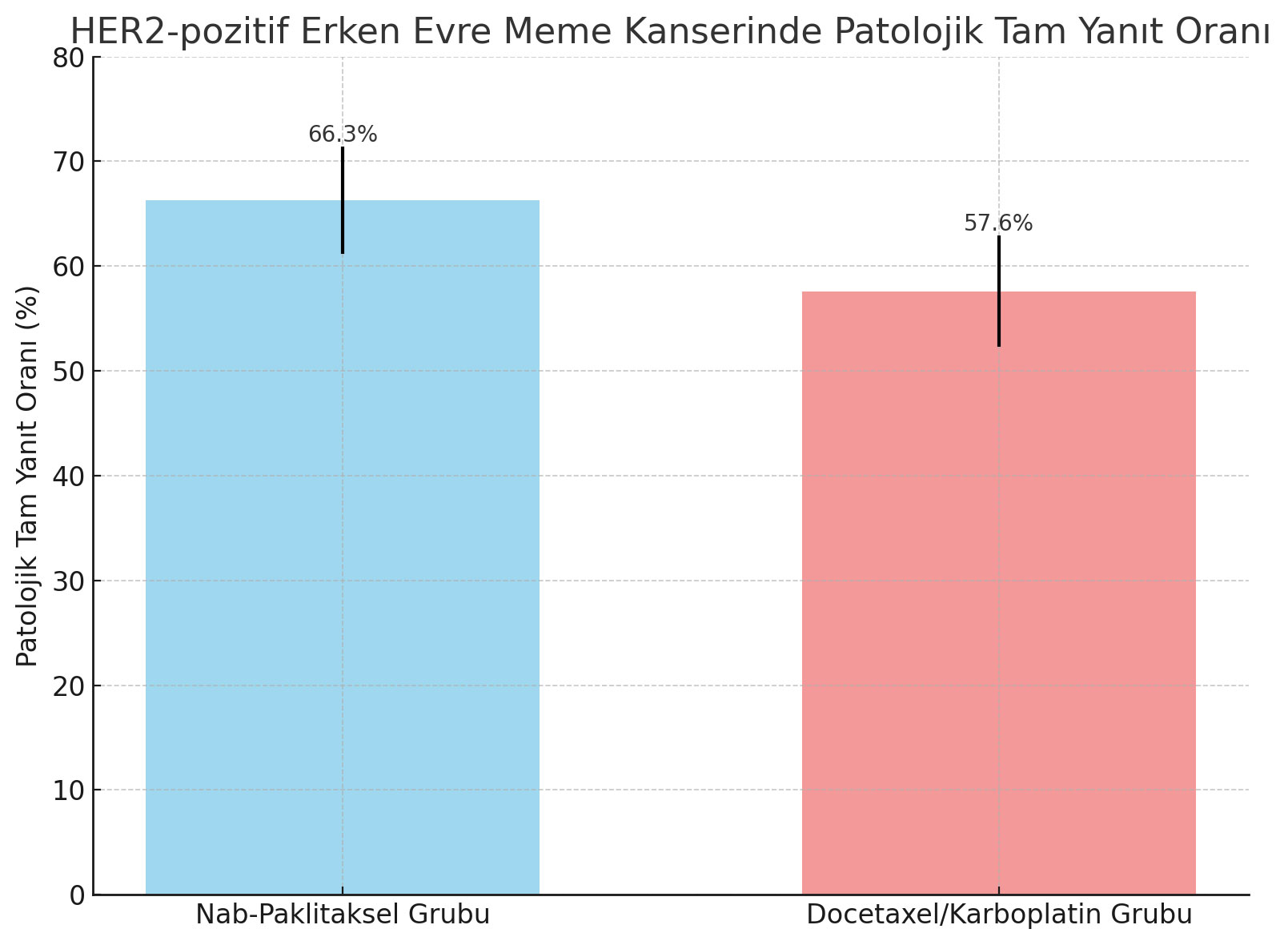
Nab-paclitaxel group: 66.3% (confidence interval [CI] 61.2% – 71.4%)
-
Docetaxel / carboplatin group: 57.6% (CI 52.3% – 62.9%)
- Nab-paclitaxel increased the likelihood of a pathological complete response by 54% compared with docetaxel / carboplatin. Odds ratio: 1.54 (CI 1.10 – 2.14; P = 0.011)
-
These results showed that the nab-paclitaxel combination offered a clear advantage over the docetaxel / carboplatin regimen.
Adverse Event Profile
-
Grade 3-4 Adverse Events:
-
30% in the nab-paclitaxel group.
-
38% in the docetaxel/carboplatin group.
-
-
Common Adverse Events:
-
Nab-paclitaxel group: Neuropathy (13%), diarrhea (8%), nausea (7%).
-
Docetaxel/carboplatin group: Nausea (23%), diarrhea (16%), vomiting (8%).
-
-
Serious drug-related adverse events: 3 patients (1%) in the nab-paclitaxel group and 5 patients (2%) in the docetaxel/carboplatin group.
-
Treatment-Related Deaths: None were observed.
Conclusion and Assessment
The researchers suggested that the combination of nab-paclitaxel, trastuzumab, and pertuzumab offered a significant advantage over standard neoadjuvant treatment in HER2-positive early-stage breast cancer and could be considered a new standard of treatment.
This study shows promise for the nab-paclitaxel-based regimen, with a lower adverse event profile and a higher pCR rate. However, long-term survival data and confirmation of similar success rates in other patient populations are needed.
Future Research and Clinical Applications
These findings encourage evaluation of the nab-paclitaxel combination in broader patient populations. Continued research into individualized treatment strategies to select the optimal treatment in HER2-positive breast cancer may increase the potential to improve patient responses.
Sources
Was this article helpful?
Your feedback helps us improve our content.




Reader comments
Share your comment
Your name and comment are published only after administrator approval. Your email address is never shown to visitors.
Be the first to comment.